WeOrthodox
EN UA

Eastern Orthodoxy Daily He/Who/Is

Instagram ↗ 112 discussions

Scripture, Saints & Satire Left Rome for Home 📍Illinois USA📍 ╬☦️ Dyophysite Eastern Orthodox ☦️╬

Holy Prophet Obadiah: Protector of Prophets and Voice of Judgment

The post presents the Holy Prophet Obadiah, commemorated on November 19, as one of the Twelve Minor Prophets of the Old Testament. It recounts that Obadiah served in the household of King Ahab and acted to protect one hundred prophets from the persecution initiated by Queen Jezebel. He hid these prophets in caves and supplied them with food and water. The post then turns to the content of Obadiah's prophetic book, stating that it condemns pride,…

The post presents the Holy Prophet Obadiah, commemorated on November 19, as one of the Twelve Minor Prophets of the Old Testament. It recounts that Obadiah served in the household of King Ahab and acted to protect one hundred prophets from the persecution initiated by Queen Jezebel. He hid these prophets in caves and supplied them with food and water.

The post then turns to the content of Obadiah's prophetic book, stating that it condemns pride, injustice, and betrayal, while proclaiming the coming judgment of God and the ultimate triumph of His Kingdom. A specific verse is quoted from Obadiah 1:15: "For the day of the Lord upon all the nations is near; as you have done, it shall be done to you."

  • Commemorated on November 19 as one of the Twelve Minor Prophets
  • Served in King Ahab's household and protected 100 prophets from Queen Jezebel's persecution
  • Hid the prophets in caves and provided them with food and water
  • His prophetic book condemns pride, injustice, and betrayal
  • Proclaims God's coming judgment and the triumph of His Kingdom, citing Obadiah 1:15

Accepting the Canon While Rejecting the Church That Witnessed It

The speaker argues there is no factual historical evidence that John wrote the Gospel attributed to him. He directs the listener to early church history and apostolic succession, the chain of disciples who learned from John and taught others, as the basis for the text's authority. The speaker then criticizes a figure known as "The God Logic" for appealing to the early church to defend the Bible while rejecting its teaching on the real presence…

The speaker argues there is no factual historical evidence that John wrote the Gospel attributed to him. He directs the listener to early church history and apostolic succession, the chain of disciples who learned from John and taught others, as the basis for the text's authority. The speaker then criticizes a figure known as "The God Logic" for appealing to the early church to defend the Bible while rejecting its teaching on the real presence in the Eucharist and the authority of bishops.

He contends that if the apostolic church was wrong about its doctrines, there is no reason to trust its testimony about Scripture. The argument concludes that one cannot reject the very church whose witness undergirds the canon.

Key moments

  1. The speaker states there is no factual historical evidence that John wrote the Gospel attributed to him.
  2. The speaker directs the listener to early church history and the concept of apostolic succession, those who knew the disciples and their disciples.
  3. The speaker describes apostolic succession as people who learned from John becoming teachers themselves.
  4. The speaker accuses "The God logic" of relying on the early church to defend the Bible but rejecting it when it contradicts his theology.
  5. The speaker notes that "The God logic" appeals to apostolic succession but dismisses the church's teaching on the real presence in the Eucharist and episcopal authority.
  6. The speaker argues that if the apostolic church was wrong about its teachings, one cannot be certain it was right about the Bible.
  7. The speaker concludes that you cannot reject the very church whose testimony you depend on to defend your scripture.
10 opinions in the discussion Only leans on apostolic succession when convenient, tosses it when it's not Read the discussion

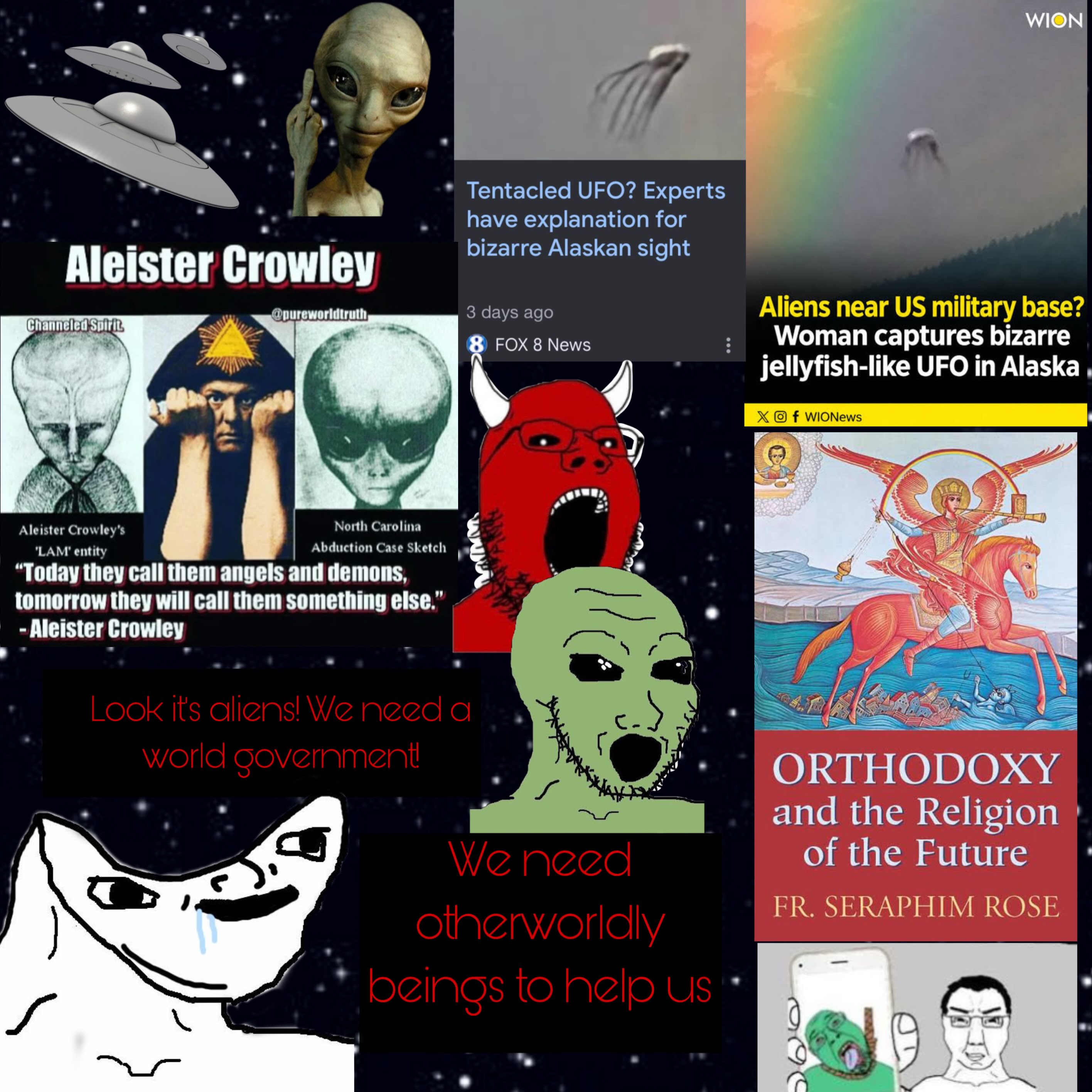
Fr. Seraphim Rose on UFOs as demonic deception

The post presents a series of images connecting modern UFO phenomena to occult practices and Fr. Seraphim Rose's critique in "Orthodoxy and the Religion of the Future." It begins with Aleister Crowley, the influential occultist who claimed contact with an entity called LAM, depicted in a drawing that resembles later "grey alien" imagery. News screenshots show recent jellyfish-like UFO sightings near military bases in Alaska. A sketch from a…

The post presents a series of images connecting modern UFO phenomena to occult practices and Fr. Seraphim Rose's critique in "Orthodoxy and the Religion of the Future." It begins with Aleister Crowley, the influential occultist who claimed contact with an entity called LAM, depicted in a drawing that resembles later "grey alien" imagery.

News screenshots show recent jellyfish-like UFO sightings near military bases in Alaska. A sketch from a North Carolina abduction case and the caption "Channelled Spirit" link alien encounters to spirit channeling. A quote attributed to Crowley states: "Today they call them angels and demons, tomorrow they will call them something else."

The final image displays the cover of Fr. Seraphim Rose's book alongside text suggesting a false alien disclosure could be used to justify world government. The author's caption asserts that aliens are "fake gay and demonic" and that New Age occultists promote them as intelligent helpers. The discussion centers on the Orthodox view that UFOs and alien encounters are demonic deceptions preparing humanity for a counterfeit spirituality and globalist control, a theme Fr. Seraphim developed from patristic teaching on prelest (spiritual deception).

  • Aleister Crowley's LAM entity resembles modern grey alien imagery
  • Recent UFO sightings in Alaska shown near military installations
  • Abduction sketches and channeling linked to occult spirit contact
  • Crowley quote suggests rebranding of demons as aliens
  • Fr. Seraphim Rose's work frames UFOs as end-times deception for world government
Read more

Christ's Establishment of the Church as Institution in Matthew 18

A dialogue examines whether Christ established an institution. One speaker argues that religious systems and institutions kill the spirit of God and questions whether Christ founded an institution. The other responds that God established a way of salvation. The first speaker then cites Matthew 18 as explicit evidence that Christ did establish an institution. He outlines the three-step process Jesus gives for dealing with a sinning brother: first…

A dialogue examines whether Christ established an institution. One speaker argues that religious systems and institutions kill the spirit of God and questions whether Christ founded an institution. The other responds that God established a way of salvation. The first speaker then cites Matthew 18 as explicit evidence that Christ did establish an institution.

He outlines the three-step process Jesus gives for dealing with a sinning brother: first confront him privately, then bring two or three witnesses, and finally bring the matter to the church. The speaker argues that this third step, bringing the matter to the church, demonstrates an institution that transcends the body of believers, concluding that the church is both a body and an institution.

Key moments

  1. The first speaker claims that religious systems and institutions are the things that kill the spirit of God in the world.
  2. The first speaker asks whether Christ established an institution.
  3. The second speaker answers that God established a way of salvation.
  4. The first speaker argues that Christ established an institution, pointing to Matthew chapter 18 as explicit evidence.
  5. The first speaker outlines the steps in Matthew 18: go to the brother privately, then bring two or three witnesses, which constitutes a church, and if they refuse to listen, bring them to the church.
  6. The first speaker concludes that this third category demonstrates an institution transcending just the body, affirming that the church is both a body and an institution.
4 opinions in the discussion This argument doesn't get enough credit. Any kind of church discipline that actually does anything requires being the exclusive church. Read the discussion