WeOrthodox
EN UA

Disgruntled Docs

Instagram ↗ 117 discussions

Doc posting memes ☦️ Reader Nektarios Veteran owned All my opinions are my own

The Hardened Heart: How the Word of God Wears Away Stone

A narrated reflection on how the heart becomes hardened and how it is softened again. The heart is presented as the organ that shapes our decisions, and Orthodox Christians are called to understand how it grows hard. St. Isaac the Syrian teaches that a soft, charitable heart burns with love for all of God's creation and cannot bear witness to any suffering. Abba Pomen compares the hard heart to stone that is gradually worn down by the soft,…

A narrated reflection on how the heart becomes hardened and how it is softened again. The heart is presented as the organ that shapes our decisions, and Orthodox Christians are called to understand how it grows hard. St. Isaac the Syrian teaches that a soft, charitable heart burns with love for all of God's creation and cannot bear witness to any suffering.

Abba Pomen compares the hard heart to stone that is gradually worn down by the soft, frequently heard word of God, as water wears away stone. The narration turns to modern life: society is full of noise and spiritual traps, and work and responsibilities crowd out the time to slow down and decide rationally. Many put career or image before Christ, and without time for Christ and His example a person becomes arrogant.

Orthodox Christianity, the video says, is not just the wearing of the cross but the carrying of it. The remedy is to slow down, find inner peace, and create a space for prayer and spiritual mourning, asking Christ's grace and spirit to burn the thorns around the heart caused by years of sin, so that a blackened heart beats for Christ and reflects His image.

For those who doubt prayer or claim they have no time, the advice is to start small: a morning Jesus Prayer or Our Father and the veneration of an icon take only a few minutes, yet they remind the heart of the Alpha and Omega, through whom we are softened and restored by His tender love and mercy.

Key moments

  1. St. Isaac the Syrian says a soft charitable heart burns with love for all of God's creation and cannot bear witness to any suffering.
  2. Abba Pomen teaches that a hard heart is gradually worn down by the soft, frequently heard word of God, like water wearing away stone.
  3. Modern society is full of noise and spiritual traps, and work and responsibilities often keep us from slowing down and making decisions rationally.
  4. Many people put their career or image before Christ, and without time for Christ and His example we become arrogant.
  5. Orthodox Christianity is not just the wearing of the cross but the carrying of it.
  6. By slowing down, finding inner peace, and creating a space for prayer and spiritual mourning, we ask Christ's grace and spirit to burn the thorns around our heart caused by years of sin and wrongdoings.
  7. Our blackened hearts are brought to life again, beating for Christ and conditioning our being to think, act and reflect His image.
  8. For those who say they lack time or doubt the life-giving words of prayer, the advice is to start small: a morning Jesus prayer or Our Father and veneration of an icon take only a few minutes yet remind our hearts of the Alpha and Omega.
Read more

Saint Gregory Palamas: Defender of Hesychasm and Theosis

The post commemorates Saint Gregory Palamas on his feast day, November 14. Born in Constantinople in 1296, he received an imperial education but left court life for monasticism on Mount Athos, where he practiced Hesychasm and the Jesus Prayer. In the 14th century he defended the Orthodox teaching that God's essence is inaccessible while His energies are uncreated and communicable to humanity. This controversy arose against Barlaam of Calabria,…

The post commemorates Saint Gregory Palamas on his feast day, November 14. Born in Constantinople in 1296, he received an imperial education but left court life for monasticism on Mount Athos, where he practiced Hesychasm and the Jesus Prayer. In the 14th century he defended the Orthodox teaching that God's essence is inaccessible while His energies are uncreated and communicable to humanity.

This controversy arose against Barlaam of Calabria, who challenged the hesychast claim that the light of Christ's Transfiguration on Mount Tabor is divine and uncreated. Palamas articulated that through grace human beings truly participate in God's life, the doctrine of theosis, without becoming God by essence. He suffered persecution and imprisonment for this teaching. In 1347 he became Archbishop of Thessalonica, and in 1351 a council solemnly affirmed his theology.

He died in 1359 and is also commemorated on the Second Sunday of Great Lent. The post includes numerous quotations from his homilies, treatises, and the Philokalia on faith and works, the true nature of fasting, the Filioque, the authority of the saints, spiritual struggle against passions, unceasing prayer for all Christians, human culpability beyond Adam, the illumination of the purified heart, and the necessity of repentance for sexual sins.

  • Commemorates Saint Gregory Palamas (1296-1359), Archbishop of Thessalonica, on November 14
  • Defended hesychast theology: God's essence inaccessible, His energies uncreated and participable
  • Taught the Transfiguration light is uncreated divine glory, affirmed at councils in 1347 and 1351
  • Quotations cover faith and works, true fasting, the Filioque, saintly authority, spiritual warfare, unceasing prayer for laity, and repentance
  • Also commemorated on the Second Sunday of Great Lent as a defender of Orthodoxy
Read more

Orthodox critique of Catholic confession approach to homosexuality

The speaker recounts confessing to a Catholic priest that he was gay. The priest took him out of the confessional and said he could not confess something he cannot change. The speaker identifies this response as humanism infiltrating the church.

He cites Saint Paul's clarity on sexual immorality and accuses Catholic priests of compromising Christ's teachings to grow their church. He asserts that an apostolic tradition of faith unchanged for 2000 years exists, but states it is not Catholicism.

Key moments

  1. 0:00 The speaker confessed to a priest that he was gay, and the priest took him out of the confessional and said he cannot confess to something he cannot change.
  2. 0:00 The speaker says this is exactly what happens when a church falls into humanism.
  3. 0:00 Saint Paul was clear about sexual immorality, yet Catholic priests are compromising these teachings.
  4. 0:00 In the name of growing their church, Catholic priests are willing to sacrifice the very teachings of Christ.
  5. 0:00 There is an apostolic tradition of faith that has remained unchanged for 2000 years, but it is not Catholicism.
22 opinions in the discussion Elpidophoros baptized the children, not the gay couple, and the Holy Synod of Greece unanimously protested what he did. Meanwhile Pope Francis approved Fiducia Supplicans, which officially… Read the discussion

Feast of the 100,000 Martyrs of Tbilisi and Metekhi Church

The author marks the feast day of the 100,000 Martyrs of Tbilisi, observed on November 13 according to the old calendar. These martyrs refused to renounce Christianity or spit on icons of Christ and the Theotokos when Persian Muslim invaders demanded it, and were killed for their refusal. The author notes that Metekhi Church in Tbilisi remains a living, functioning parish where all sacraments are celebrated, including daily Liturgy, funerals,…

The author marks the feast day of the 100,000 Martyrs of Tbilisi, observed on November 13 according to the old calendar. These martyrs refused to renounce Christianity or spit on icons of Christ and the Theotokos when Persian Muslim invaders demanded it, and were killed for their refusal. The author notes that Metekhi Church in Tbilisi remains a living, functioning parish where all sacraments are celebrated, including daily Liturgy, funerals, and marriages.

The author was married there and shares a photo from the wedding. The background audio is Tsmindao Ghmerto, the Georgian version of the Trisagion hymn.

  • November 13 (old calendar) is the feast of the 100,000 Martyrs of Tbilisi
  • Martyrs refused to renounce Christianity or desecrate icons under Persian Muslim invaders
  • Metekhi Church continues as an active parish with daily Liturgy and all sacraments
  • Author was married at Metekhi Church
  • Background song is the Georgian Trisagion, Tsmindao Ghmerto
Read more

Orthodox View on Papal Supremacy: Primacy Not Universal Jurisdiction

The post responds to a claim that Orthodox saints and ecumenical councils teach the Bishop of Rome is the universal head by divine right. The speaker argues that this claim confuses Rome's historical primacy of honour with the later Roman Catholic doctrine of universal papal supremacy. Roman Catholics often appeal to Saint Peter, apostolic succession, the Church Fathers, and the Ecumenical Councils to defend universal papal supremacy. He…

The post responds to a claim that Orthodox saints and ecumenical councils teach the Bishop of Rome is the universal head by divine right. The speaker argues that this claim confuses Rome's historical primacy of honour with the later Roman Catholic doctrine of universal papal supremacy. Roman Catholics often appeal to Saint Peter, apostolic succession, the Church Fathers, and the Ecumenical Councils to defend universal papal supremacy.

He examines Scripture: Christ gave Peter the keys of the kingdom (Matthew 16:19) but also gave all the apostles authority to bind and loose (Matthew 18:18). The Council of Jerusalem (Acts 15) shows the apostles deliberating together, illustrating the conciliar nature of the early Church. The speaker affirms apostolic succession but says inheriting an apostolic office does not automatically confer supreme jurisdiction over every other bishop.

He cites Canon 6 of Nicaea, which recognises ancient jurisdictional customs, and Canon 28 of Chalcedon, which connects Constantinople's ecclesiastical privileges to its imperial status, granting it equal rank with Rome. The Orthodox Church acknowledges Rome's ancient primacy of honour but disputes that this establishes universal jurisdiction.

Primacy is not the same as supremacy. The speaker cites Colossians 1:18 that Christ is the head of the Church, and the Church is governed by apostolic bishops in communion, not by one bishop's absolute authority. He challenges the questioner to produce a first-millennium ecumenical council that explicitly teaches the universal papal jurisdiction and infallibility defined at Vatican I in 1870.

The burden of proof remains: where did Christ establish that every bishop throughout the world must submit to the supreme jurisdiction of the Bishop of Rome?

Key moments

  1. 0:00 The questioner asks what Orthodox Christians do with the claim that their saints and ecumenical councils teach the Bishop of Rome is the universal head by divine origin from Peter.
  2. 0:30 The speaker replies that the argument mistakes Rome's historical primacy for universal papal supremacy, reading modern doctrine back into ancient history.
  3. 1:06 The speaker notes that Christ gave the keys to Peter but also gave binding and loosing authority to all the apostles, and Acts 15 shows doctrinal disputes resolved by a council, not by Peter alone.
  4. 1:06 The speaker affirms apostolic succession but says inheriting an apostolic office does not automatically confer supreme jurisdiction over every other bishop.
  5. 1:42 The speaker cites Nicaea Canon 6 and Chalcedon Canon 28, which recognize Rome's ancient customs and link its privileges to imperial status, granting Constantinople equal rank.
  6. 1:42 The speaker distinguishes primacy from supremacy: Rome's ancient primacy as first among bishops does not entail universal jurisdiction over all bishops.
  7. 1:42 The speaker cites Colossians 1:18 that Christ is the head of the Church, and the Church is governed by apostolic bishops in communion, not by one bishop's absolute authority.
  8. 2:28 The speaker challenges the questioner to produce a first-millennium ecumenical council that explicitly teaches the universal papal jurisdiction and infallibility defined at Vatican I in 1870.
15 opinions in the discussion Do Roman Catholics also forget that Peter was Bishop of Antioch too???? Read the discussion
Disgruntled Docs with Trust God ☦︎︎︎ Instagram

Saint John Chrysostom: Feast Day and Selected Teachings

The post commemorates the feast of Saint John Chrysostom on November 13, providing a biographical sketch followed by twenty quotations attributed to him. The biography notes his birth in Antioch around 347, upbringing by his mother Saint Anthousa, theological study under Diodore of Tarsus, years of ascetic practice, ordination as deacon in 381 and priest in 386, and the origin of his epithet "Chrysostom" (Golden-Mouthed) from his preaching. It…

The post commemorates the feast of Saint John Chrysostom on November 13, providing a biographical sketch followed by twenty quotations attributed to him. The biography notes his birth in Antioch around 347, upbringing by his mother Saint Anthousa, theological study under Diodore of Tarsus, years of ascetic practice, ordination as deacon in 381 and priest in 386, and the origin of his epithet "Chrysostom" (Golden-Mouthed) from his preaching.

It records his election as Archbishop of Constantinople in 398, his charitable work among the poor and sick, his role in shaping the Divine Liturgy that bears his name, his confrontation with imperial power leading to deposition and exile, and his death in 407 with the final words "Glory to God for all things." The quotations cover a range of themes: reliance on divine mercy rather than personal virtue; the surpassing love of God; endurance in trials; happiness through gratitude; the power of prayer; Eucharistic unity drawn from 1 Corinthians 10:17; marriage as a "little Church" modeled on Christ's love for the Church; guarding the tongue; repentance as divine medicine; opposing virtues to vices; rejecting false doctrine in the name of love; valuing virtue over physical beauty; the social obligations of fasting including feeding the hungry and visiting the sick; the identification of hoarding wealth with theft; condemnation of abortion as worse than murder; and the insistence that honoring Christ's body requires caring for the poor rather than adorning churches with gold. The post presents these sayings without additional commentary or discussion.

  • Biographical overview of Saint John Chrysostom's life and episcopacy
  • Twenty quotations on mercy, prayer, repentance, and the Christian life
  • Teaching on the Eucharist as unity in one Body of Christ
  • Exhortations to charity, fasting, and care for the poor
  • Condemnation of abortion and critique of wealth hoarding

Saint Josaphat Kuncevich accused of violent forced union with Rome

The video presents a critical perspective on Saint Josaphat Kuncevich, the Eastern Catholic bishop murdered by an Orthodox mob in 1623. It argues that Josaphat employed violent measures to compel union with Rome rather than dying as a peaceful martyr. Specific allegations include the removal of Orthodox priests, the closure of Orthodox churches, and legal proceedings against those who refused to submit to papal authority. The video cites a…

The video presents a critical perspective on Saint Josaphat Kuncevich, the Eastern Catholic bishop murdered by an Orthodox mob in 1623. It argues that Josaphat employed violent measures to compel union with Rome rather than dying as a peaceful martyr. Specific allegations include the removal of Orthodox priests, the closure of Orthodox churches, and legal proceedings against those who refused to submit to papal authority.

The video cites a Catholic official who supported the union but condemned Josaphat's methods, stating it never occurred to him that people would be forced to join by such violent measures. The narrative highlights the arrest and imprisonment of an Orthodox priest for refusing Rome's authority shortly before Josaphat's death. In the aftermath, 19 townsmen were executed by beheading, dozens more were sentenced to death in absentia, and the city lost its rights and privileges.

The speaker contends that Catholics defend the Crusades as defensive warfare against Muslim invasion while condemning Orthodox Christians for resisting religious persecution, characterizing this as a double standard. The discussion centers on whether Josaphat's actions constituted legitimate ecclesiastical discipline or persecution, and how historical memory shapes contemporary Catholic-Orthodox relations.

The video references historical events surrounding the Union of Brest and the suppression of Orthodox resistance in the Polish-Lithuanian Commonwealth.

Key moments

  1. 0:00 Josaphat Kuncevich was an Eastern Catholic bishop murdered by an Orthodox mob in 1623 after rumors spread that he wanted to destroy Eastern traditions and make everyone Latin.
  2. 0:30 Josaphat removed Orthodox priests, shut down Orthodox churches, and took legal action against those who refused to submit to Rome.
  3. 0:30 A Catholic official who supported the union criticized Josaphat, saying it never occurred to him that Josaphat would make people join by such violent measures.
  4. 0:30 An Orthodox priest was arrested and imprisoned for refusing to submit to Rome's authority shortly before Josaphat's death.
  5. 0:30 After Josaphat's death, 19 townsmen were executed by beheading, dozens more were sentenced to death in their absence, and the city was stripped of its rights and privileges.
  6. 1:02 Catholics defend the Crusades as fighting back against Muslim invasion but condemn Orthodox Christians for resisting religious persecution, showing a double standard.
22 opinions in the discussion Josaphat Kuntsevych took part in the persecution and torture of Orthodox Christians. Enough said. Read the discussion

Did St. Gregory Palamas teach Christians and Muslims worship the same God?

The post responds to a claim that Orthodox Christians and Muslims worship the same God, citing Saint Gregory Palamas. The claim asserts that Palamas observed Muslim prayers are directed to God, that Muslims have a deficient understanding but the same object of worship, that Palamas sought common ground by noting Muslim belief in Christ's future judgment, that converts to Orthodoxy do not renounce Allah, that a twelfth-century anathema against…

The post responds to a claim that Orthodox Christians and Muslims worship the same God, citing Saint Gregory Palamas. The claim asserts that Palamas observed Muslim prayers are directed to God, that Muslims have a deficient understanding but the same object of worship, that Palamas sought common ground by noting Muslim belief in Christ's future judgment, that converts to Orthodoxy do not renounce Allah, that a twelfth-century anathema against the "God of Muhammad" was removed, and that five living patriarchs profess the same God.

The author argues this misreads Palamas. In 1354, while held captive by Ottoman Turks, Palamas engaged in theological discussions with Muslims. His purpose was to lead them to the fullness of truth revealed in Jesus Christ, not to validate Islamic theology. Three distinctions are presented. First, historical context: Palamas used common ground to communicate the Christian faith, not to suggest doctrinal equivalence.

Second, the Holy Trinity: Orthodox Christianity confesses the Father, Son, and Holy Spirit, while Islam explicitly rejects the Trinity and the divinity of Christ. John 5:23 states that whoever does not honour the Son does not honour the Father. Third, God's essence and energies: Palamas defended the Orthodox teaching that we participate in God's uncreated energies while His essence remains incomprehensible, a framework absent in Islam.

The author also notes that the Arabic word "Allah" is used by Arabic Christians and does not establish theological agreement, and that the removal of the anathema was not a declaration of shared doctrine; condemnation of Muhammad's teachings remained. Palamas acknowledged common ground to proclaim Christ, because Christ declares in John 14:6 that no one comes to the Father except through Him.

The theological gap is fundamental: directing prayers to an entity does not mean sharing Orthodox revelation.

Key moments

  1. 0:00 The initial claim states that Orthodox Christians and Muslims worship the same God, citing St. Gregory Palamas's observation that Muslim prayers are directed to God and that Muslims have a deficient understanding but the same object of worship.
  2. 0:33 The claim continues that Palamas sought common ground by noting Muslims believe Christ will judge mankind so they should invoke Christ, that converts to Orthodoxy do not renounce Allah, that a 12th century anathema against 'God of Muhammad' was removed, and that five living patriarchs profess Christians and Muslims worship the same God.
  3. 1:03 The speaker objects that this misreads Palamas, who was captured by Ottoman Turks in 1354 and engaged Muslims to direct them to Christ as the eternal Word of God, not to affirm Islamic theology as sufficient.
  4. 1:35 Orthodox Christianity confesses one God in three persons while Islam rejects the Trinity and Christ's divinity, and John 5:23 states that not honoring the Son means not honoring the Father, a difference concerning God's very identity.
  5. 2:07 Palamas's essence-energies distinction teaches that we know God through uncreated energies; Islam lacks this theology of divine participation, so directing prayers to an entity does not mean sharing Orthodox revelation.
  6. 2:37 The word 'Allah' means God and is used by Arabic Christians; the 12th century anathema removal was not a declaration of theological agreement, and condemnation of Muhammad's teachings remained.
  7. 2:37 Palamas used common ground to proclaim Christ, not to say rejecting the Trinity and Christ's divinity makes no difference, since Christ declares in John 14:6 that no one comes to the Father except through Him.
16 opinions in the discussion You've got three persons, Father, Son, Holy Spirit, each described as fully God, each with their own will, each doing things the others don't. The Son prays to the Father. The Son dies; the… Read the discussion

Resurrection of Christ distinguished from pagan myths by historical eyewitness testimony

The speaker tells his Christian friends that even if every biblical event happened exactly as written, the resurrection would not be unique because pagan gods also rise from the dead. He says his friends get upset when he makes this point. He then challenges them to show one pagan god who rose with historical eyewitness testimony comparable to that of Jesus Christ. He argues that they are confusing mythology with historical testimony. He states…

The speaker tells his Christian friends that even if every biblical event happened exactly as written, the resurrection would not be unique because pagan gods also rise from the dead. He says his friends get upset when he makes this point. He then challenges them to show one pagan god who rose with historical eyewitness testimony comparable to that of Jesus Christ.

He argues that they are confusing mythology with historical testimony. He states that the resurrection of Christ is not some recycled pagan myth. Rather, it is a historical claim rooted in apostolic testimony and preserved by the church until this day.

The discussion centers on the distinction between mythological resurrection stories and the specific historical evidence for Christ's resurrection, particularly the apostolic eyewitness accounts maintained continuously by the church.

Key moments

  1. He says his Christian friends get crazy when he says if everything in the Bible happened exactly as it said, literally.
  2. He says resurrection happens all the time and pagan gods resurrect all the time.
  3. He challenges them to show one pagan god who rose with historical eyewitness testimony comparable to that of Jesus Christ.
  4. He says they are confusing mythology with historical testimony.
  5. He says the resurrection of Christ isn't some recycled pagan myth.
  6. He says it is a historical claim rooted in apostolic testimony and preserved by the church until this day.
Read more

Orthodox rebuttal to claim that Christians and Muslims worship the same God

The speaker refutes the claim that Orthodox Christians and Muslims worship the same God. He argues that Jonathan misrepresents St. Gregory Palamas, a 12th-century anathema, and modern patriarchal statements. Palamas acknowledged that Muslims intend to address the Creator but insisted they must invoke Christ as God, since their theology explicitly denies the Son. Palamas tried to find common ground by noting Muslims believe Christ will judge, so…

The speaker refutes the claim that Orthodox Christians and Muslims worship the same God. He argues that Jonathan misrepresents St. Gregory Palamas, a 12th-century anathema, and modern patriarchal statements. Palamas acknowledged that Muslims intend to address the Creator but insisted they must invoke Christ as God, since their theology explicitly denies the Son.

Palamas tried to find common ground by noting Muslims believe Christ will judge, so they should invoke Christ when addressing God. The speaker notes Palamas does not say Muslims pray to a false god but reorients their understanding; modern reception of Muslims does not require renouncing Allah, and the anathema against the God of Muhammad was removed in the 12th century.

That removal was a compromise: Emperor Manuel I wanted it removed, the synod resisted, St. Eustathius objected, and condemnation was redirected to Muhammad and his teaching. Muslims worship according to Muhammad's teaching, which denies the Trinity and Christ's eternal sonship, shaping their understanding of God despite intending to worship the Creator.

Jonathan reproduces Vatican II's articulation (Lumen Gentium 16, CCC 841) and imports it into Orthodoxy, but patriarchal statements are not dogmatic definitions. Palamas tells Muslims the God they claim to worship is Jesus Christ, whom their theology refuses to worship as God; the one God is Father, Son, and Holy Spirit, and Scripture says denying the Son means not having the Father.

The speaker concludes this is not defined Orthodox teaching but an attempt to reaffirm Rome's position, and cites St. John of Damascus affirming Christ as God.

Key moments

  1. 0:00 Jonathan argues St. Gregory Palamas said Muslim prayers are directed to God, so both worship the same God despite deficient understanding.
  2. 0:00 Palamas tries to find common ground by noting Muslims believe Christ will judge, so they should invoke Christ when addressing God.
  3. 0:32 The speaker notes Palamas does not say Muslims pray to a false god but reorients their understanding; modern reception of Muslims does not require renouncing Allah, and the anathema against the God of Muhammad was removed in the 12th century.
  4. 0:32 Jonathan reproduces Vatican II's articulation (Lumen Gentium 16, CCC 841) and imports it into Orthodoxy, but patriarchal statements are not dogmatic definitions.
  5. 1:02 Palamas tells Muslims the God they claim to worship is Jesus Christ, whom their theology refuses to worship as God; the one God is Father, Son, and Holy Spirit, and Scripture says denying the Son means not having the Father.
  6. 1:34 The 12th-century anathema removal was a compromise: Emperor Manuel I wanted it removed, the synod resisted, St. Eustathius objected, and condemnation was redirected to Muhammad and his teaching.
  7. 1:34 Muslims worship according to Muhammad's teaching, which denies the Trinity and Christ's eternal sonship, shaping their understanding of God despite intending to worship the Creator.
  8. 2:05 The speaker concludes this is not defined Orthodox teaching but an attempt to reaffirm Rome's position, and cites St. John of Damascus affirming Christ as God.
Read more
Disgruntled Docs with Trust God ☦︎︎︎ Instagram

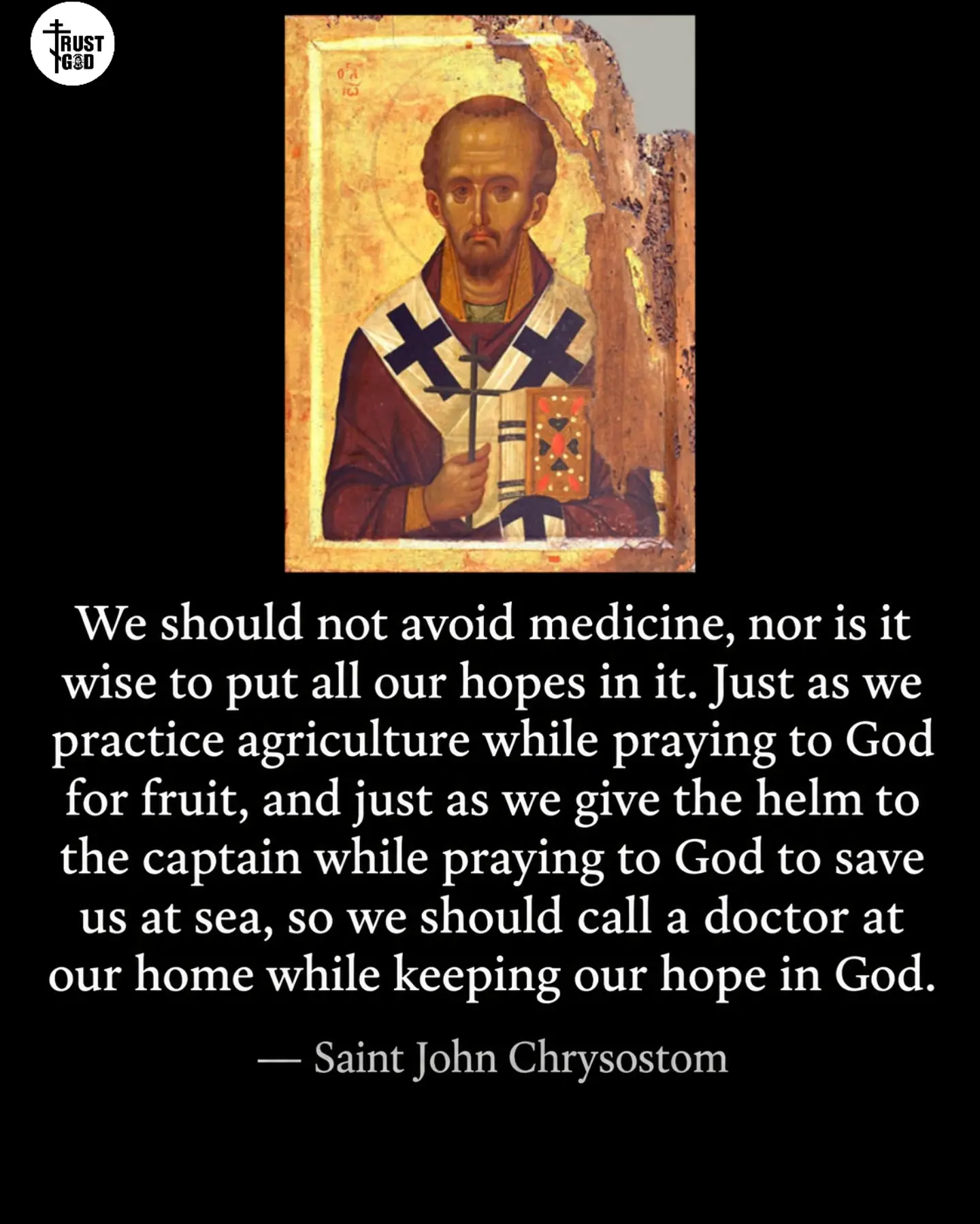
Saint John Chrysostom on Medicine and Faith

The post shares a quotation from Saint John Chrysostom addressing the relationship between medical treatment and Christian faith. The saint teaches that seeking medical help does not indicate a lack of faith. He illustrates this with two analogies: just as farmers cultivate the land while praying to God for fruit, and just as sailors entrust the helm to a captain while praying for safety at sea, so Christians should call a doctor while keeping…

The post shares a quotation from Saint John Chrysostom addressing the relationship between medical treatment and Christian faith. The saint teaches that seeking medical help does not indicate a lack of faith. He illustrates this with two analogies: just as farmers cultivate the land while praying to God for fruit, and just as sailors entrust the helm to a captain while praying for safety at sea, so Christians should call a doctor while keeping their hope in God.

The text states that medicine may treat the body, but our deepest hope belongs to God alone. It encourages doing what is within one's power, praying, and entrusting everything else to Him.

  • Saint John Chrysostom teaches that using medicine does not contradict faith
  • The saint compares medical treatment to agriculture and navigation, human effort alongside prayer
  • Christians should seek medical help while keeping ultimate hope in God
  • Medicine treats the body, but spiritual hope remains in God alone
  • The teaching encourages practical action combined with prayer and trust
Read more

Sacraments as Christ's Medicine for Healing and Salvation

The speaker addresses a claim that sacraments are a way for the church through the priest to have control over people in the most important times of their life. The opposing view states that God's word says you don't need sacraments, you only need Jesus. The speaker counters that the sacraments are gifts from God, given to us for our healing and salvation. He points out that Christ commanded baptism, instituted the Eucharist, and gave his…

The speaker addresses a claim that sacraments are a way for the church through the priest to have control over people in the most important times of their life. The opposing view states that God's word says you don't need sacraments, you only need Jesus. The speaker counters that the sacraments are gifts from God, given to us for our healing and salvation.

He points out that Christ commanded baptism, instituted the Eucharist, and gave his apostles authority to forgive sins. Citing St John Chrysostom, the speaker describes the church as a hospital, not a court of justice. In this framework, sin is a sickness, Christ is the physician, and the sacraments are the medicine through which God heals us and unites us to himself.

The church is the body of Christ. To reject the church's mysteries is to reject the very means of healing and salvation Christ has given us. The discussion turns on whether the sacraments are human inventions for ecclesiastical control or divine gifts for salvation. The speaker argues that Christ himself established these mysteries, and the fathers of the church, such as St John Chrysostom, understood them as therapeutic means by which the sickness of sin is healed.

The church as the body of Christ is the context in which these mysteries operate, and separation from them means separation from the healing presence of Christ the physician.

Key moments

  1. The opposing view states that sacraments are a way for the church through the priest to have control over people in the most important times of their life.
  2. The opposing view states that God's word says you don't need sacraments, you only need Jesus.
  3. The sacraments are gifts from God, given to us for our healing and salvation.
  4. Christ commanded baptism, instituted the Eucharist, and gave his apostles authority to forgive sins.
  5. St John Chrysostom said the church is a hospital, not a court of justice.
  6. Sin is a sickness, Christ is the physician, and the sacraments are the medicine through which God heals us and unites us to himself.
  7. The church is the body of Christ.
  8. To reject the church's mysteries is to reject the very means of healing and salvation Christ has given us.
Read more

Orthodox growth in America challenged by historical latinization and ecumenism

The author warns that certain practices in American Orthodox parishes, such as dog collars, kneeling on Sundays, omitting "catechumens depart," using the Latin calendar, infrequent confession, no veiling, women giving homilies, and not baptizing normatively, are gateways to false unity with heterodox Christians and joint prayer. He traces this latinization to historical events: the 1596 Union of Brest, when Orthodox bishops in the…

The author warns that certain practices in American Orthodox parishes, such as dog collars, kneeling on Sundays, omitting "catechumens depart," using the Latin calendar, infrequent confession, no veiling, women giving homilies, and not baptizing normatively, are gateways to false unity with heterodox Christians and joint prayer.

He traces this latinization to historical events: the 1596 Union of Brest, when Orthodox bishops in the Polish-Lithuanian Commonwealth entered communion with Rome under political pressure; the Kiev Theological Academy founded by Saint Peter Mogila in 1615, which adopted scholastic Western methods and Latin as the principal language of instruction because of intense missionary efforts; the influence of this Western education on Moscow, contributing to Peter the Great's abolition of the patriarchate and creation of the Holy Synod; the 1923 Constantinople council convened by Patriarch Meletios IV, a Freemason, which proposed reforms including married clergy after ordination, removal of vestments and beards, shortened services, and relaxed fasts, but only the calendar change to the Gregorian calendar passed, despite its prior anathematization three times in the 16th century; Patriarch Athenagoras, also a Freemason, pursued ecumenical dialogue with the Pope, leading the Holy Mountain to cease commemorating him; and Metropolitan Philaret of New York, who is incorrupt, presiding over the 1971 ROCOR Synod against ecumenism, warning against practices like kneeling on Sundays, dog collars, shortened liturgies, pushing people away from baptism, lacking an iconostasis, using the Catholic kiss of peace, treating the Eucharist without seriousness, and installing pews. The author argues that tradition in its entirety must be resisted against latinization.

Key moments

  1. 0:00 Orthodoxy is growing massively in the United States, but this growth is frightening because the root of religious compromise almost always stems from the goal of political power.
  2. 0:00 In 1589 the Moscow Patriarchate was granted autocephaly while Orthodox Ruthenians faced hardships under the Catholic Polish-Lithuanian Commonwealth, with restricted political power for nobles and bishops and intense missionary efforts from papal Protestants.
  3. 0:34 The Polish king feared Moscow's political power, and through demonic temptation the Union of Brest in 1596 led many Orthodox bishops to enter communion with Rome while keeping their liturgical traditions and dogmas, a contradictory move that the opposition resisted under heavy persecution.
  4. 0:34 In 1615 Saint Peter Mogila established the Kiev Theological Academy, which used scholastic Western argumentation and Latin as the principal language of instruction because of the massive missionary efforts they faced.
  5. 1:04 This Western influence reached Moscow and led to Peter the Great taking control of the church, abolishing the Moscow Patriarchate, and establishing the Holy Synod, further Westernizing state-controlled institutions.
  6. 1:34 In 1923 a council in Constantinople convened by Patriarch Meletios IV, a Freemason, proposed allowing clergy to marry after ordination, removing vestments and beards, shortening services, and relaxing fasts; none passed except the calendar change from the Julian to the Western festival calendar, which had been anathematized three times in the 16th century.
  7. 2:04 Patriarch Athenagoras of Constantinople, also a Freemason, described the Orthodox and Papist churches as sister churches and attempted to lift excommunications when meeting with the Pope, causing the Holy Mountain to cease commemorating him during the liturgy.
  8. 2:41 Metropolitan Philaret of New York, who is incorrupt, presided over the 1971 ROCOR Synod against Ecumenism and warned of practices such as kneeling on Sundays, dog collars, shortened liturgies, pushing people away from baptism, lacking an iconostasis, using the Catholic handshake kiss of peace, treating the Eucharist without seriousness, and installing pews, all fruits of ecumenism that must be addressed before Orthodoxy in America can truly grow.
35 opinions in the discussion Guess what all these saints who pointed out the Latin captivity and spoke out against ecumenism did? That's right, they baptized everyone. Read the discussion

Orthodox Teaching on Baptism Validity and Early Practice

The post examines what constitutes a valid baptism from an Orthodox perspective. It begins by questioning who has authority to declare a baptism real given over 10,000 denominations and corrupted formulas. The author describes first-century practice: baptism in the name of the Father, Son, and Holy Spirit per Matthew 28:19, triple immersion in living water, and the Didache (c. 90 AD) prescribing fasts and exorcisms before the ritual. Modern…

The post examines what constitutes a valid baptism from an Orthodox perspective. It begins by questioning who has authority to declare a baptism real given over 10,000 denominations and corrupted formulas. The author describes first-century practice: baptism in the name of the Father, Son, and Holy Spirit per Matthew 28:19, triple immersion in living water, and the Didache (c. 90 AD) prescribing fasts and exorcisms before the ritual.

Modern practices are contrasted: some baptize in the "Name of Jesus" using "Creator, Sustainer, and Redeemer"; Mormons use the words but mean three separate gods; others sprinkle or use water guns; independent storefront churches keep no records of how they baptized. For uncertainty, the post cites Canon 72 of the Fifth Council of Carthage (AD 401): those without certain witnesses ought to be baptized without scruple.

The author argues Scripture commands baptism but a book cannot verify a local pastor; private interpretation leaves believers guessing; Christ gave binding authority to a living Church. Rome's approach is criticized: the Council of Trent (1547) dogmatized that any heretic confers valid baptism with water and the names, replacing true faith with mechanical formulas.

The post notes Rome accepted Mormon baptisms until 2001 and invented conditional rites. Sacraments are not autonomous rituals separated from the Body of Christ (Ephesians 1:22); bishops hold the keys to bind and loose (Matthew 16:19). The early Church evaluated converts through councils and bishops, sometimes baptizing from scratch when previous ceremonies could not be verified or had incorrect form, sometimes receiving through anointing with oil where the Church supplied the grace of the Holy Spirit they were lacking.

The conclusion: Orthodox Christianity alone preserves the exact first-century method, and the living Church determines whether a prior baptism suffices.

  • Validity depends on correct form (triple immersion in the Trinity's name) and authority within the historic Church.
  • Early practice included triple immersion, fasting, and exorcisms as recorded in the Didache (c. 90 AD).
  • Modern variations such as single-name formulas, sprinkling, and lack of records create uncertainty.
  • Canon 72 of Carthage (401) mandates baptism when prior baptism cannot be verified.
  • Orthodox teaching holds that sacraments require the living Church's discernment, not private interpretation or mechanical formulas.
Read more

Two infallible councils contradict on salvation outside the Church

The speaker presents a historical argument concerning Roman Catholic teaching on the necessity of the Church for salvation. He cites Pope Boniface VIII's 1302 declaration that submission to the Roman pontiff is absolutely necessary for salvation for every human creature. The Council of Florence in 1442 taught that those outside the Catholic Church cannot inherit eternal life unless they are joined to the Church before death, and explicitly…

The speaker presents a historical argument concerning Roman Catholic teaching on the necessity of the Church for salvation. He cites Pope Boniface VIII's 1302 declaration that submission to the Roman pontiff is absolutely necessary for salvation for every human creature. The Council of Florence in 1442 taught that those outside the Catholic Church cannot inherit eternal life unless they are joined to the Church before death, and explicitly stated that even martyrdom for Christ does not save someone who remains outside the Church.

The Second Vatican Council, by contrast, teaches that those who through no fault of their own do not know Christ or his Church can attain salvation, and it includes Muslims in God's plan of salvation. Catholic apologists often appeal to an implicit desire for the Church to reconcile these positions, but the speaker observes that Florence demands actual union with the Church before death.

Because the Roman Catholic Church claims its dogmatic definitions are infallible, the speaker argues that two contradictory teachings cannot both be infallible. He concludes that this contradiction requires a return to apostolic Christianity, which he identifies as the Orthodox Church.

Key moments

  1. Pope Boniface VIII declared in 1302 that it is absolutely necessary for salvation that every human creature be subject to the Roman pontiff.
  2. The Council of Florence in 1442 taught that those outside the Catholic Church cannot inherit eternal life unless they are joined to the Church before death, and that martyrdom for Christ does not save someone outside the Church.
  3. The Second Vatican Council teaches that those who through no fault of their own do not know Christ or his Church can attain salvation, and it includes Muslims in God's plan of salvation.
  4. Catholic apologists appeal to an implicit desire for the Church, but Florence explicitly requires union with the Church before death.
  5. Since Rome claims its dogmatic definitions are infallible, two contradictory teachings cannot both be infallible, therefore we must return to the Orthodox Church as the one, holy, Catholic and apostolic church.

St. Paisios on God-centered marriage

The post shares a teaching attributed to St. Paisios stating that true love between a man and a woman can only exist when God is at the center of their lives. The quote appears in text over an image of a church interior with frescoes.

  • St. Paisios teaches God must be central for true marital love
  • Quote presented on church interior image
Read more

Protestant argues Reformers abandoned apostolic Christianity

The speaker identifies as a Protestant by conviction, not convenience or complacency, and argues that the Reformers, Martin Luther, John Calvin, Ulrich Zwingli, Philipp Melanchthon, and John Knox, did not restore apostolic Christianity but departed from it. He names them as those who reformed the church but says they actually did the opposite of restoring apostolic Christianity. He cites three early church fathers to show what the early church…

The speaker identifies as a Protestant by conviction, not convenience or complacency, and argues that the Reformers, Martin Luther, John Calvin, Ulrich Zwingli, Philipp Melanchthon, and John Knox, did not restore apostolic Christianity but departed from it. He names them as those who reformed the church but says they actually did the opposite of restoring apostolic Christianity.

He cites three early church fathers to show what the early church held. Saint Ignatius of Antioch defended the authority of bishops. Saint Irenaeus of Lyons defended apostolic succession. Saint Basil the Great defended holy tradition and its authority.

The speaker then points to specific rejections by two leading Reformers. Luther rejected the sacramental priesthood. Calvin rejected the Eucharistic sacrifice. The speaker asserts these departures contradict both the early church and Scripture itself.

He observes that Protestants remain divided over baptism, the Eucharist, salvation, and church authority. He concludes that a movement cannot claim to restore the apostolic faith while remaining divided over what that faith is. The speaker presents his case as a Protestant who has examined the historical record and found the Reformation's claims wanting.

The discussion turns on whether the Reformation was a recovery or a rupture, and the speaker contends the evidence shows rupture.

Key moments

  1. The speaker states he is a Protestant out of conviction, not convenience or complacency.
  2. He names the Reformers, Martin Luther, John Calvin, Zwingli, Melanchthon, Knox, as those who reformed the church but says they actually did the opposite of restoring apostolic Christianity.
  3. He cites St. Ignatius defending the authority of bishops, St. Irenaeus defending apostolic succession, and St. Basil defending holy tradition and its authority.
  4. He says Luther rejected the sacramental priesthood and Calvin rejected the Eucharistic sacrifice.
  5. He asserts these departures contradict the early church and Scripture itself.
  6. He observes Protestants remain divided over baptism, the Eucharist, salvation, and church authority.
  7. He concludes you cannot claim to restore the apostolic faith while remaining divided over what the faith even is.
8 opinions in the discussion And then all the reformers went to war with each other and produced an endless number of denominations. 👌 Read the discussion

Calling on Jesus' name and the sign of the cross in spiritual warfare

The post teaches that in times of temptation one should immediately call upon the name of Jesus Christ and make the sign of the cross. The author states that demons tremble at the name of Christ and that the cross is the sign of His victory over sin, death, and the devil. The Jesus Prayer, "Lord Jesus Christ, Son of God, have mercy on me, a sinner", is given as the specific invocation. The text cites James 4:7: "Resist the devil, and he will…

The post teaches that in times of temptation one should immediately call upon the name of Jesus Christ and make the sign of the cross. The author states that demons tremble at the name of Christ and that the cross is the sign of His victory over sin, death, and the devil. The Jesus Prayer, "Lord Jesus Christ, Son of God, have mercy on me, a sinner", is given as the specific invocation.

The text cites James 4:7: "Resist the devil, and he will flee from you." The accompanying video summary adds that Jesus Christ is the slayer of Satan and that His name acts as kryptonite to evil. It notes that St. Paul describes the Christian life as a condition of spiritual war.

When sensing attack, one should humble oneself, call on the name of Jesus, and make the sign of the cross in the name of the Father, the Son, and the Holy Spirit. The video recounts that St. Anthony the Great saw demons assaulting him erupt in fire when he invoked the Lord's name and made the sign of the precious cross. Refuge is found in the name of the Lord, and drawing His cross brings rescue, peace, and protection.

The video further explains that speaking or calling on the name of Jesus is great power and great protection, and that the sign of the cross is a great and potent force against all evil. It emphasizes that we live in a condition of spiritual war, as St. Paul says, and that the proper response to demonic assault is humility, invocation of the name, and the sign of the cross.

St. Anthony's experience illustrates the immediate effect of these weapons: the demons erupted in fire. The conclusion is that the name of the Lord is a refuge and that making the sign of the cross brings the Lord's rescue, granting great peace and protection.

Key moments

  1. Jesus Christ is the slayer of Satan, and His name is kryptonite to evil.
  2. Speaking or calling on the name of Jesus is great power and great protection.
  3. The sign of the cross is a great and potent force against all evil.
  4. We live in a condition of spiritual war, as St. Paul says.
  5. When sensing attack, one should humble oneself, call on the name of Jesus, and make the sign of the cross in the name of the Father, the Son, and the Holy Spirit.
  6. St. Anthony the Great saw demons assaulting him erupt in fire when he called on the name of the Lord and made the sign of the precious cross.
  7. Find refuge in the name of the Lord; draw His cross on you and the Lord will come to your rescue and grant great peace and protection.
Read more

Saint George Church in Mantouki preserves Saint Cosmas of Aetolia's sacred shirt

The Church of Saint George in Mantouki, Corfu, contains a red-and-gold wooden iconostasis with intricate carvings crowned by dragons that symbolize Christ's triumph over evil. The church also safeguards the sacred shirt of Saint Cosmas of Aetolia, an Orthodox missionary saint. The relic was brought to Mantouki in the 19th century and has been preserved in Saint George's Church after its original home was destroyed during World War II.

  • The church features a carved red-and-gold iconostasis with dragons representing Christ's victory over evil.
  • It houses the sacred shirt of Saint Cosmas of Aetolia, a revered Orthodox missionary.
  • The relic was transferred to Mantouki in the 19th century.
  • The shirt was preserved in Saint George's Church after the destruction of its previous location in World War II.
  • The site combines artistic, historical, and spiritual significance.
Read more

Saint Silouan the Athonite on Humility and Prayer for Enemies

The post presents the life and teaching of Saint Silouan the Athonite (1866-1938), a Russian Orthodox monk at the Monastery of St. Panteleimon on Mount Athos. Born Simeon Ivanovich Antonov, he entered monastic life in 1892 and devoted himself to prayer, repentance, humility, and unceasing communion with God. Through profound spiritual struggles he experienced the grace of Christ and became known for extraordinary humility, compassion, and love…

The post presents the life and teaching of Saint Silouan the Athonite (1866-1938), a Russian Orthodox monk at the Monastery of St. Panteleimon on Mount Athos. Born Simeon Ivanovich Antonov, he entered monastic life in 1892 and devoted himself to prayer, repentance, humility, and unceasing communion with God. Through profound spiritual struggles he experienced the grace of Christ and became known for extraordinary humility, compassion, and love for all humanity.

His central teaching is "Keep thy mind in hell, and despair not," which expresses the struggle against pride and despair through humility and unwavering hope in Christ. His spiritual life was deeply rooted in prayer for the whole world, including his enemies, whom he regarded as equally worthy of God's mercy. The post also includes a second saying: "The man who cries out against evil men but does not pray for them will never know the grace of God."

His life and writings were preserved by his disciple Archimandrite Sophrony, and he remains a powerful witness to Orthodox spirituality and the path of genuine holiness.

  • Saint Silouan (1866-1938) was a Russian monk at St. Panteleimon Monastery on Mount Athos.
  • His central teaching: "Keep thy mind in hell, and despair not."
  • He emphasized prayer for the whole world, including enemies.
  • A second saying: "The man who cries out against evil men but does not pray for them will never know the grace of God."
  • His spiritual legacy was preserved by his disciple Archimandrite Sophrony.
Read more