WeOrthodox
EN UA

☦️An Orthodox Blog☦️

Instagram ↗ 116 discussions

"La Ortodoxia es lo que Jesús enseñó, los Apóstoles predicaron y los Padres guardaron"

St. John Chrysostom: Flee Heresy, Do Not Judge Life

The post shares a saying attributed to St. John Chrysostom distinguishing between matters of faith and matters of life. It states that one should flee from anyone holding an evil heretical doctrine, even if that person is an angel from heaven, and have no dealings with them. However, one should not judge another's way of life, because the command "Judge not, that you be not judged" applies to all matters of life, not to matters of the faith.

  • St. John Chrysostom teaches to flee from heretics, even angels, and have no dealings with them.
  • The command not to judge applies to matters of life, not to matters of faith.
  • Heresy is to be rejected absolutely; personal lifestyle is not to be judged.
  • The distinction separates doctrinal error from personal conduct.
  • The quote is shared as a teaching from the Church Fathers.
Read more
☦️An Orthodox Blog☦️ Instagram

Ochi: The Greek 'No' that became a symbol of faith and freedom

The video recounts how a single Greek word, 'Ochi' meaning 'no', became a symbol of the faith, freedom, and dignity of an entire people. Each year on October 28 the Greek people commemorate the day in 1940 when Greece rejected the ultimatum of fascist Italy that demanded the entry of its troops into Greek territory. The video notes that the Greek resistance awakened the admiration of the world, admiration captured in a phrase attributed to…

The video recounts how a single Greek word, 'Ochi' meaning 'no', became a symbol of the faith, freedom, and dignity of an entire people. Each year on October 28 the Greek people commemorate the day in 1940 when Greece rejected the ultimatum of fascist Italy that demanded the entry of its troops into Greek territory. The video notes that the Greek resistance awakened the admiration of the world, admiration captured in a phrase attributed to Winston Churchill: that we should not say Greeks fight like heroes, but that heroes fight like Greeks.

For the Greek people, the video explains, this date transcends military history; it is also memory, identity, and hope. The Orthodox tradition that has accompanied the life of the Greek people for centuries reminds them of the value of defending dignity, freedom, and what is considered just. The video then poses a question for today: do we have the courage to remain firm before that which threatens our principles?

It concludes by observing that there are words which last only an instant but whose echo crosses generations.

Key moments

  1. Una sola palabra griega, Ochi, se volvió símbolo de la fe, la libertad y la dignidad de todo un pueblo.
  2. Cada 28 de octubre el pueblo griego recuerda el día del Ochi, cuando en 1940 rechazó el ultimátum de la Italia fascista que exigía permitir la entrada de sus tropas en territorio griego.
  3. La resistencia griega despertó la admiración del mundo, resumida en la frase atribuida a Winston Churchill: no diremos que los griegos luchan como héroes, sino que los héroes luchan como griegos.
  4. Para el pueblo griego esta fecha es mucho más que un recuerdo militar; es también memoria, identidad y esperanza.
  5. La tradición ortodoxa que ha acompañado durante siglos la vida del pueblo griego nos recuerda el valor de defender la dignidad, la libertad y aquello que consideramos justos.
  6. Hoy el Ochi nos deja una pregunta: ¿tenemos nosotros el valor de permanecer firme ante aquello que amenaza nuestros principios?
  7. Hay palabras que duran un instante, pero cuyo eco atraviesa generaciones.

Saints Eulampius and Eulampia: Martyrs of Nicomedia under Maximian

The post recounts the martyrdom of Saints Eulampius and Eulampia, a brother and sister from Nicomedia during the persecution under Emperor Maximian. Many Christians had fled the city and hidden themselves. Young Eulampius was sent to bring bread to the faithful. He saw an imperial decree ordering the persecution and execution of Christians posted on a wall. Filled with righteous courage, he tore it down and destroyed it. He was immediately…

The post recounts the martyrdom of Saints Eulampius and Eulampia, a brother and sister from Nicomedia during the persecution under Emperor Maximian. Many Christians had fled the city and hidden themselves. Young Eulampius was sent to bring bread to the faithful. He saw an imperial decree ordering the persecution and execution of Christians posted on a wall.

Filled with righteous courage, he tore it down and destroyed it. He was immediately arrested and brought before a judge. The judge urged him to renounce Christ; Eulampius instead urged the judge to abandon the lifeless idols and recognize Jesus Christ as the one true and living God. Enraged, the judge ordered him beaten and subjected to terrible tortures.

When Eulampia heard of his suffering, she rushed to him and openly declared that she too was a Christian, desiring to suffer alongside her brother rather than abandon him or her faith. Both were cruelly beaten and thrown into boiling pitch and a blazing furnace. Through the power of the name of Jesus Christ and the sign of the Holy Cross, the flames could not harm them.

Witnessing their courage and the miracles of God, two hundred people came to believe in Christ. Finally, Saint Eulampius was beheaded, while Saint Eulampia surrendered her soul to God before the sword struck her. The two hundred new believers were also martyred. Together they received the eternal crowns of martyrdom in the Kingdom of Heaven.

The post ends with a reflection that true faith is measured by firmness when everything is taken, and a prayer asking the holy martyrs to pray to God for us.

  • Eulampius tears down an imperial decree against Christians in Nicomedia
  • He is arrested, tortured, and refuses to renounce Christ
  • Eulampia joins him, declaring her faith and sharing his sufferings
  • Both survive boiling pitch and furnace unharmed; two hundred witnesses convert
  • Eulampius is beheaded, Eulampia dies before the sword; the converts are also martyred
Read more

Saint Philip the Deacon: Apostle to Samaria and the Ethiopian Eunuch

The post recounts the life of Saint Philip the Deacon, one of the Seventy Apostles. Born in Caesarea of Palestine, he was married and had four daughters who were consecrated virgins with the gift of prophecy. The apostles chose him as one of the first seven deacons to serve the poor and widows. When persecution scattered the Jerusalem church, Philip went to Samaria, where he preached the Gospel, performed healings, cast out demons, and baptized…

The post recounts the life of Saint Philip the Deacon, one of the Seventy Apostles. Born in Caesarea of Palestine, he was married and had four daughters who were consecrated virgins with the gift of prophecy. The apostles chose him as one of the first seven deacons to serve the poor and widows.

When persecution scattered the Jerusalem church, Philip went to Samaria, where he preached the Gospel, performed healings, cast out demons, and baptized many, including Simon the sorcerer. He then met an Ethiopian eunuch, a court official of Queen Candace, explained the Scriptures concerning Christ, and baptized him. Afterward, the Spirit transported Philip to Azotus, where he continued preaching.

Later he was appointed bishop in Lydia, where he baptized many and guided the church until his peaceful repose at an advanced age. The account emphasizes that serving Christ begins with love for others, whether through charity or evangelism.

  • One of the Seventy Apostles, born in Caesarea of Palestine, married with four prophetic daughters.
  • Chosen as one of the first seven deacons to serve the poor and widows.
  • Preached in Samaria with miracles, baptizing Simon the sorcerer among others.
  • Explained Scripture to and baptized the Ethiopian eunuch, then was miraculously carried to Azotus.
  • Served as bishop in Lydia until his peaceful repose at an advanced age.
Read more

Seventh Ecumenical Council (787) affirmed veneration of holy icons

The Seventh Ecumenical Council convened in Nicaea in 787 during the reign of Empress Irene and her son Constantine VI, under Patriarch Tarasius of Constantinople. The council addressed the iconoclast controversy, which rejected and destroyed holy icons. Three hundred sixty-seven Holy Fathers gathered to defend the Orthodox teaching on sacred images. They affirmed that veneration of icons is lawful, grounding the decision in Holy Scripture, the…

The Seventh Ecumenical Council convened in Nicaea in 787 during the reign of Empress Irene and her son Constantine VI, under Patriarch Tarasius of Constantinople. The council addressed the iconoclast controversy, which rejected and destroyed holy icons. Three hundred sixty-seven Holy Fathers gathered to defend the Orthodox teaching on sacred images.

They affirmed that veneration of icons is lawful, grounding the decision in Holy Scripture, the writings of the Holy Fathers, and accounts of miracles associated with icons. The Fathers clarified that Christians do not worship the material of an icon, wood, paint, or stone, but direct honor toward the holy person depicted, while worship belongs to God alone.

Among the miracles cited was an account from Bishop Constantine of Cyprus: a shepherd influenced by iconoclast teaching struck an icon of the Theotokos with an iron staff, damaging the right eye of the image; as he walked away, he stumbled and injured his own right eye with the same staff, leading him to repent. The council also decreed that holy relics of martyrs be placed within the antimension used for the Divine Liturgy.

Through these definitions, the council upheld the truth that the Son of God truly became man and, because Christ took visible human flesh, He can be depicted in sacred images. The Holy Fathers of the Seventh Ecumenical Council are commemorated for preserving the apostolic faith and teaching the proper honor due to saints while directing worship to the Holy Trinity. Holy Fathers of the Seventh Ecumenical Council, pray to God for us.

  • Council held in Nicaea in 787 under Empress Irene, Constantine VI, and Patriarch Tarasius
  • 367 Holy Fathers defended veneration of icons against iconoclasm
  • Council distinguished worship (due to God alone) from honor given to icons directed to the prototype
  • Miracle of the shepherd who damaged an icon of the Theotokos and injured his own eye
  • Decree that relics of martyrs be placed in the antimension for the Divine Liturgy
Read more
☦️An Orthodox Blog☦️ with Orthodoxy ☦︎ Instagram

St. John Chrysostom on Prayer Dispelling Passions

The post shares a quotation from St. John Chrysostom comparing prayer to sunlight. He writes that when the sun rises, wild beasts flee to their dens. In the same way, when a person begins to pray, prayer shines like a ray upon the mind, illumining it. The light of prayer causes wild and senseless passions to flee away. The passage presents prayer as an illuminating force that drives out disordered movements of the soul, using the natural image…

The post shares a quotation from St. John Chrysostom comparing prayer to sunlight. He writes that when the sun rises, wild beasts flee to their dens. In the same way, when a person begins to pray, prayer shines like a ray upon the mind, illumining it.

The light of prayer causes wild and senseless passions to flee away. The passage presents prayer as an illuminating force that drives out disordered movements of the soul, using the natural image of animals retreating before daylight. No further commentary or discussion accompanies the quote.

  • St. John Chrysostom compares prayer to the rising sun
  • Prayer illumines the mind like a ray of light
  • Wild and senseless passions flee before prayer's light
  • The analogy uses wild beasts retreating to dens at dawn
  • The quote presents prayer as a spiritual force against passions
☦️An Orthodox Blog☦️ Instagram

Hymn to Saint Demetrios the Great Martyr

The hymn addresses Saint Demetrios as a great champion whom the world found in times of danger. It describes him as a trophy-bearer who routed the nations like a lion and cast down their arrogance in the stadium while encouraging Nestor. The faithful ask the holy Great Martyr Demetrios to entreat Christ God to grant great mercy.

Key moments

  1. The world found in Saint Demetrios a great champion in dangers.
  2. As a trophy-bearer, he routed the nations like a lion and cast down their arrogance in the stadium.
  3. He encouraged Nestor in the contest.
  4. The hymn asks Saint Demetrios to entreat Christ God to grant great mercy.
Read more
☦️An Orthodox Blog☦️ with Orthodoxy ☦︎ Instagram

St. Paisios on Parental Love and Honoring God

The post shares a teaching from St. Paisios the Athonite responding to the claim that some children feel hurt by their parents' love. The elder states that no one is harmed by the love of parents. Whoever feels hurt by it is foolish, because he ought to thank God for the love and tenderness of his parents. St. Paisios then connects the duty toward parents to the duty toward God: if someone does not honor and love his parents, he cannot possibly…

The post shares a teaching from St. Paisios the Athonite responding to the claim that some children feel hurt by their parents' love. The elder states that no one is harmed by the love of parents. Whoever feels hurt by it is foolish, because he ought to thank God for the love and tenderness of his parents.

St. Paisios then connects the duty toward parents to the duty toward God: if someone does not honor and love his parents, he cannot possibly love, honor, and fear God. The teaching presents parental love as a gift from God that demands gratitude, and the honor given to parents as a necessary foundation for a right relationship with God.

  • St. Paisios rejects the idea that parental love can harm children
  • Those who feel hurt by parental love are called foolish
  • Children should thank God for parental love and tenderness
  • Honoring and loving parents is a prerequisite to loving, honoring, and fearing God
  • The teaching comes from St. Paisios the Athonite, a recognized Orthodox saint
Read more
☦️An Orthodox Blog☦️ with Orthodoxy ☦︎ Instagram

St. Isaac the Syrian on Love That Seeks God

0:20

The post shares a saying attributed to St. Isaac the Syrian that contrasts two kinds of love. The first kind seeks something in return; St. Isaac compares it to a small lantern that shines only while it is fed oil, or to a winter stream that flows only when rain falls. The second kind has God as its end, and he calls God "the only Fountain of love."

This love is likened to a river whose current never ceases and whose waters never run dry. The text presents the analogy without additional commentary or explanation.

  • St. Isaac distinguishes love that seeks a return from love whose end is God.
  • Conditional love is compared to a lantern needing oil and a winter stream needing rain.
  • Love directed to God is compared to a perpetual river.
  • God is identified as "the only Fountain of love."
  • The quote comes from St. Isaac the Syrian, a recognized Church Father.
☦️An Orthodox Blog☦️ Instagram

Saint Demetrios Hymn: Martyr's Victory and Prayer for Mercy

1:09

The video presents a hymn addressed to Saint Demetrios, calling him the great martyr who has triumphed over the nations and contended in the stadium. The hymn asks the saint to intercede with Christ God so that great mercy may be granted to the faithful. The content focuses on the saint's martyrdom and his role as an intercessor, reflecting the Orthodox practice of seeking the prayers of the martyrs.

Key moments

  1. The hymn calls Saint Demetrios the great martyr and describes his victories over the nations and his contest in the stadium.
  2. It asks Saint Demetrios to pray to Christ God to grant us great mercy.
Read more
☦️An Orthodox Blog☦️ Instagram

Saint Demetrios of Thessaloniki: Faith That Transforms Life

The video presents the life of Saint Demetrios of Thessaloniki, a fourth-century martyr commemorated on October 26. He held an important position in the city but placed his love for Christ above his status, confessing his faith during persecution and accepting imprisonment and death. The speaker explains that Saint Demetrios teaches that Christian faith requires living according to the Gospel even when difficult, defending truth without hatred,…

The video presents the life of Saint Demetrios of Thessaloniki, a fourth-century martyr commemorated on October 26. He held an important position in the city but placed his love for Christ above his status, confessing his faith during persecution and accepting imprisonment and death. The speaker explains that Saint Demetrios teaches that Christian faith requires living according to the Gospel even when difficult, defending truth without hatred, practicing justice, helping the needy, and remaining faithful in daily decisions.

His witness is not merely historical but a living example that faith must transform one's way of life. The presentation emphasizes that it is possible to remain faithful to Christ in a world that pressures one to deny Him. Saint Demetrios lived as a man of high standing in Thessaloniki, yet his life was defined by his love for Christ.

During persecution he did not conceal his faith but confessed Jesus Christ, leading to his imprisonment and martyrdom. Christian faith is not limited to attending church, venerating icons, or knowing Church teachings. Being a Christian means living according to the Gospel even when it is difficult, defending truth without hatred, practicing justice, helping the needy, and staying faithful in everyday choices.

Saint Demetrios is not only a hero of the past but a living example that faith must transform how we live. His testimony should inspire believers not to be ashamed of the Gospel and to demonstrate by their works that Christ lives in them.

Key moments

  1. It is possible to remain faithful to Christ in a world that pressures one to deny Him.
  2. Saint Demetrios lived in the fourth century as a man of high standing in Thessaloniki, yet his life was defined by his love for Christ.
  3. During persecution he did not conceal his faith but confessed Jesus Christ, leading to his imprisonment and martyrdom.
  4. Christian faith is not limited to attending church, venerating icons, or knowing Church teachings.
  5. Being a Christian means living according to the Gospel even when it is difficult, defending truth without hatred, practicing justice, helping the needy, and staying faithful in everyday choices.
  6. Saint Demetrios is not only a hero of the past but a living example that faith must transform how we live.
  7. His testimony should inspire believers not to be ashamed of the Gospel and to demonstrate by their works that Christ lives in them.
Read more
☦️An Orthodox Blog☦️ with Orthodoxy ☦︎ Instagram

St. Paisios: Christ turns bitterness of pain into honey

The post shares a saying attributed to St. Paisios the Athonite. He states that when a person brings the bitterness of his pain to Christ, who is sweet, that bitterness and poison are transformed into pure honey. The quote presents the spiritual teaching that Christ's sweetness converts suffering into something sweet and healing.

  • St. Paisios teaches that bringing pain to Christ transforms it.
  • Christ is described as sweet.
  • Bitterness and poison become pure honey.
  • The saying illustrates the redemptive power of Christ over suffering.
☦️An Orthodox Blog☦️ Instagram

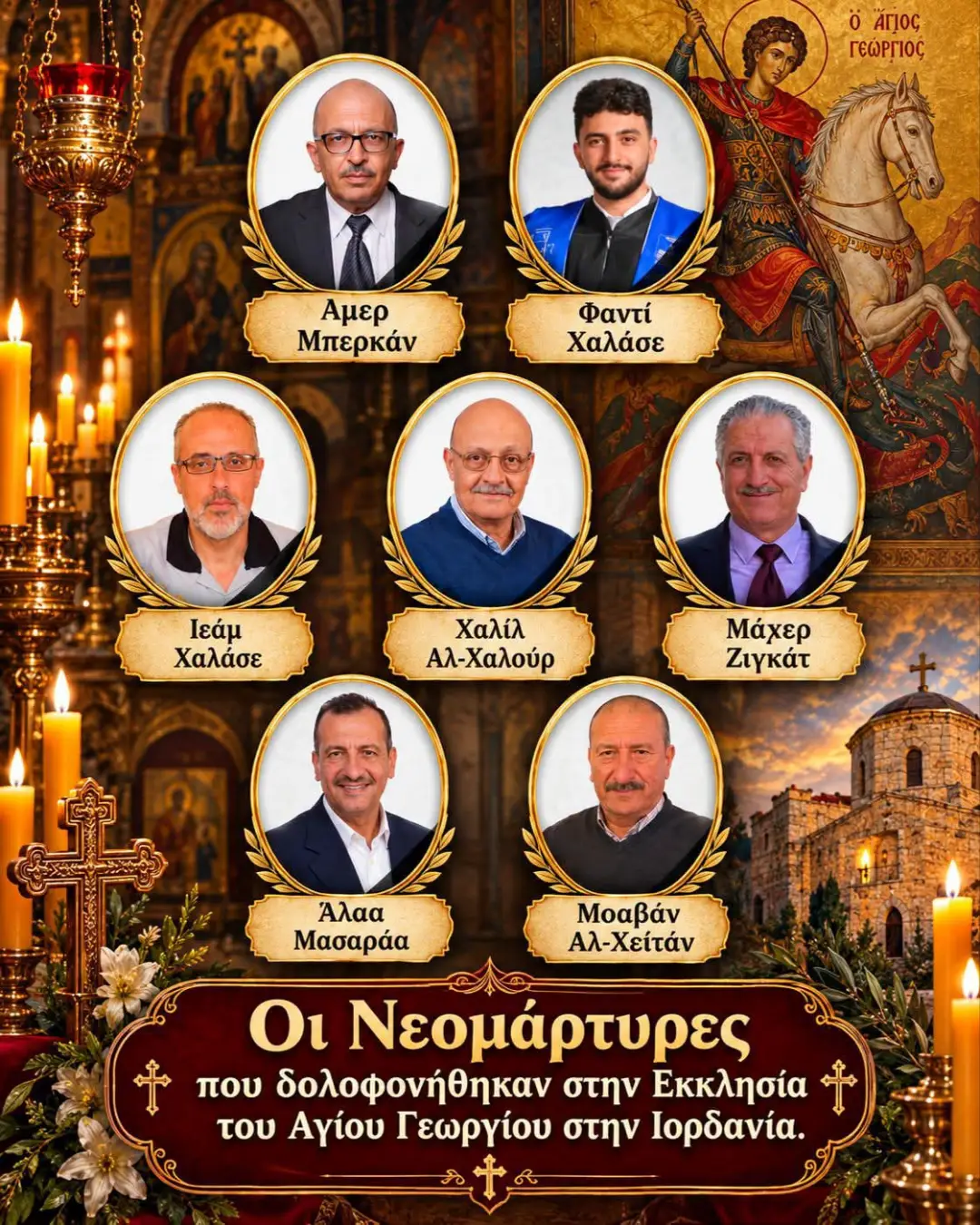
New Martyrs of Saint George Church in Jordan commemorated

The image presents a list of nine names identified as New Martyrs who were killed in the Church of Saint George in Jordan. The first line names Saint George, likely the church's patron. The following eight lines give names in Greek transliteration from Arabic: Amer Berkan, Fanti Halase, Ieam Halase, Halil Al-Halour, Macher Zigat, Alaa Masaraa, Moavan Al-Heitan. The caption states these are the New Martyrs murdered in that church.

  • List of eight individuals named as New Martyrs
  • Killed in the Church of Saint George in Jordan
  • Names given in Greek transliteration
  • Saint George named as patron of the church
  • No additional details or discussion provided
☦️An Orthodox Blog☦️ with Orthodoxy ☦︎ Instagram

St. John Chrysostom: Death as a Flight to Heaven

The post shares a saying attributed to St. John Chrysostom: "If you see your son or a relative lying in repose, do not think of him as dead, but as one who has flown away and ascended to heaven." The quote reframes the death of a loved one as a departure to heaven rather than an end.

  • Quote from St. John Chrysostom on death as ascension
  • Encourages viewing the deceased as having flown to heaven
Read more
☦️An Orthodox Blog☦️ with Orthodoxy ☦︎ Instagram

St. Paisios: True love reveals itself without outward signs

The post shares a saying attributed to St. Paisios the Athonite. He states that true love reveals itself to the other without outward signs. The one who loves perceives the other's love, and the other perceives his love. People understand whether love is true or tainted by hypocrisy.

  • True love reveals itself without outward signs
  • Lovers perceive each other's love mutually
  • People discern true love from hypocritical love

Saint James the Apostle: Preached in Egypt, Martyred by Crucifixion

The post recounts the life of Saint James, the son of Alphaeus, one of the Twelve Apostles and brother of Saint Matthew the Evangelist. He witnessed Christ's teachings, miracles, suffering, Resurrection, and Ascension. After Pentecost, he preached first in Eleutheropolis and surrounding regions, then traveled to Egypt. Through his preaching and miracles, casting out demons, healing the sick, delivering people from spiritual darkness, he…

The post recounts the life of Saint James, the son of Alphaeus, one of the Twelve Apostles and brother of Saint Matthew the Evangelist. He witnessed Christ's teachings, miracles, suffering, Resurrection, and Ascension. After Pentecost, he preached first in Eleutheropolis and surrounding regions, then traveled to Egypt.

Through his preaching and miracles, casting out demons, healing the sick, delivering people from spiritual darkness, he challenged pagan worship and brought many to Christianity. Churches were established, and bishops and priests were appointed to guide the new communities. In the Egyptian city of Ostracine, pagans seized him and condemned him to death by crucifixion.

He gave his life for the Lord whose Resurrection he had witnessed and whose Gospel he had preached. The post concludes that his life shows following Christ requires faithfulness through sacrifice, suffering, and every trial, not merely verbal belief.

  • Saint James, son of Alphaeus, was one of the Twelve Apostles and brother of Saint Matthew
  • He preached in Eleutheropolis and Egypt after Pentecost, performing miracles and converting many
  • Churches were founded and clergy appointed through his apostolic work
  • He was martyred by crucifixion in the Egyptian city of Ostracine
  • His life exemplifies faithfulness to Christ through sacrifice and suffering
Read more

Saint Pelagia the Penitent: from a life of sin to holiness through repentance

Saint Pelagia was born in Antioch and lived a life far from God, using her extraordinary beauty for sinful purposes and gaining wealth through immorality. One day, while passing the Church of Saint Julian the Martyr, she heard Bishop Nonnus preaching about the Last Judgment and the consequences of sin. His words pierced her heart, and she saw the true condition of her soul. Overcome with sorrow, she fell before the bishop and begged him to…

Saint Pelagia was born in Antioch and lived a life far from God, using her extraordinary beauty for sinful purposes and gaining wealth through immorality. One day, while passing the Church of Saint Julian the Martyr, she heard Bishop Nonnus preaching about the Last Judgment and the consequences of sin. His words pierced her heart, and she saw the true condition of her soul.

Overcome with sorrow, she fell before the bishop and begged him to baptize her, crying, "Have mercy on me, a sinner, and baptize me and teach me repentance. I am a sea of lawlessness, an abyss of destruction." Saint Nonnus baptized her, and the deaconess Romana became her godmother, guiding her in the Christian faith. Pelagia did not stop at baptism. Desiring to leave her former life completely, she gave all her wealth to the poor and secretly traveled to Jerusalem.

There, under the name Pelagius, she lived as a monk in a small cell on the Mount of Olives, dedicating herself to fasting, prayer, vigils, and deep repentance. After three years of spiritual struggle, Deacon James, a disciple of Saint Nonnus, visited her. When he returned a few days later, he found that she had peacefully departed to the Lord. Saint Pelagia reposed around the year 461.

  • Born in Antioch, lived in sin and gained wealth through immorality.
  • Heard Bishop Nonnus preach on the Last Judgment at the Church of Saint Julian, leading to repentance.
  • Baptized by Nonnus with deaconess Romana as godmother.
  • Gave all wealth to the poor, became a monk named Pelagius on the Mount of Olives.
  • After three years of asceticism, visited by Deacon James; reposed c. 461.
Read more

Saints Sergius and Bacchus: Roman Soldiers Who Chose Christ Over Honor

The post recounts the martyrdom of Saints Sergius and Bacchus, who were respected military officers at the court of Emperor Maximian. The emperor admired them for their courage, wisdom, and loyalty. When he discovered they were Christians, his admiration turned into anger. During a pagan celebration, Maximian commanded them to offer sacrifices to the idols. Both saints refused, openly confessing their faith in Jesus Christ. Furious, the emperor…

The post recounts the martyrdom of Saints Sergius and Bacchus, who were respected military officers at the court of Emperor Maximian. The emperor admired them for their courage, wisdom, and loyalty. When he discovered they were Christians, his admiration turned into anger.

During a pagan celebration, Maximian commanded them to offer sacrifices to the idols. Both saints refused, openly confessing their faith in Jesus Christ. Furious, the emperor stripped them of their military uniforms, dressed them in women's clothing, placed iron rings around their necks, and paraded them through the streets of Rome to humiliate them.

Yet their faith remained unshaken. They were sent to the governor Antiochus, a man who had received his position through their help. He begged them to deny Christ and save themselves from torture and death. But they answered: "Honor and dishonor, life and death: all are the same to the one who seeks the Kingdom of Heaven."

Saint Bacchus was tortured first. He was beaten so severely that his body was broken, and his soul was carried by angels into the presence of the Lord. Saint Sergius was then forced to walk in iron shoes filled with sharp nails. After enduring terrible suffering, he was taken to Resafa in Syria, where he was beheaded for Christ.

Around the year 309, both saints received the crowns of martyrdom. They lost their military ranks, their earthly honors, and finally their lives, but they never lost Christ. The post closes with the invocation: Holy Martyrs Sergius and Bacchus, pray to God for us.

  • Sergius and Bacchus were high-ranking Roman officers under Emperor Maximian.
  • They refused to sacrifice to idols and confessed Christ during a pagan festival.
  • Maximian humiliated them publicly, then sent them to Governor Antiochus.
  • Bacchus died from severe beating; Sergius was beheaded in Resafa around 309.
  • The account ends with a prayer for their intercession.
Read more
☦️An Orthodox Blog☦️ Instagram

The Trinity: Mystery Lived in Liturgy, Not Solved by Reason

The video presents the Orthodox understanding of the Trinity as one God in three distinct persons, Father, Son, and Holy Spirit, who share the same divine essence without confusion or division. The baptism of Jesus reveals all three simultaneously: the Father speaks from heaven, the Son stands in the water, and the Spirit appears as a dove. The Father is unbegotten, the Son is begotten, and the Holy Spirit proceeds from the Father. The…

The video presents the Orthodox understanding of the Trinity as one God in three distinct persons, Father, Son, and Holy Spirit, who share the same divine essence without confusion or division. The baptism of Jesus reveals all three simultaneously: the Father speaks from heaven, the Son stands in the water, and the Spirit appears as a dove.

The Father is unbegotten, the Son is begotten, and the Holy Spirit proceeds from the Father. The ecumenical councils of 325 and 381 established these boundaries to protect the apostolic faith, affirming that Christ is consubstantial with the Father and the Spirit is the Lord and giver of life. Orthodoxy does not defend the Trinity in philosophical debate but on its knees in the liturgy, immersing the mind in the infinite rather than trying to contain the infinite in the mind.

St. Gregory the Theologian described the balance: no sooner do I conceive of the One than I am illumined by the Three; no sooner do I distinguish the Three than I am carried back to the One. St. Basil the Great wrote that the way of knowing God goes from the one Spirit through the one Son to the one Father. The Trinity is not a mathematical problem to solve but a mystery in which Christians participate, lived in communion rather than rationalized.

Key moments

  1. The Trinity is not a mathematical problem to solve but a mystery in which Christians participate.
  2. St. Gregory the Theologian described the balance: no sooner do I conceive of the One than I am illumined by the Three; no sooner do I distinguish the Three than I am carried back to the One.
  3. The Father is unbegotten, the Son is begotten, and the Holy Spirit proceeds from the Father.
  4. The councils of 325 and 381 fixed the limits of the faith to protect the apostolic teaching.
  5. The Trinity is not rationalized but lived in communion.
  6. St. Basil the Great wrote that the way of knowing God goes from the one Spirit through the one Son to the one Father.
☦️An Orthodox Blog☦️ Instagram

Prayer to the Theotokos for Cuba's people

The prayer calls on the Most Holy Theotokos as Mother of the Word and Virgin to save those greatly afflicted by temptations. The speaker seeks refuge from passions and assaults of despondency that overwhelm the soul. The prayer asks the Maiden to bring peace through the calm of her Son and God.

A doxology glorifies the Father, Son, and Holy Spirit, acknowledging that the Virgin bore the Savior and God. The speaker lifts up both soul and mind to her now and forever.

Key moments

  1. The speaker calls on the Most Holy Theotokos to save those greatly afflicted by temptations, fleeing to her as Mother of the Word and Virgin for deliverance from difficult and terrible things.
  2. Passions and assaults of great despondency overwhelm the soul; the prayer asks the Maiden to bring peace with the calm of her Son and God, the All-blameless One.
  3. Glory is given to the Father, Son, and Holy Spirit, acknowledging that the Virgin bore the Savior and God, and the speaker lifts up both soul and mind to her now and ever and unto ages of ages.
Read more