WeOrthodox
EN UA

Orthodox posts, videos and discussions

We follow Orthodox channels, communities and blogs across the web, summarise every post and video, and highlight the conversations with real substance.

Debate claim challenged: Orthodoxy as apostolic from the start

The video presents a speaker responding to a statement attributed to the apologist God Logic from a DebateCon event. The speaker quotes God Logic as saying there was no orthodox Christianity until several centuries after Jesus. The speaker rejects this assertion, arguing that orthodox Christianity is the original faith handed down from the first Christians. He explains that orthodoxy means acknowledging what the early Christians believed and the…

The video presents a speaker responding to a statement attributed to the apologist God Logic from a DebateCon event. The speaker quotes God Logic as saying there was no orthodox Christianity until several centuries after Jesus. The speaker rejects this assertion, arguing that orthodox Christianity is the original faith handed down from the first Christians.

He explains that orthodoxy means acknowledging what the early Christians believed and the tradition they transmitted. The speaker invites the audience to share their thoughts on the matter.

Key moments

  1. The speaker says God Logic admitted that Orthodox Christianity is apostolic.
  2. The speaker quotes God Logic from the debate: 'There was no such thing as orthodox Christianity until several centuries after Jesus.'
  3. The speaker counters that this is not true, stating that orthodox Christianity is simply orthodoxy and is the origin.
  4. The speaker disagrees with God Logic, explaining that orthodoxy means acknowledging what the early Christians believed and the tradition they handed down.
  5. The speaker asks the audience for their thoughts.
Read more

Žitomislić Monastery: Monks Martyred in 1941, Canonized in 2005

The Žitomislić monastery, founded in the 15th century on the left bank of the Neretva near Mostar, has been burned, looted, and demolished multiple times but rebuilt each time. In late June 1941, during the Independent State of Croatia, the monks were summoned to a local office on the pretext of registration, then arrested, tortured, bound with wire, and taken to Blizanci where they were killed and thrown into the Neretva. The victims included…

The Žitomislić monastery, founded in the 15th century on the left bank of the Neretva near Mostar, has been burned, looted, and demolished multiple times but rebuilt each time. In late June 1941, during the Independent State of Croatia, the monks were summoned to a local office on the pretext of registration, then arrested, tortured, bound with wire, and taken to Blizanci where they were killed and thrown into the Neretva.

The victims included Iguman Konstantin Vučurović, aged 26, hieromonks Dositej, Vukićević, and Makarije, a chanter, young novices and theology students, and Protopresbyter Vladimir Čejović from Mostar, who refused an offer to leave. Their remains could not be properly buried for decades under communist rule; they were exhumed in late 1990 and buried in a marble tomb by the altar in 1991.

The monastery was mined and the tomb destroyed again in 1992. The Holy Assembly of Bishops of the Serbian Orthodox Church canonized the monks as holy priest-martyrs in 2005, with their feast day on June 26. Part of their relics are now kept in the rebuilt monastery. A palm tree in the monastery courtyard, damaged when the bell tower fell on it during the 1992 destruction, continues to grow.

Key moments

  1. 0:05 The monastery was founded in the 15th century, burned, looted, and demolished, but rebuilt thanks to the faith and labor of people who preserved its heritage.
  2. 0:40 Behind its walls lies a story of spirituality, suffering, and perseverance of the Serbian Orthodox people in Herzegovina, where monks endured severe suffering and remained faithful to Christ when it was hardest.
  3. 1:22 In late June 1941, during the Independent State of Croatia, the monks were invited to a local office under the pretext of registration, arrested, tortured, bound with wire, and taken to the village of Blizanci.
  4. 1:22 All were killed and their bodies thrown into the Neretva; the victims included Iguman Konstantin Vučurović, aged 26, hieromonks Dositej, Vukićević, and Makarije, a chanter, young novices and theology students, and Protopresbyter Vladimir Čejović from Mostar, who refused an offer to leave.
  5. 1:58 Their bones could not be properly buried for decades because of the communists; the remains were exhumed in late 1990 and buried in 1991 in a marble tomb near the altar of the monastery church.
  6. 1:58 The monastery was mined and destroyed again in 1992, and the martyrs' tomb was also destroyed, but by God's will and with the help of the faithful people, Žitomislić was rebuilt again.
  7. 2:28 The Holy Assembly of Bishops of the Serbian Orthodox Church canonized them in 2005 as holy priest-martyrs of Žitomislić, and their feast day is celebrated on June 26.
  8. 2:28 Today part of the relics of the martyred monks is kept in the rebuilt monastery, and standing before this shrine one sees not only rebuilt walls but a place that preserves the memory of faith, sacrifice, and people who are not forgotten.
Read more
Prayer Orthodoxy ® Instagram

Feast of St. Demetrios the Myrrh Streamer, Patron of Thessaloniki

The post announces the commemoration of the Holy Great Martyr St. Demetrios the Myrrh Streamer on October 26. He is identified as the patron saint and protector of Thessaloniki, Greece. The author asks for the saint's holy intercessions and extends name day wishes to those named Demetrios, Dimitris, Dimitras, and Demetrias. The message appears in both English and Greek, with the Greek text repeating the same information.

  • Commemoration of St. Demetrios the Myrrh Streamer on October 26
  • He is the patron saint and protector of Thessaloniki
  • Request for the saint's intercessions
  • Name day greetings for variations of the name Demetrios
  • Text provided in English and Greek
Read more

God Is With Us: From Bethlehem to Al-Karak

The post features a declaration in Arabic proclaiming "God is with us," drawing on the biblical promise of Isaiah 8:9-10. The speaker asserts that because God is present, the nations will ultimately be defeated despite any temporary victories. The proclamation spans from the birthplace of Christ in Bethlehem to Al-Karak, Jordan, a city with deep Christian history. The video expands on this theme: the speaker addresses the ends of the earth and…

The post features a declaration in Arabic proclaiming "God is with us," drawing on the biblical promise of Isaiah 8:9-10. The speaker asserts that because God is present, the nations will ultimately be defeated despite any temporary victories. The proclamation spans from the birthplace of Christ in Bethlehem to Al-Karak, Jordan, a city with deep Christian history.

The video expands on this theme: the speaker addresses the ends of the earth and the strong, declaring their defeat is certain because God remains with the faithful. This testimony reflects the Orthodox understanding of divine protection and the ultimate triumph of God's purpose over worldly powers. The phrase "God is with us" is a traditional Orthodox affirmation, often sung during Great Compline and associated with the Nativity.

The geographic reference connects the biblical narrative to the living Christian presence in the Holy Land and Jordan.

Key moments

  1. The speaker asserts that God is with them, therefore the nations will not overcome them.
  2. The speaker addresses the ends of the earth and the strong ones, stating they will be defeated and any temporary victory they achieve will ultimately be reversed because God is with the speaker.
Read more

The Noonday Demon: When Discouragement Attacks Faith

The post explains the spiritual struggle known as the Noonday Demon, or despondency (acedia), as taught by early Church Fathers. Evagrius Ponticus named it the Noonday Demon, describing it as a state that makes a person restless, dissatisfied, and convinced that life would be better somewhere else. It attacks not through obvious temptation but through a loss of meaning, causing one to question purpose, circumstances, and relationship with God.…

The post explains the spiritual struggle known as the Noonday Demon, or despondency (acedia), as taught by early Church Fathers. Evagrius Ponticus named it the Noonday Demon, describing it as a state that makes a person restless, dissatisfied, and convinced that life would be better somewhere else. It attacks not through obvious temptation but through a loss of meaning, causing one to question purpose, circumstances, and relationship with God.

Saint Isaac the Syrian adds that it produces confusion, irritation, and wandering thoughts. The post advises that not every difficult season signals a need to change one's life; sometimes God calls for growth within it. The recommended response is to keep praying even without feeling, maintain discipline, attend Divine Liturgy, and seek guidance from a spiritual father.

It also notes that genuine exhaustion or mental health struggles deserve proper care. The greatest spiritual victory may be simply refusing to abandon the place where God has put you to grow.

Key moments

  1. The devil's attack doesn't always feel like a temptation; it can sound like "what's the point," causing loss of motivation, difficult prayer, meaningless work, and the sense that everyone else has a better life.
  2. The early church fathers knew this battle well and called it despondency; Evagrius named it the noonday demon.
  3. Evagrius taught that despondency makes people feel dissatisfied with where they are, who they're with, and what they are doing, the belief that life would be better somewhere else.
  4. Sometimes God isn't asking you to escape your life but to be faithful inside it.
  5. Saint Isaac the Syrian teaches that despondency produces confusion, irritation, and wandering thoughts.
  6. When you hit that season, don't make every decision from an exhausted mind.
  7. The response is to pray, keep your routine, go to church, speak to your spiritual father, and keep moving on.
  8. Sometimes your greatest spiritual victory is simply refusing to abandon the place where God has put you to grow.
Read more

Gerontas Filimon: Responsibility and self-knowledge in a pilgrim story

Gerontas Filimon recounts a story about a priest at the Portaitissa on Mount Athos who placed handkerchiefs containing money, five, ten, or one hundred drachmas, in trees for pilgrims to find. When a pilgrim found one, the priest told them to take it if they needed it, but to leave it if they did not, thereby placing the responsibility for the choice on the person. The elder connects this to spiritual life: each person is responsible for their…

Gerontas Filimon recounts a story about a priest at the Portaitissa on Mount Athos who placed handkerchiefs containing money, five, ten, or one hundred drachmas, in trees for pilgrims to find. When a pilgrim found one, the priest told them to take it if they needed it, but to leave it if they did not, thereby placing the responsibility for the choice on the person.

The elder connects this to spiritual life: each person is responsible for their own actions and will give an account to God for their sins and weaknesses, especially when they had the ability to do better.

Key moments

  1. The priest at the Portaitissa placed handkerchiefs with money in trees for pilgrims to find.
  2. He instructed those who found them to take the money only if they needed it, otherwise leave it, making the person responsible for the choice.
  3. The speaker says this mirrors spiritual life: each person is responsible for everything they do.
  4. Everyone will give an account to God for their sins and weaknesses, particularly when they had the ability to do better.
Read more

St. John Chrysostom on Prayer Dispelling Passions

The post shares a quotation from St. John Chrysostom comparing prayer to sunlight. He writes that when the sun rises, wild beasts flee to their dens. In the same way, when a person begins to pray, prayer shines like a ray upon the mind, illumining it. The light of prayer causes wild and senseless passions to flee away. The passage presents prayer as an illuminating force that drives out disordered movements of the soul, using the natural image…

The post shares a quotation from St. John Chrysostom comparing prayer to sunlight. He writes that when the sun rises, wild beasts flee to their dens. In the same way, when a person begins to pray, prayer shines like a ray upon the mind, illumining it.

The light of prayer causes wild and senseless passions to flee away. The passage presents prayer as an illuminating force that drives out disordered movements of the soul, using the natural image of animals retreating before daylight. No further commentary or discussion accompanies the quote.

  • St. John Chrysostom compares prayer to the rising sun
  • Prayer illumines the mind like a ray of light
  • Wild and senseless passions flee before prayer's light
  • The analogy uses wild beasts retreating to dens at dawn
  • The quote presents prayer as a spiritual force against passions

The Mind in the Heart: Standing Before God's Face

The text explains what it means to have the mind in the heart. It begins with a question: do you know where the heart is? The answer is to stand there with attention and remain constantly. The mind becomes inseparable from attention; where attention is, the mind is also. The author notes that readers have written about feeling fire in the heart while reading the Akathist to Sweetest Jesus. That sensation marks the place. One should keep…

The text explains what it means to have the mind in the heart. It begins with a question: do you know where the heart is? The answer is to stand there with attention and remain constantly. The mind becomes inseparable from attention; where attention is, the mind is also.

The author notes that readers have written about feeling fire in the heart while reading the Akathist to Sweetest Jesus. That sensation marks the place. One should keep attention there and not go outward, not only during prayer but at all times. Standing there is not passive; it requires the awareness of standing before the face of the Lord or before His all-seeing eye, which sees the hidden chambers of the heart.

To stand this way, one must labor to kindle some feeling toward God, fear, love, trust, devotion, painful compunction, or similar. This state is described as the norm of inner order. Whenever one notices it disrupted in anything, one must hurry to re-establish it.

  • The mind in the heart means standing there with constant attention
  • Mind and attention become inseparable
  • The warmth felt during the Akathist to Sweetest Jesus marks the heart's location
  • One must remain before God's face or all-seeing eye at all times, not only in prayer
  • Inner order requires cultivating feelings toward God and restoring them when disrupted
Read more
Orthodox Life Instagram

Saint Demetrios the Myrrh-streamer: Great Martyr of Thessaloniki

Saint Demetrios of Thessaloniki was a Roman noble, military commander, and proconsul in the third century. Born into a prominent Macedonian family, he secretly practiced Christianity while openly teaching the faith during his service in the Roman administration, using his position to convert many pagans. When Emperor Galerius Maximian began a severe persecution of Christians, Demetrios was arrested and thrown into a cold underground prison cell.…

Saint Demetrios of Thessaloniki was a Roman noble, military commander, and proconsul in the third century. Born into a prominent Macedonian family, he secretly practiced Christianity while openly teaching the faith during his service in the Roman administration, using his position to convert many pagans. When Emperor Galerius Maximian began a severe persecution of Christians, Demetrios was arrested and thrown into a cold underground prison cell.

There he spent his time in continuous prayer and offered spiritual guidance to fellow believers who faced trial. During imperial games held in the city, a young Christian named Nestor sought Demetrios's blessing to confront the emperor's champion, a giant named Lyaios. With the saint's prayers, Nestor defeated Lyaios, an outcome that enraged Galerius and led to the execution of both men.

On October 26, 306 AD, soldiers entered Demetrios's cell and killed him with lances, making him a Great Martyr. His servant Lupus collected the saint's blood-stained tunic and ring, which later became instruments of miraculous healings. After his death, a fragrant oil known as myrrh began to flow from his tomb in the Church of Saint Demetrios in Thessaloniki, giving him the title Myrrh-streamer.

The saint is venerated as the eternal protector and patron of Thessaloniki. The accompanying images display icons inscribed in Greek and Church Slavonic, depictions of the saint's martyrdom and repose, and the silver reliquary in the Thessaloniki church where his relics rest, surrounded by flowers and written prayer requests.

  • Saint Demetrios was a Roman noble, military commander, and proconsul who secretly lived as a Christian in the third century.
  • He was imprisoned during the persecution under Emperor Galerius Maximian and continued to pray and guide fellow prisoners.
  • A young Christian named Nestor, with Demetrios's blessing, defeated the emperor's champion Lyaios in the arena.
  • Demetrios was martyred by lances on October 26, 306 AD, and his servant Lupus preserved his tunic and ring as sources of healing.
  • Myrrh flowed from his tomb in the Thessaloniki church, giving him the title Myrrh-streamer, and he is honored as the city's patron saint.
Read more

Elder Paisios: Give your hands to the world, your heart to Christ

The post shares a saying of Venerable Paisios of the Holy Mountain. He advises not to give one's heart to the world but to offer it hands and reasoning instead. The heart should not be given to anything insignificant or useless, because it must beat for Christ.

When the heart is in Christ, work is felt differently, and a person preserves inner spiritual freshness and experiences true joy. The text is accompanied by a photograph of the sea with Mount Athos in the distance and a seagull flying by.

  • Do not give your heart to the world; give it your hands and reasoning.
  • Do not give your heart to insignificant or useless things.
  • The heart must be free to beat for Christ.
  • When the heart is in Christ, work is felt and inner spiritual freshness is preserved.
  • True joy is experienced when the heart is in Christ.

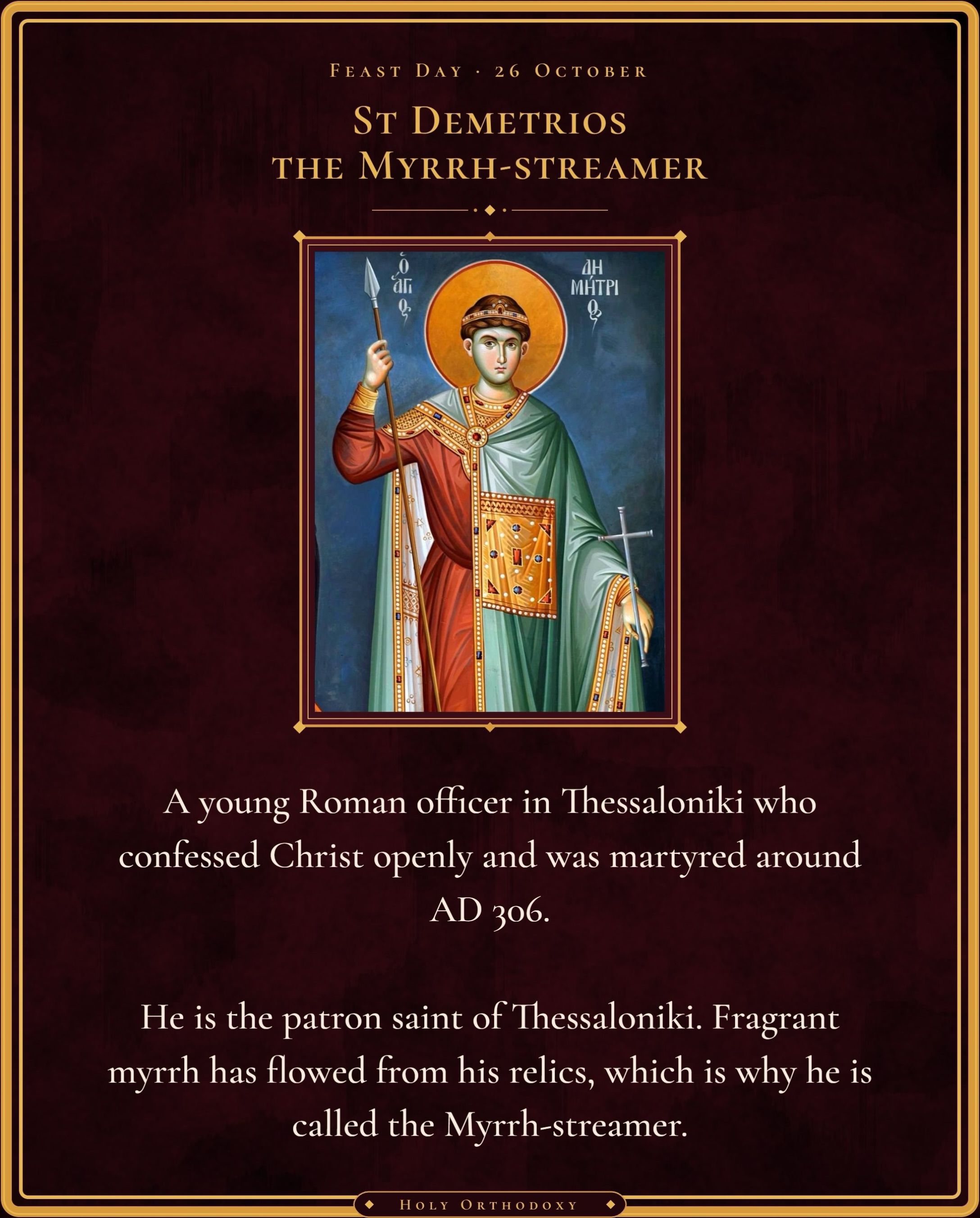
Feast of St Demetrios the Myrrh-streamer, 26 October

The post marks the feast of St Demetrios the Myrrh-streamer on 26 October. It recounts his life: born to a Christian family in Thessaloniki, he rose to high rank under Emperor Maximian, a persecutor of Christians. Demetrios taught Christ openly in the city, was arrested and imprisoned. From his cell he blessed Nestor, a young Christian who defeated the emperor's champion gladiator Lyaeus. In fury, Maximian ordered Demetrios put to death around…

The post marks the feast of St Demetrios the Myrrh-streamer on 26 October. It recounts his life: born to a Christian family in Thessaloniki, he rose to high rank under Emperor Maximian, a persecutor of Christians. Demetrios taught Christ openly in the city, was arrested and imprisoned.

From his cell he blessed Nestor, a young Christian who defeated the emperor's champion gladiator Lyaeus. In fury, Maximian ordered Demetrios put to death around AD 306; he was pierced with spears. Centuries later, fragrant myrrh began to flow from his tomb, earning him the title Myrrh-streamer.

He remains the beloved protector of Thessaloniki. The post concludes with a prayer to the saint and name-day greetings to those named Demetrios, Dimitris, Dimitra, and variants.

  • St Demetrios was a high-ranking officer in Thessaloniki who confessed Christ openly under Emperor Maximian.
  • He blessed Nestor, who defeated the gladiator Lyaeus, leading to Demetrios's martyrdom by spears around AD 306.
  • Fragrant myrrh later flowed from his relics, giving him the title Myrrh-streamer.
  • He is the patron saint and protector of Thessaloniki.
  • The post includes a prayer and name-day wishes for those bearing his name.
Read more
☦️An Orthodox Blog☦️ Instagram

Hymn to Saint Demetrios the Great Martyr

The hymn addresses Saint Demetrios as a great champion whom the world found in times of danger. It describes him as a trophy-bearer who routed the nations like a lion and cast down their arrogance in the stadium while encouraging Nestor. The faithful ask the holy Great Martyr Demetrios to entreat Christ God to grant great mercy.

Key moments

  1. The world found in Saint Demetrios a great champion in dangers.
  2. As a trophy-bearer, he routed the nations like a lion and cast down their arrogance in the stadium.
  3. He encouraged Nestor in the contest.
  4. The hymn asks Saint Demetrios to entreat Christ God to grant great mercy.
Read more

Saint Tikhon the Athonite on humility and the Jesus Prayer

Saint Tikhon the Athonite (1884-1968) was a Russian ascetic who lived on Mount Athos and became the spiritual father of Saint Paisios. He dedicated his life to humility, repentance, and unceasing prayer. The post presents four sayings attributed to him. He taught that three prostrations offered with humility are better than a thousand prostrations made with arrogance.

He declared that only humility will save us. He called the Jesus Prayer, "Lord Jesus Christ, have mercy upon me!", the pure wheat. He also urged death to the world.

  • Saint Tikhon the Athonite (1884-1968), Russian ascetic of Mount Athos
  • Spiritual father of Saint Paisios
  • Life centered on humility, repentance, and unceasing prayer
  • "Better three prostrations with humility than 1,000 prostrations with arrogance."
  • "The prayer, 'Lord Jesus Christ, have mercy upon me!' is the pure wheat."
Read more

Seeking the Kingdom First: True Good Beyond Material Success

The speaker explains that every person seeks what is good for his life, but without understanding what is truly good he brings harm to himself and others because he does not see how his actions serve real benefit. When a person understands the essence of life, he realizes true good both spiritually and materially by seeking first the Kingdom of God, and the Lord adds all other things. External goods such as wealth and career do not give peace or…

The speaker explains that every person seeks what is good for his life, but without understanding what is truly good he brings harm to himself and others because he does not see how his actions serve real benefit. When a person understands the essence of life, he realizes true good both spiritually and materially by seeking first the Kingdom of God, and the Lord adds all other things.

External goods such as wealth and career do not give peace or joy if the conscience is not in order; departing from the path of truth means material success brings nothing good. The teaching draws on the Gospel principle that seeking God's Kingdom first reorders all other pursuits. The speaker contrasts the pursuit of external goods with the inner state of a properly ordered conscience, noting that wealth and career advancement cannot produce genuine peace or joy when a person has strayed from the way of truth.

Material arrangements and professional achievements do not benefit someone who has left the path of true life; they bring nothing good. The message emphasizes that spiritual orientation determines whether material things become a blessing or remain empty.

Key moments

  1. 0:00 Every person seeks the good of his life, but without awareness of what is truly good he brings only harm to himself because he does not understand how his actions serve his own benefit, others, and society.
  2. 0:38 If a person understands the essence of life, he truly realizes himself and receives true good both spiritually and materially by seeking first the Kingdom of God.
  3. 0:38 The Lord adopts his good and adds everything else, but this is not connected to peace of soul that can come from abundance or wealth.
  4. 1:19 When a person pursues external goods, his conscience is not in order, and he has no peace or joy because those goods do not let him truly feel joy and peace in life.
  5. 1:49 When a person departs from the way of truth, he cannot walk the path of true life, and career or material arrangement does not benefit him, it brings nothing good.
Read more
Anthony’s Cell YouTube

Sacrifice: From Mosaic Ritual to Christ's Bloodless Offering

Sacrifice: From Mosaic Ritual to Christ's Bloodless Offering 4:28

The audio reading presents an article from the Orthodox Study Bible on the theology of sacrifice. The article explains the Old Testament sacrificial system instituted through Moses in Leviticus and Deuteronomy. Animal sacrifices, cattle, sheep, goats, and doves, and vegetable offerings, wheat, barley, olive oil, wine, cereal, and frankincense, were offered first at the Tabernacle and later at the temple. These offerings prefigured Christ's…

The audio reading presents an article from the Orthodox Study Bible on the theology of sacrifice. The article explains the Old Testament sacrificial system instituted through Moses in Leviticus and Deuteronomy. Animal sacrifices, cattle, sheep, goats, and doves, and vegetable offerings, wheat, barley, olive oil, wine, cereal, and frankincense, were offered first at the Tabernacle and later at the temple.

These offerings prefigured Christ's incarnation. Blood represented the life force and created identification between the sacrifice and the worshiper, pointing directly to Christ's redeeming blood. The Day of Atonement ceremony included animal sacrifices for sins and the placing of Israel's transgressions on a scapegoat driven into the wilderness, foreshadowing Christ's once-for-all self-sacrifice as high priest who takes all humanity's sins upon himself.

Christ's sacrifice supersedes the Mosaic system. The Divine Liturgy offers a bloodless sacrifice, the body and blood of Christ, in which worshipers participate substantially. The Church prays, "Thine own of thine own we offer unto thee on behalf of all and for all." In the Liturgy we offer the body and blood of Christ to God, participating in Christ's once-for-all sacrifice, uniting us to Christ in baptism and nurturing that union through the Eucharist.

The article notes that sacrifices never exempted the Hebrews from prayerful and moral living; the prophets condemned empty ritual and pointed to the self-offering described in Romans 12:1 and 1 Peter 2:5.

Key moments

  1. 0:33 The Lord commands Moses to institute a comprehensive system of ritual sacrifices in Leviticus and Deuteronomy 12-26 to reconcile the Hebrews with God and restore harmony disrupted by sin.
  2. 1:05 Sacrifices were of two types: animal (cattle, sheep, goats, doves) and vegetable (wheat, barley, olive oil, wine, cereal, frankincense), offered first at the Tabernacle and later the temple.
  3. 1:36 In Old Testament animal sacrifices, the blood represented the life force offered to God, with identification between the animal and the worshiper, prefiguring Christ's blood of the new covenant shed for remission of sins.
  4. 2:08 The Day of Atonement included animal sacrifices for sins and placing Israel's transgressions on the scapegoat driven into the wilderness, prefiguring Christ taking all humanity's sins and reconciling us to God.
  5. 2:38 Christ's once-for-all offering supersedes the Mosaic system; the Eucharistic service in the Divine Liturgy is a bloodless sacrifice offered in remembrance, understood as our sacrifice of praise and mercy of peace.
  6. 3:10 In the Divine Liturgy we offer the body and blood of Christ to God, participating in Christ's once-for-all sacrifice, uniting us to Christ in baptism and nurturing that union through the Eucharist.
  7. 3:43 The Church prays "Thine own of thine own we offer unto thee on behalf of all and for all."
  8. 4:15 Sacrifices never exempted the Hebrews from prayerful and moral living; prophets stood against empty ritual, and the system points to self-sacrificial service as in Romans 12:1 and 1 Peter 2:5.
Disgruntled Docs with TimothyNegrete Instagram discussion

God Loves Everyone, But Love Is Not Approval

The speaker addresses the question of whether God truly loves everyone, using the Amalekites as a test case. He argues that God loves all people without exception, but that love does not equal approval of their actions. Divine judgment, such as the punishment of the Amalekites, does not cancel God's love. The Bible presents God as both loving and just, and these attributes coexist without contradiction. The discussion turns on the distinction…

The speaker addresses the question of whether God truly loves everyone, using the Amalekites as a test case. He argues that God loves all people without exception, but that love does not equal approval of their actions. Divine judgment, such as the punishment of the Amalekites, does not cancel God's love.

The Bible presents God as both loving and just, and these attributes coexist without contradiction. The discussion turns on the distinction between love and approval, and the error of using God's judgment to deny his love or using his love to deny his judgment. The speaker notes that atheists often cite the Amalekites to challenge God's love, but punishment and love are not mutually exclusive.

He emphasizes that God's love does not give freedom to live in sin, and that neither attribute cancels the other.

Key moments

  1. God loves everyone, no exceptions.
  2. Just because God loves you doesn't mean he approves of everything you do; love isn't the same thing as approval.
  3. God's love doesn't mean we are free to live in sin.
  4. Atheists bring up the Amalekites, but just because God judges or punishes someone doesn't mean he doesn't love them.
  5. Punishment and love aren't mutually exclusive.
  6. The Bible teaches that God is both loving and just.
  7. You can't take God's judgment and pretend it disproves his love just like you can't take his love and pretend it eliminates his judgment.
3 opinions in the discussion He loves them, but telling someone that this behavior is sinful is NOT hate. God calls us to actively repent more than we ask for forgiveness. That's the main point. So it's still a sin. Read the discussion

Icon of the Theotokos at Dečani and a Child's Joy

The post presents an icon of the Mother of God, the patroness of Dečani Monastery. The icon was painted to revive a historical fresco of the Theotokos who, according to tradition, protected the monastery during difficult times from many temptations and attacks. The author shares the icon with joy and gratitude, describing a child's heart full of joy before the image. A hymn titled "Theotokos Rejoice" was composed for the occasion, matching the…

The post presents an icon of the Mother of God, the patroness of Dečani Monastery. The icon was painted to revive a historical fresco of the Theotokos who, according to tradition, protected the monastery during difficult times from many temptations and attacks. The author shares the icon with joy and gratitude, describing a child's heart full of joy before the image.

A hymn titled "Theotokos Rejoice" was composed for the occasion, matching the spirit of the scene and the joy it conveys. The post reflects on the gift of God's love as seen through a child's sincere love.

  • Icon of the Theotokos as protector of Dečani Monastery
  • Painted to revive a historical fresco
  • Tradition of the Theotokos guarding the monastery in hard times
  • A child's joy before the icon shared with gratitude
  • Accompanying hymn "Theotokos Rejoice" composed for the icon
Read more
George Instagram discussion

Layman adopts Athonite monastic rhythm at home this winter

The speaker describes a long-standing attraction to the monastic life of Mount Athos, where days are ordered around prayer, services, work, and simple living. Because he has a partner and a son, he cannot leave them to enter a monastery. Instead, he plans to follow that same rhythm in his own house during the coming winter, treating his home as a monastery. He intends to remove as many outside distractions as possible and center each day on his…

The speaker describes a long-standing attraction to the monastic life of Mount Athos, where days are ordered around prayer, services, work, and simple living. Because he has a partner and a son, he cannot leave them to enter a monastery. Instead, he plans to follow that same rhythm in his own house during the coming winter, treating his home as a monastery.

He intends to remove as many outside distractions as possible and center each day on his family and his connection with God. He acknowledges that this domestic practice is not the same as true monasticism but says he will share the experience with his audience. He also asks whether listeners have ever felt daily life pulling them away from God and sensed a need to draw closer to Him.

Key moments

  1. The monks of Mount Athos wake up in the middle of the night to pray, attend services and the liturgy, perform their diakonia, eat simply, pray again, and sleep early.
  2. The speaker has a family, a partner and a son, and cannot leave them to live on the Holy Mountain.
  3. He will try to live the monastic rhythm in his own home this winter, making his house his monastery.
  4. He wants to remove as many distractions from the outside world as possible.
  5. He wants to focus on what really matters: his home, his family, and his connection with God.
  6. He knows this is not the same as being a real monk.
  7. He will share with the audience how it goes.
  8. He asks if the audience has ever felt daily life pulling them away from God and needing to come closer to Him.
11 opinions in the discussion A monk lived in a cave. One day he asked God whether anyone lived a higher spiritual life than him. The Holy Spirit led him to a poor family (a couple with a few kids) at the edge of the… Read the discussion

Four spiritual maxims from the book "Jasika"

The post shares four numbered passages from the Serbian Orthodox book "Jasika". The first states that wherever the light of God is not bound in a stance, thought, word, or deed, there is darkness. The second says a soul that loves God does not trust itself but trusts Him. The third is a prayer: "Lord make me good! Let love be both my form and essence." The fourth declares that when one does not resemble God, one is nothing and walks no one's path.

  • Where God's light is absent in thought, word, or deed, there is darkness
  • A soul that loves God trusts Him, not itself
  • Prayer for goodness and for love to become one's form and essence
  • Without resemblance to God, a person is nothing and walks no path
Read more

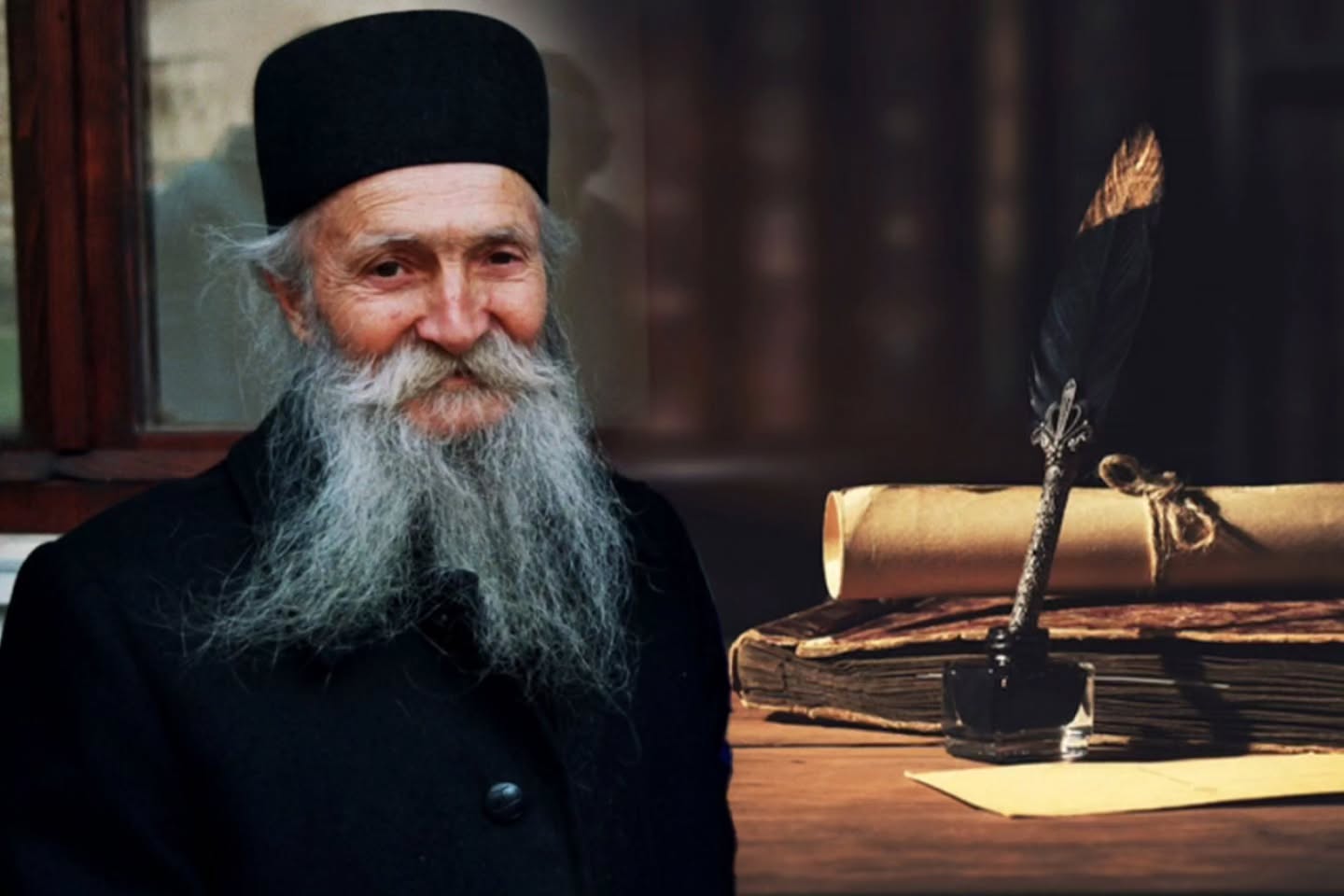
Father Tadej: Good Thoughts Heal Family Discord

Father Tadej teaches that human thought possesses great power for good or destruction. People are often unaware of the influence of their positive and negative thoughts. Family discord, quarrels, illnesses, and major misfortunes stem from the rusty thoughts of family members. The first and only condition for changing a corrupt family climate is a change of mind in its leading members. He urges consciously sending good thoughts, thoughts of love…

Father Tadej teaches that human thought possesses great power for good or destruction. People are often unaware of the influence of their positive and negative thoughts. Family discord, quarrels, illnesses, and major misfortunes stem from the rusty thoughts of family members.

The first and only condition for changing a corrupt family climate is a change of mind in its leading members. He urges consciously sending good thoughts, thoughts of love and good wishes, to those who hate, insult, or do not love you. Through personal example one can verify the power of good thoughts.

Sick and unruly children are so because of their parents and the discord between them. The same dynamic occurs in workplaces, factories, schools, and hospitals. He advises stopping evil thoughts about one's boss or colleague and turning them into good thoughts, which will change the behavior of those considered enemies.

If even one person in a family is devoted to God, everything in that family changes. That person acts as a catalyst: soothing embittered spirits and transforming disharmony into harmony. The measure of his divine grace determines his humble mission in the family.

  • Human thought has power to do good or destroy
  • Family discord and illness result from negative thoughts of members
  • Changing family climate requires leading members to change their thoughts
  • Sending good thoughts to enemies transforms relationships
  • One God-devoted person in a family acts as a catalyst for harmony
Read more