WeOrthodox
EN UA

Orthodox posts, videos and discussions

We follow Orthodox channels, communities and blogs across the web, summarise every post and video, and highlight the conversations with real substance.

Prayer Orthodoxy ® with Prayer Orthodoxy® Instagram

Your Eye Is the Lamp of Your Body: Guarding What Enters the Soul

The post reflects on Luke 11:34, where Christ says, "Your eye is the lamp of your body," and continues: "When your eye is sound, your whole body is full of light; but when it is not sound, your body is full of darkness. Therefore be careful lest the light in you be darkness. If then your whole body is full of light, having no part dark, it will be wholly bright, as when a lamp with its rays gives you light." The author draws out the verse's…

The post reflects on Luke 11:34, where Christ says, "Your eye is the lamp of your body," and continues: "When your eye is sound, your whole body is full of light; but when it is not sound, your body is full of darkness. Therefore be careful lest the light in you be darkness. If then your whole body is full of light, having no part dark, it will be wholly bright, as when a lamp with its rays gives you light."

The author draws out the verse's meaning for daily life: what we choose to see, what we allow into our hearts, and where we direct our attention all shape our spiritual lives. Christ calls us to guard our hearts, turn away from darkness, and seek the light of His truth. The post closes with a question for the reader: "What are you allowing to enter your soul?"

The same reflection is given in English and in Greek, quoting the verse from Luke 11:34 in both languages. The image text sets out the fuller passage from Luke, including the warning that the light in a person may itself be darkness, and the promise that a body full of light, with no part dark, will be wholly bright. There is no further discussion in the post; it stands as a short meditation on the Gospel verse and an invitation to examine what one permits into the soul through the eyes and the attention.

  • Christ's words in Luke 11:34: "Your eye is the lamp of your body."
  • When the eye is sound, the whole body is full of light; when it is not, the body is full of darkness.
  • The verse warns: "Be careful lest the light in you be darkness."
  • What we choose to see and where we direct our attention shape our spiritual lives.
  • The post asks readers: what are you allowing to enter your soul?
Read more
Treadwell YouTube

Priest asks whether Christ's call enters the ear or the heart

Priest asks whether Christ's call enters the ear or the heart 7:49

The priest asks whether the Lord's words "He who has ears, let him hear" reach the ear only or the heart, and whether we listen to change our lives or merely hear familiar words. He compares this to marriage: couples vow to love forever, but when difficulties come they stop listening to the heart, turn to the world and their own wants, things fall apart, and they blame each other instead of admitting their own unfaithfulness. He recounts an…

The priest asks whether the Lord's words "He who has ears, let him hear" reach the ear only or the heart, and whether we listen to change our lives or merely hear familiar words. He compares this to marriage: couples vow to love forever, but when difficulties come they stop listening to the heart, turn to the world and their own wants, things fall apart, and they blame each other instead of admitting their own unfaithfulness.

He recounts an artist who invited him to bless a first major exhibit on the Upper East Side about twenty years ago. At the exhibit the artist showed a massive paper piece the size of the church and identified it as a helicopter. In the next hall he became angry when workers hung a large arc upside down and backwards despite his instructions.

The workers said they had tried four ways and this was best, but the artist replied, "I don't care what you think. I did it. You didn't do it. You have it wrong. What I made is what it is, not what you want it to be." The priest applies the story: God made us and told us what He wants us to be, yet we insist on turning His design around to please ourselves and tell God to give us what we want instead of listening to Him.

We cannot change what God has made; we can only distort it in our own lives to our detriment, and we must ask for grace to plant God's word in the heart rather than letting it disappear or listening to our desires. This life is a moment and the next is eternity; we cannot take worldly things with us, and chasing money, politics, and culture leaves us empty, while the world gives only a grave.

Baptism promises eternal life and joy only if we follow Christ, not our greed, because He alone makes and keeps promises.

Key moments

  1. 0:00 The priest asks whether the Lord's call "He who has ears, let him hear" enters the ear or the heart, and whether we truly listen to change our lives or just hear familiar words.
  2. 0:31 He compares this to marriage: couples vow to love forever, but when difficulties come they stop listening to the heart, listen to the world and their own wants, things fall apart, and they blame each other instead of admitting their own unfaithfulness.
  3. 1:35 He tells of a parish artist who invited him to bless his first major exhibit on the Upper East Side about twenty years ago.
  4. 2:38 At the exhibit, the artist showed a massive paper piece the size of the church and identified it as a helicopter, then in the next hall became angry when workers hung a large arc upside down and backwards despite his instructions.
  5. 3:11 The workers said they had tried four ways and this was best, but the artist replied, "I don't care what you think. I did it. You didn't do it. You have it wrong. What I made is what it is, not what you want it to be."
  6. 3:43 The priest applies the story: God made us and told us what He wants us to be, yet we insist on turning His design around to please ourselves and tell God to give us what we want instead of listening to Him.
  7. 4:49 We cannot change what God has made; we can only distort it in our own lives to our detriment, and we must ask for grace to plant God's word in the heart rather than letting it disappear or listening to our desires.
  8. 5:52 This life is a moment and the next is eternity; we cannot take worldly things with us, and chasing money, politics, and culture leaves us empty, while the world gives only a grave, baptism promises eternal life and joy only if we follow Christ, not our greed, because He alone makes and keeps promises.

St. Paisios the Athonite: injustice brings down the wrath of God

The post quotes St. Paisios the Athonite on injustice. He calls injustice a great sin that brings down the wrath of God. Those who commit injustice, he says, heap fire upon their own heads, and calamities and afflictions come upon them. The quote is presented as a short teaching from the saint, tagged for Christian and Orthodox readers. There is no further discussion in the post; it passes on the saint's warning about the consequences of unjust dealing.

  • St. Paisios the Athonite calls injustice a great sin that brings down the wrath of God.
  • Those who commit injustice heap fire upon their own heads.
  • Calamities and afflictions come upon those who act unjustly.
CHRISTIANITY UNITED Instagram

The Holy Mystery of Marriage in the Orthodox Church

The post explains the Orthodox Christian understanding of marriage as a Holy Mystery rather than a simple exchange of vows. It describes the wedding ceremony's key elements: the blessing of rings, which symbolize commitment and faithfulness, and the crowning of the bride and groom. The crowns carry a dual meaning, they represent the dignity of marriage and the sacrificial love to which husband and wife are called. This love is defined by…

The post explains the Orthodox Christian understanding of marriage as a Holy Mystery rather than a simple exchange of vows. It describes the wedding ceremony's key elements: the blessing of rings, which symbolize commitment and faithfulness, and the crowning of the bride and groom. The crowns carry a dual meaning, they represent the dignity of marriage and the sacrificial love to which husband and wife are called.

This love is defined by patience in difficulty, forgiveness when mistakes occur, and faithfulness when feelings change. The crowns also point to martyrdom, not because marriage is miserable, but because genuine love requires setting aside selfishness for the other. The couple does not undertake this journey alone; Christ is invited to the center of their home, struggles, joys, and future.

Through prayer, forgiveness, the Holy Eucharist, and shared life in the Church, spouses help each other grow closer to God. The post cites Saint Paul's words from Ephesians 5:31: "And they two shall be one flesh." It concludes with a prayer for God's blessing on Orthodox marriages, strength for those struggling, and guidance for those preparing to enter this Mystery, noting that a marriage rooted in Christ is a shared journey toward the Kingdom of Heaven.

Key moments

  1. The speaker says: 'Trudna subita dola łuczi, otok da senir, tuczi łuczi.'
  2. The speaker continues: 'Tuczi i łuczi, i łuja i bełno, czacze namsada.'
  3. The speaker repeats: 'zapoi se bro, zapoi se bro.'
  4. The speaker concludes: 'jeda po czirne, a ty na mij straj, po czini sine.'
Read more

Saint Hilarion the Great: From Gaza to the Desert, Fleeing Human Praise

The post tells the life of Saint Hilarion the Great. He was born to pagan parents in Thabatha near Gaza in Palestine and was sent as a young man to Alexandria to study. There he came to faith in Jesus Christ and received Holy Baptism. Wanting to give his life to God, he went to the Egyptian desert and became a disciple of Saint Anthony the Great, learning prayer, fasting, and spiritual struggle. He then returned to Palestine and settled in the…

The post tells the life of Saint Hilarion the Great. He was born to pagan parents in Thabatha near Gaza in Palestine and was sent as a young man to Alexandria to study. There he came to faith in Jesus Christ and received Holy Baptism. Wanting to give his life to God, he went to the Egyptian desert and became a disciple of Saint Anthony the Great, learning prayer, fasting, and spiritual struggle.

He then returned to Palestine and settled in the wilderness near Gaza, living in solitude. Demons attacked him with frightening visions and temptations, and he overcame them through prayer and the sign of the Holy Cross. When his holiness became known, people gathered around him for spiritual guidance and healing, and the post describes him as what Saint Anthony was to Egypt, he became to Palestine.

Yet Hilarion feared human praise above all things. With tears he said: "Woe to me! I have received my reward on earth!" To avoid recognition he kept moving from place to place, seeking silence and communion with God. He traveled through Egypt, Sicily, and Dalmatia, and finally settled on Cyprus.

Around the year 372, at about eighty years of age, he died in peace. His disciple Hesychius later moved his wonderworking relics to the monastery Hilarion had founded in Palestine. The post closes with the thought that the greatest spiritual treasure is being known and loved by God rather than admired by the world, and that the holiest souls often seek only silence, humility, and the presence of Christ. It ends with a prayer: Holy Venerable Father Hilarion, pray to God for us.

  • Hilarion, born to pagan parents near Gaza, found Christ while studying in Alexandria and was baptized.
  • He became a disciple of Saint Anthony the Great in the Egyptian desert before returning to Palestine to live in solitude.
  • He defeated demonic visions and temptations through prayer and the sign of the Holy Cross.
  • Fearing human praise, he cried "Woe to me! I have received my reward on earth!" and kept fleeing from place to place.
  • He died on Cyprus around 372 at about eighty years of age; Hesychius later moved his relics to his monastery in Palestine.
Saint Wisdom Instagram

Saint John Climacus on Gossip and True Humility

Saint John Climacus teaches that when someone speaks badly of you, whether behind your back or to your face, you must not let their words turn your heart against them. The response is to continue loving them. He explains that true humility is not demonstrated simply by speaking lowly of yourself. Rather, it is proven when you are insulted by another person and still refuse to return hatred. This teaching addresses the common experience of being…

Saint John Climacus teaches that when someone speaks badly of you, whether behind your back or to your face, you must not let their words turn your heart against them. The response is to continue loving them. He explains that true humility is not demonstrated simply by speaking lowly of yourself. Rather, it is proven when you are insulted by another person and still refuse to return hatred.

This teaching addresses the common experience of being gossiped about or directly insulted, and it sets a high standard for Christian love and humility. The saint identifies the real test of humility not in self-deprecating words but in the reaction to mistreatment from others. The teaching is brief and direct, focusing on the interior disposition required when facing slander or insult.

Key moments

  1. When someone speaks badly about you behind your back or to your face, do not let their words turn your heart against them; continue to love them.
  2. True humility is shown not merely by speaking lowly of yourself, but by being insulted by another person and still refusing to return hatred.
Read more
Discover Orthodox Christianity Facebook

St. Gabriel and St. George Karslidis on the Divine Liturgy

The post reflects on the Divine Liturgy as the Divine Table prepared by Christ through the clergy by the grace of the Holy Spirit. It cites St. Gabriel of Georgia, who said that if one knew the greatness of the Liturgy's blessing, one would collect even the dust from the church floor to wash one's face with it. The author notes that angels attend the Liturgy, heaven and earth meet, and the saints participate. St. George Karslidis is quoted…

The post reflects on the Divine Liturgy as the Divine Table prepared by Christ through the clergy by the grace of the Holy Spirit. It cites St. Gabriel of Georgia, who said that if one knew the greatness of the Liturgy's blessing, one would collect even the dust from the church floor to wash one's face with it. The author notes that angels attend the Liturgy, heaven and earth meet, and the saints participate.

St. George Karslidis is quoted urging the faithful not to sit during the Liturgy, but to devote all their time in church to prayer, because the King has prepared Himself for our salvation. The post explains that we owe God our full body and mind, concentrated in prayer, so that we may be clothed in a wedding garment with heart, body, mind, and soul made "whiter than snow" (Psalm 50).

When the congregation approaches to partake of the Body and Blood of Christ, the author asks whether we should not stand in awe, fear of God, and love, keeping our attention fixed on prayer.

  • The Divine Liturgy is the Divine Table prepared by Christ through the clergy by the Holy Spirit's grace
  • St. Gabriel of Georgia: the blessing of the Liturgy is so great one would use church dust to wash one's face
  • Angels attend, heaven and earth meet, and the saints participate in the Liturgy
  • St. George Karslidis: do not sit; devote all time in church to prayer because the King is present for our salvation
  • We must give full body and mind to concentrated prayer, becoming "whiter than snow" (Psalm 50) as a wedding garment
Read more

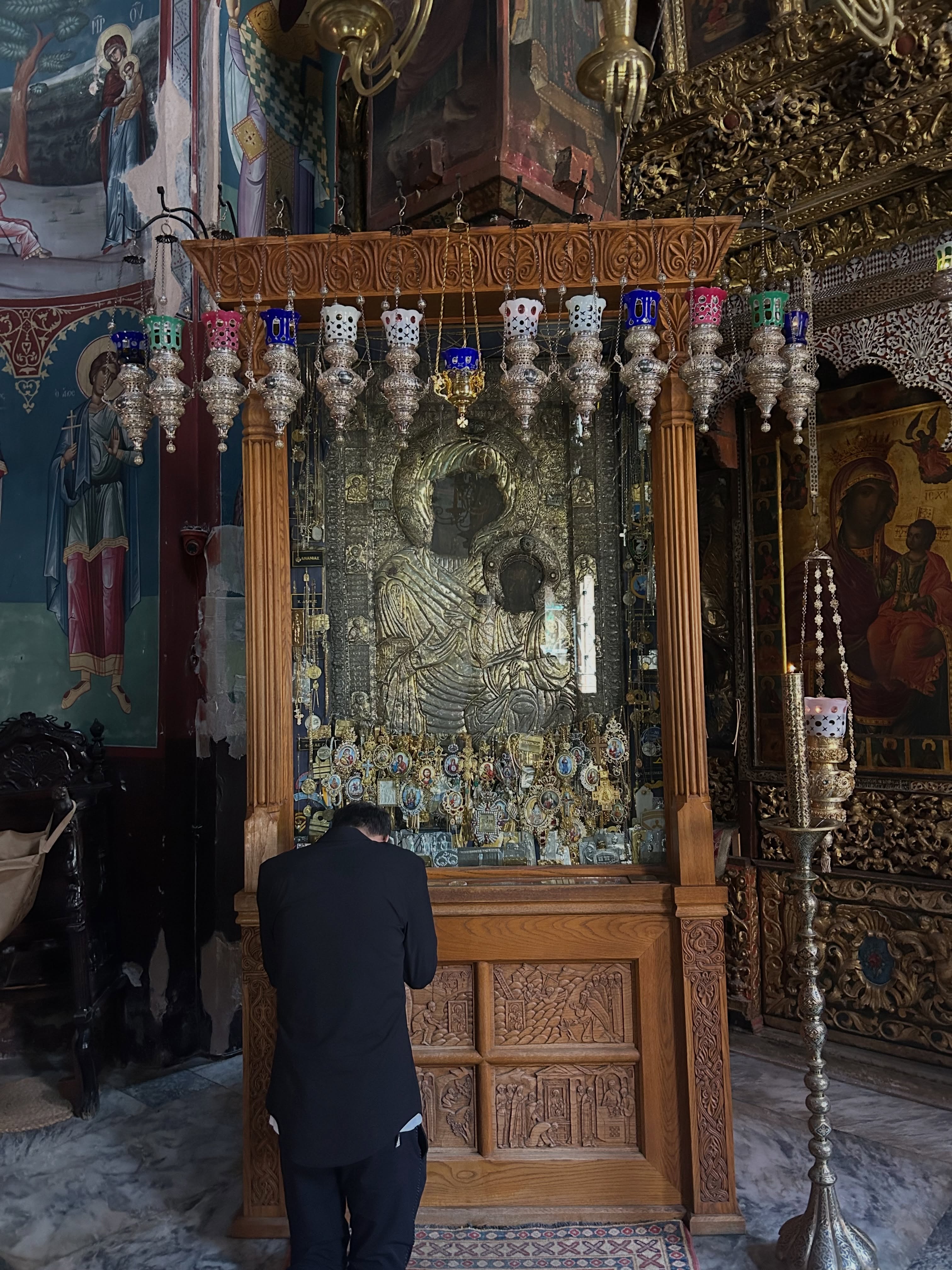
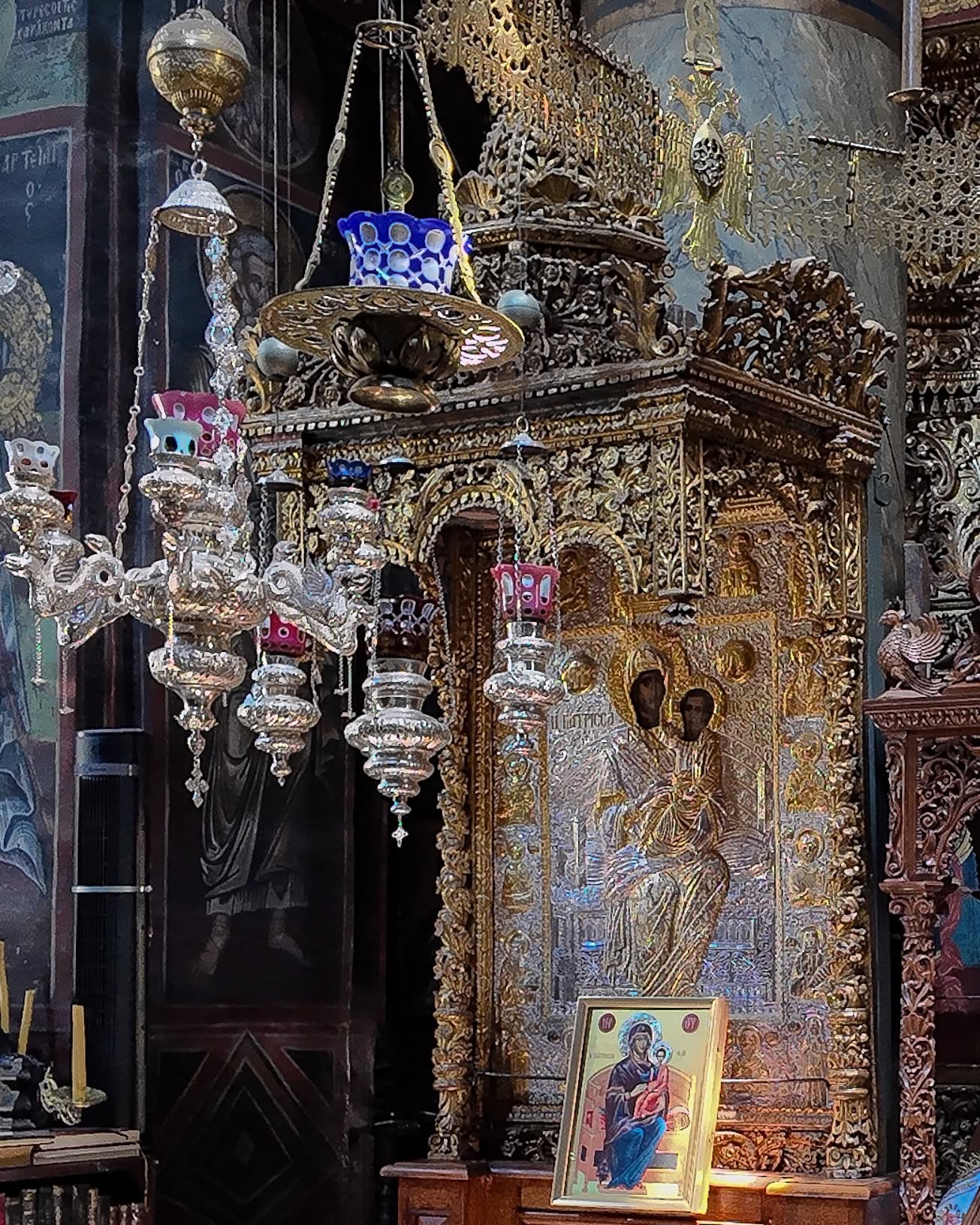
The Portaitissa icon of the Mother of God at Iviron Monastery

The post presents the icon of the Mother of God known as the Portaitissa, kept at the Holy Monastery of Iviron on Mount Athos. The text names the icon in Romanian and Greek, identifying it as the image of the Panagia Portaitissa from Iviron Monastery. The accompanying image shows the icon with the Mother of God holding Christ, with the usual Greek abbreviations marking the names of Jesus Christ and the Mother of God, and the title Hagios (Holy)…

The post presents the icon of the Mother of God known as the Portaitissa, kept at the Holy Monastery of Iviron on Mount Athos. The text names the icon in Romanian and Greek, identifying it as the image of the Panagia Portaitissa from Iviron Monastery. The accompanying image shows the icon with the Mother of God holding Christ, with the usual Greek abbreviations marking the names of Jesus Christ and the Mother of God, and the title Hagios (Holy) inscribed on the halos.

No further story, teaching or discussion accompanies the post; it stands as a presentation of this well-known wonderworking icon of the Athonite monastery, which is one of the most venerated images of the Mother of God in the Orthodox world.

  • The icon shown is the Portaitissa of the Mother of God at Iviron Monastery on Mount Athos.
  • The post names the icon in both Romanian and Greek.
  • The image shows the Mother of God with Christ Child and standard Greek inscriptions identifying them.
  • Iviron Monastery is the home of this venerated icon.
Read more
George Instagram discussion

The Eucharist: A Holy Mystery Beyond Explanation

The post explains why the Orthodox Church calls the Eucharist a holy mystery rather than a sacrament. It notes that most people assume that if they cannot explain how bread and wine become the Body and Blood of Christ, then it must be only a symbol. The Orthodox Church, however, does not call it a sacrament but a holy mystery. Christ Himself never explained how the transformation happens. In John 6, Jesus said, "Unless you eat the flesh of the…

The post explains why the Orthodox Church calls the Eucharist a holy mystery rather than a sacrament. It notes that most people assume that if they cannot explain how bread and wine become the Body and Blood of Christ, then it must be only a symbol. The Orthodox Church, however, does not call it a sacrament but a holy mystery.

Christ Himself never explained how the transformation happens. In John 6, Jesus said, "Unless you eat the flesh of the Son of Man and drink His blood, you have no life in you," and when asked how, He answered, "My flesh is food indeed and My blood is drink indeed." Many disciples walked away, but Peter replied, "Lord, to whom shall we go?

You have the words of eternal life"; he did not understand how, but he knew who was speaking. Christ instituted the Eucharist at the Last Supper, His last night with the disciples before the crucifixion, saying, "This is My body" and "This is My blood." The post observes that just as we cannot explain how a husband and wife become one or how the Holy Spirit dwells within us, the Eucharist remains a mystery.

It looks and tastes like bread and wine but is truly Christ's Body and Blood, and this should not surprise us given that God humbled Himself to be born in a cave, live as a poor carpenter, and die on a cross. The author adds that God became a piece of bread just to be with us, and asks whether the reader has ever struggled to believe this.

Key moments

  1. Most people think that if they cannot explain how bread and wine become the body and blood of Christ, then it must be only a symbol.
  2. The Orthodox Church does not call it a sacrament but a holy mystery.
  3. Christ himself never explained how the transformation happens.
  4. In John 6, Jesus said "unless you eat my flesh and drink my blood, you have no life in you," and when asked how, he answered "my flesh is food indeed and my blood is drink indeed."
  5. Many disciples walked away, but Peter replied "Lord, to whom shall we go? You have the words of eternal life", he did not understand how, but he knew who was speaking.
  6. Christ instituted the Eucharist at the Last Supper, his last night with the disciples before the crucifixion, saying "this is my body" and "this is my blood."
  7. We cannot explain how a husband and wife become one or how the Holy Spirit lives inside a person, yet these realities are true.
  8. The Eucharist looks like bread and tastes like wine but is truly Christ's body and blood, and this should not surprise us given that God humbled himself to be born in a cave, live as a poor carpenter, and be crucified.
8 opinions in the discussion Bravo George! Keep sharing… a saint once wrote that if we could see what's actually happening during the Divine Liturgy we would fall to the ground! Gurdjieff described it as a… Read the discussion
Lives of the Saints 🙏 Instagram

Saint Gerasimos of Kefalonia: Ascetic, Wonderworker, Founder of Monastery

Saint Gerasimos the New was born in 1509 in Trikala, in the Peloponnese region of Greece, into the distinguished Notaras family. Although he came from a noble background, his heart was drawn not toward earthly honor or wealth but toward Jesus Christ. Desiring a life of complete devotion to God, he traveled to Mount Athos, where he embraced the ascetic life of prayer, fasting, and spiritual struggle. Later, he journeyed to the Holy Land, where he…

Saint Gerasimos the New was born in 1509 in Trikala, in the Peloponnese region of Greece, into the distinguished Notaras family. Although he came from a noble background, his heart was drawn not toward earthly honor or wealth but toward Jesus Christ. Desiring a life of complete devotion to God, he traveled to Mount Athos, where he embraced the ascetic life of prayer, fasting, and spiritual struggle.

Later, he journeyed to the Holy Land, where he continued his spiritual labors and undertook a forty-day fast. Through these years of sacrifice and prayer, Saint Gerasimos grew in humility, patience, and love for God. Eventually, he settled on the Greek island of Kefalonia, where he founded a monastery for women dedicated to the spiritual life.

But God had given him more than the gift of guiding souls. Through his prayers, remarkable miracles took place. During times of drought, he prayed and rain fell upon the land. Those suffering from illnesses received healing, and God granted him the spiritual gift of foreseeing events yet to come.

People came to him seeking comfort, healing, and guidance, finding in this humble servant of Christ a source of hope. On August 15, 1579, Saint Gerasimos peacefully surrendered his soul to the Lord. Yet his miracles did not cease with his earthly departure. He continued to be honored as a wonderworker, with the faithful seeking his intercessions and giving glory to God.

An accompanying image bears the title in Greek and English: "Saint Gerasimos the New the Wonderworker of Kefalonia who healed the sick and brought rain through prayer" and the Greek phrase "ΤΕΚΝΙΑ ΡΗΓΕΤΕ ΚΑΙ ΜΗ ΤΑ ΥΨΗΛΑ ΤΑ ΦΡΟΝΕΙΤΕ".

  • Born 1509 in Trikala, Peloponnese, into the Notaras family.
  • Embraced ascetic life on Mount Athos and in the Holy Land, including a forty-day fast.
  • Founded a women's monastery on Kefalonia.
  • Known for miracles: bringing rain during drought, healing the sick, and foreseeing future events.
  • Died August 15, 1579; continues to be venerated as a wonderworker.
Read more
Holy Resurrection YouTube

St. Isaac the Syrian on the Endless Path of Divine Wisdom

St. Isaac the Syrian on the Endless Path of Divine Wisdom 6:35

The video presents teachings from St. Isaac the Syrian's Ascetical Homilies, Homily 21, on the nature and pursuit of divine wisdom. Wisdom is identified as God himself, and the path toward it has no end, ascending until it unites the seeker with God. The first step requires striving with all strength to follow God's wisdom until death, even to the point of laying down one's life. A person of true understanding recognizes that this life ends and…

The video presents teachings from St. Isaac the Syrian's Ascetical Homilies, Homily 21, on the nature and pursuit of divine wisdom. Wisdom is identified as God himself, and the path toward it has no end, ascending until it unites the seeker with God. The first step requires striving with all strength to follow God's wisdom until death, even to the point of laying down one's life.

A person of true understanding recognizes that this life ends and seeks to depart incorrupt, free from lust and sinful desire. Worldly knowledge without purity of soul is foolish because such hope remains confined to this world. True strength lies in courage amid afflictions, which conceal victory; one cannot draw near to God without affliction, and abandoning righteous works leaves a person defenseless.

Enlightenment means discerning the world's hidden bitterness, refusing its cup, and detaching from the world, which is described as a harlot that deceives and enslaves even those who try to escape, stripping a person at death. The divided heart must be denied as Christ commands. The teaching emphasizes that afflictions are not obstacles but the very means by which victory is hidden and the soul is prepared for union with God.

Purity of soul, not intellectual attainment, is the measure of true wisdom, and the world's allurements are revealed as bitter and enslaving to those who have received spiritual enlightenment.

Key moments

  1. 0:12 Wisdom is God himself; the path of wisdom has no end and ascends until it unites the follower with God.
  2. 0:42 The first path to wisdom is striving with all strength to follow God's wisdom until death, ready to lay down one's life.
  3. 1:14 A man of understanding knows this life ends and seeks to depart incorrupt, free from lust and sinful desire.
  4. 1:46 Worldly knowledge without soul purity is foolish; such a person's hope is confined to this world.
  5. 2:18 True strength is courage amid afflictions, which hide victory, not desiring the easy way of shame.
  6. 2:49 One cannot draw near to God without affliction; abandoning righteous works leaves one defenseless.
  7. 3:20 Enlightenment is discovering the world's hidden bitterness, refusing its cup, and detaching from the world.
  8. 3:50 The world is a harlot that deceives and enslaves even those who try to escape; it strips a man at death.
Prayer Orthodoxy ® with Prayer Orthodoxy® Instagram

St. John Chrysostom: Life, Preaching, and Enduring Liturgy

The post presents a concise biography of St. John Chrysostom, noting his birth in Antioch around 347 AD and his rise as one of the Church's greatest theologians and preachers. It lists his service as Archbishop of Constantinople, his defense of the poor, his condemnation of corruption, and his death in exile in 407 AD. It also notes that the Divine Liturgy bearing his name is celebrated throughout the Orthodox world. The same biographical points…

The post presents a concise biography of St. John Chrysostom, noting his birth in Antioch around 347 AD and his rise as one of the Church's greatest theologians and preachers. It lists his service as Archbishop of Constantinople, his defense of the poor, his condemnation of corruption, and his death in exile in 407 AD. It also notes that the Divine Liturgy bearing his name is celebrated throughout the Orthodox world.

The same biographical points are then repeated in Greek, providing a parallel text for Greek-speaking readers. Following the biography, the post offers three attributed sayings. The first urges believers to stretch forth their hands to the poor rather than to heaven, linking worship directly to almsgiving.

The second declares that nothing welds human life together like the love of husband and wife, affirming the spiritual weight of marriage. The third states that nothing attracts God to us so much as mercy, placing compassion at the center of the spiritual life. The selection of quotes reflects Chrysostom's consistent emphasis on practical charity, the sanctity of the family, and the primacy of mercy in Christian practice.

  • Born in Antioch around 347 AD; recognized as a leading theologian and preacher.
  • Served as Archbishop of Constantinople, defended the poor, and denounced corruption.
  • Died in exile in 407 AD; the Divine Liturgy bearing his name is celebrated worldwide.
  • The post provides a Greek translation of the biography.
  • Three attributed sayings address charity toward the poor, the bond of marriage, and the power of mercy.
Read more

Jesus Calls Sinners to Repentance in Luke 5:27-32

The speaker introduces the passage by stating that Jesus came to save sinners, not those who think they are perfect, and then reads Luke 5:27-32. The passage describes Jesus seeing Levi at the tax office and saying "Follow me"; Levi leaves all, rises, and follows him; Levi gives a great feast with many tax collectors; Pharisees complain to the disciples; Jesus replies that the well have no need of a physician but the sick do, and he came to call…

The speaker introduces the passage by stating that Jesus came to save sinners, not those who think they are perfect, and then reads Luke 5:27-32. The passage describes Jesus seeing Levi at the tax office and saying "Follow me"; Levi leaves all, rises, and follows him; Levi gives a great feast with many tax collectors; Pharisees complain to the disciples; Jesus replies that the well have no need of a physician but the sick do, and he came to call sinners to repentance.

The speaker draws three lessons. First, Christ calls people regardless of their past sins; Matthew was a despised tax collector, yet Christ saw beyond his sins and called him, showing that one's past does not disqualify a person from God's mercy. Second, following Christ requires decisive action; Matthew left everything, got up, and followed, demonstrating that true repentance requires action, not just words, and involves turning away from sin and turning to Christ.

Third, Christ is the Great Physician and the Church is a spiritual hospital where he heals through grace, calling sinners to repentance, healing, and transformation rather than leaving them comfortable in their sins. The conclusion emphasizes that no one is too far gone for God's mercy, the door to repentance remains open no matter how far one has fallen, and each person must decide whether to leave behind what separates them from Christ and follow him.

Key moments

  1. 0:00 The speaker introduces the passage: Jesus came to save sinners, not those who think they are perfect, and reads from Luke 5 about Levi the tax collector.
  2. 0:34 The speaker reads Luke 5:27-32: Jesus sees Levi at the tax office and says "Follow me"; Levi leaves all, rises, and follows him; Levi gives a great feast with many tax collectors; Pharisees complain to the disciples; Jesus replies that the well have no need of a physician but the sick do, and he came to call sinners to repentance.
  3. 1:04 First lesson: Christ calls us regardless of our past; Matthew was a despised tax collector, yet Christ saw beyond his sins and called him.
  4. 1:04 Second lesson: Following Christ requires action; Matthew left everything, got up, and followed; repentance is not just feeling sorry but turning away from sin and turning to Christ.
  5. 1:34 Third lesson: Christ is the great physician; the church is a spiritual hospital where Christ heals through grace; Christ calls us to repentance, healing, and transformation, not to remain in sin.
  6. 2:06 Conclusion: No one is too far gone for God's mercy; we must be willing to leave behind whatever separates us from Christ; Christ is calling, the question is whether we will get up and follow.
Read more

Why is Kaleb/Elesbaan venerated as a saint despite monophysitism?

I am an inquirer into Eastern Orthodoxy after leaving Protestantism, and I am still learning. I am torn between Catholicism and Orthodoxy, though I am leaning more toward Orthodoxy. I personally reject monophysitism, and I am curious why Kaleb is venerated as a saint when Eastern Orthodoxy also rejects that teaching. I would appreciate an answer, as it would help me on my journey.

17 opinions in the discussion The split over Chalcedon wasn't sudden. For a few hundred years it stayed an argument inside the Church. That's why St. Elesbaan is a saint for us and St. Theodora is a saint for the… Read the discussion

Archbishop Makarios Names St Paisios Patron of Australia, Consecrates First Church

On 12 July 2024, the feast day of Saint Paisios the Athonite, Archbishop Makarios of Australia declared the saint patron, guardian and protector of the Greek Orthodox Archdiocese of Australia. The announcement was made during the consecration of the first church on the continent dedicated to Saint Paisios, located at the Holy Monastery of Saint John in Forrestfield, Perth, Western Australia. Hierarchs, clergy and faithful attended the historic…

On 12 July 2024, the feast day of Saint Paisios the Athonite, Archbishop Makarios of Australia declared the saint patron, guardian and protector of the Greek Orthodox Archdiocese of Australia. The announcement was made during the consecration of the first church on the continent dedicated to Saint Paisios, located at the Holy Monastery of Saint John in Forrestfield, Perth, Western Australia.

Hierarchs, clergy and faithful attended the historic service. The archbishop stated that the saint's apolytikion will be chanted at every Divine Liturgy after the apolytikion of the church. The decision recalls the saint's 1977 visit to Australia at the invitation of Archbishop Stylianos, who held Paisios in high regard for his spirituality and visited him often on Mount Athos.

During that visit Paisios expressed interest in becoming a monk in Australia and suggested a monastery be built between Sydney and Canberra, a proposal that led Archbishop Stylianos to establish monasticism in Australia. Paisios also said he felt Australia had not yet been sanctified by the blood of martyrs and holy labourers but that it would be.

The post includes an icon of the saint with a kangaroo and photographs from the consecration.

  • Archbishop Makarios proclaimed Saint Paisios patron saint of the Archdiocese of Australia on 12 July 2024.
  • The first Australian church dedicated to Saint Paisios was consecrated at the Holy Monastery of Saint John in Forrestfield, Perth.
  • Saint Paisios visited Australia in 1977 at the invitation of Archbishop Stylianos, with whom he shared a spiritual friendship.
  • Paisios suggested a monastery between Sydney and Canberra, prompting Archbishop Stylianos to establish monasticism in Australia.
  • Paisios prophesied that Australia would be sanctified by the blood of martyrs and holy labourers.
Read more
Fr.TEDTalks Instagram

Suffering Twice Over Events That May Never Come

The post addresses the habit of suffering over future events that have not yet occurred. The author writes that people imagine conversations, anticipate failures, and worry about disasters that may never materialize, experiencing their emotional weight as if they were already real. When the feared event never arrives, the person has already suffered for nothing; if it does arrive, the person has suffered twice, once in anticipation and once in reality. The reflection connects this pattern to anxiety and the need for trust in God.

Key moments

  1. We suffer today because of something that might happen tomorrow, experiencing the emotional consequences of imagined events as though they were already real.
  2. Often the thing we feared never happens, yet we have already suffered for the thing that never happened.
  3. If the feared event does happen, we have suffered twice, once in anticipation and once in reality.
Read more
Prayer Orthodoxy ® with Jamey Bennett Instagram

Repentance Is the Normal Path, Not a Backup Plan

The author states that Christ did not come primarily for people who had already nailed the ideal from age twelve; he came for sinners, the sick, the latecomers, and those who wasted years and are only now turning around. Repentance is not plan B; it is the normal path of holiness for most. What matters now is not whether one's life story matches the beautiful outline in books, but whether one is repenting today, staying inside the church, and…

The author states that Christ did not come primarily for people who had already nailed the ideal from age twelve; he came for sinners, the sick, the latecomers, and those who wasted years and are only now turning around. Repentance is not plan B; it is the normal path of holiness for most. What matters now is not whether one's life story matches the beautiful outline in books, but whether one is repenting today, staying inside the church, and letting Christ and his body work on the actual untidy life one has.

The author notes that one's path may not photograph well for an Instagram feed of Orthodox family life; it may be a slow, quiet repentance rather than a dramatic conversion arc. That is not second-class orthodoxy; it is the normal Christian life for more people than one may realize. The post was shared on Instagram with a link to a full piece on SimplyOrthodox.info, highlighting the contrast between polished social media portrayals and the reality of gradual repentance.

Key moments

  1. Christ did not come primarily for the people who had already nailed the ideal from age 12; he came for sinners, the sick, the latecomers, the ones who wasted years and are only now turning around.
  2. Repentance isn't plan B; it is the normal path of holiness for most of us.
  3. What matters now is not whether your life story matches the beautiful outline in the books, but whether you are repenting today, staying inside the church, and letting Christ and his body work on the actual untidy life you have.
  4. Your path may not photograph well for an Instagram feed of Orthodox family life; it may be a slow, quiet repentance rather than a dramatic conversion arc.
  5. That is not second-class orthodoxy; that is the normal Christian life for more of us than you may realize.
Read more

What do Orthodox believe happens to babies who die before Baptism?

I have lost four babies, three early miscarriages and one stillborn. We have named all of them and ask for their intercession constantly. But I feel tremendous guilt that my body failed them. And when people tell me "I'll pray for them," it makes me feel like they didn't go to heaven.

My children never sinned; they didn't choose to die before baptism. Am I being scrupulous? Is there a teaching that these children go to heaven? I just can't imagine God wouldn't immediately take them in.

  • Lost four babies (three miscarriages, one stillborn) and named them all
  • Asks for their intercession but feels guilt over body failing them
  • Distressed when people say "I'll pray for them", implies they didn't go to heaven
  • Notes children never sinned and didn't choose to die unbaptized
  • Asks if scrupulous and whether Orthodox teaching says they go to heaven
24 opinions in the discussion God is love. He said let the little children come to me, and that unless you become like a little child you cannot enter the kingdom of heaven. I hope that paints a picture of God's… Read the discussion
Disgruntled Docs with Prayer Orthodoxy ® Instagram

What Separates Eastern Orthodoxy, Catholicism, Protestantism, and Oriental Orthodoxy?

The post presents the first episode of "Understanding Orthodoxy," an educational series from Prayer Orthodoxy. It outlines the historical and theological differences among Eastern Orthodoxy, Roman Catholicism, Protestantism, and Oriental Orthodoxy. All four traditions trace their origins to Jesus Christ and the apostles, confess the Trinity, and accept the authority of Scripture, but their biblical canons differ: Protestants generally use 66…

The post presents the first episode of "Understanding Orthodoxy," an educational series from Prayer Orthodoxy. It outlines the historical and theological differences among Eastern Orthodoxy, Roman Catholicism, Protestantism, and Oriental Orthodoxy. All four traditions trace their origins to Jesus Christ and the apostles, confess the Trinity, and accept the authority of Scripture, but their biblical canons differ: Protestants generally use 66 books, Roman Catholics 73 including the Deuterocanon, Eastern Orthodox a broader Old Testament based on the Septuagint, and Oriental Orthodox canons vary, with the Ethiopian Orthodox Tewahedo Church recognizing 81 books.

Eastern Orthodoxy understands itself as preserving the fullness of apostolic faith and Tradition through conciliar governance, with the Ecumenical Patriarch as first among equals, and centers worship on the Divine Liturgy and theosis. Roman Catholicism shares the first millennium heritage but teaches papal universal jurisdiction and infallibility, the Filioque clause, purgatory, and the Immaculate Conception, which Orthodoxy views as lacking early consensus.

Protestantism began with the 16th-century Reformation, emphasizing sola Scriptura and justification by faith, though traditions vary widely in sacramental theology and governance. Oriental Orthodoxy comprises six ancient church families that rejected the Council of Chalcedon in 451, following St. Cyril's miaphysite formula of one incarnate nature; modern dialogues have found substantial Christological agreement, but full communion has not been restored.

The episode concludes that Eastern Orthodoxy sees itself as the continuous historical and spiritual expression of the One, Holy, Catholic, and Apostolic Church.

  • All four traditions share apostolic roots and Trinitarian faith but differ in biblical canon, authority, and governance.
  • Eastern Orthodoxy emphasizes conciliar governance, theosis, and preservation of apostolic Tradition without universal papal jurisdiction.
  • Roman Catholicism teaches papal supremacy, infallibility, and doctrines like Filioque, purgatory, and the Immaculate Conception.
  • Protestantism originates from the 16th-century Reformation, emphasizing sola Scriptura and justification by faith, with diverse sacramental views.
  • Oriental Orthodoxy rejects Chalcedon, follows miaphysite Christology, and modern dialogues show substantial agreement but communion remains unresolved.
Read more

Why Orthodox Christians Venerate the Theotokos

The post explains why the Panagia, the Most Holy Theotokos, holds a central place in Orthodox Christian devotion. Through her humility, obedience, and unwavering faith, she became the Mother of Jesus Christ, the Lord and Savior. Orthodox Christians honor her as the Mother of God, seek her prayers and intercessions, and turn to her as a loving mother who continually directs them toward her Son. The Greek text repeats these themes: the Theotokos…

The post explains why the Panagia, the Most Holy Theotokos, holds a central place in Orthodox Christian devotion. Through her humility, obedience, and unwavering faith, she became the Mother of Jesus Christ, the Lord and Savior. Orthodox Christians honor her as the Mother of God, seek her prayers and intercessions, and turn to her as a loving mother who continually directs them toward her Son.

The Greek text repeats these themes: the Theotokos occupies a unique place in every Orthodox heart, and through her virtues she was deemed worthy to become the Mother of the Lord. The faithful venerate her as Theotokos, ask for her intercessions, and take refuge in her maternal protection, knowing she always leads them to her Son.

The post concludes with the traditional invocation "Hyperagia Theotoke, soson imas" (Most Holy Theotokos, save us). An image accompanying the post shows icon inscriptions referring to the Mother of God the Faithful and similar liturgical titles. The post is attributed to Prayer Orthodoxy.

  • The Theotokos is central to Orthodox devotion due to her humility, obedience, and faith
  • She is honored as Mother of God who became worthy through her virtues
  • Orthodox Christians seek her prayers and intercessions
  • She is viewed as a loving mother who always points to Christ
  • The post includes the traditional prayer "Most Holy Theotokos, save us"
Read more