WeOrthodox
EN UA

St Anthony’s Youth SA ☦︎

Instagram ↗ 37 discussions

☦︎ Youth of St Anthony’s ☦︎ ☦︎ Greek Orthodox Church ☦︎ ☦︎ Prospect, South Australia ☦︎

Four rules for living as preparation for eternity

The post presents four practical guidelines framed by the principle that present life prepares for the next. The first rule advises against going to places where one would not want to die. The second warns against speaking words one would not want as one's last.

The third cautions against wearing clothes in which one cannot pray. The fourth states the governing principle: because current life is preparation for the next, it must be used wisely. The text appears as a numbered list with no attribution to a specific saint or source.

  • Avoid places where you would not want to die
  • Do not speak words you would not want as your last
  • Do not wear clothes in which you cannot pray
  • Present life is preparation for the next life
  • Use present life wisely
St Anthony’s Youth SA ☦︎ with Dylan☦️ Instagram

Saint Porphyrios on Paradise on earth through love and grace

The post shares a quotation from Saint Porphyrios of Kavsokalyvia, a twentieth-century Greek elder canonized in 2013. The saint identifies four realities, love, the worship of God, longing for God, and union with God, and calls them Paradise on earth. He then states that when a person acquires the grace of God, everything becomes light and joyful, and everything is the blessing of God. The text presents these statements without additional commentary or discussion.

  • Love, worship, longing for God, and union with God are Paradise on earth
  • Acquiring the grace of God makes everything light and joyful
  • With grace, everything becomes the blessing of God
Read more

God became man so that man might become god by grace

The post presents the Orthodox teaching on theosis, the process by which humans participate in divine life through grace. The author explains that the Son of God assumed human nature without ceasing to be God, entering fallen humanity to heal and restore it through His death and resurrection. Christ did not come merely to forgive from a distance but to heal human nature and reunite humanity with God. What was separated through sin is reconciled…

The post presents the Orthodox teaching on theosis, the process by which humans participate in divine life through grace. The author explains that the Son of God assumed human nature without ceasing to be God, entering fallen humanity to heal and restore it through His death and resurrection. Christ did not come merely to forgive from a distance but to heal human nature and reunite humanity with God.

What was separated through sin is reconciled in Christ; what was wounded is healed; what was enslaved to death is brought into eternal life. The means of this union are Baptism, the Eucharist, repentance, prayer, and the life of the Holy Spirit. The author cites 2 Peter 1:4 on becoming "partakers of the divine nature" and clarifies that theosis does not mean becoming God by essence, God alone is God by nature, but by grace we share in His life and become conformed to Christ.

Salvation is not simply escaping punishment but healing, restoration, union with God, and eternal life in Christ.

The accompanying video summary argues for the necessity of Christ's full divinity. If the Son of God were a creature rather than truly God, humanity would remain mortal and never achieve true union with God. A creature cannot unite other creatures to God because it would itself require union with God, and no part of creation can save creation since it would itself need salvation.

Therefore, God sends His own Son, and the Son of God becomes the Son of man by taking created flesh. Since all were under the sentence of death, He, being distinct from all, offered His own body to death on behalf of all. The discussion turns on the theological logic that only the uncreated Word can mediate between Creator and creation, and that the Incarnation is the necessary means by which mortal humanity is joined to immortal life.

Key moments

  1. If the Son of God were a creature and not truly God, man would have remained mortal, never truly being united to God.
  2. A mere creature could not unite other creatures to God, since it would itself need to be united to him.
  3. Nor could one part of creation be the salvation of creation, for it would itself have needed salvation.
  4. Therefore, God sends his own son, and the son of God becomes the son of man, taking created flesh.
  5. Since all were under the sentence of death, he, being other than them all, offered his own body to death on behalf of all.
Read more

St. Gabriel of Georgia on Humility and the Cross

The post presents two sayings attributed to St. Gabriel of Georgia. The first states that the more a person humbles himself, the more God reveals Himself to that person, and that this is the mystery of the saints. The second recounts a question asked to the saint about which cross is better to wear.

He answered that the best cross is the one received at baptism, but if that is not available, it is better to wear a cross depicting the Crucified Christ. The post offers these teachings without additional commentary or discussion.

  • Humility leads to greater divine revelation.
  • The mystery of the saints is found in humility.
  • The best cross to wear is the baptismal cross.
  • If the baptismal cross is absent, a cross with the Crucified Christ is preferable.
Read more

Archbishop Makarios Names St Paisios Patron of Australia, Consecrates First Church

On 12 July 2024, the feast day of Saint Paisios the Athonite, Archbishop Makarios of Australia declared the saint patron, guardian and protector of the Greek Orthodox Archdiocese of Australia. The announcement was made during the consecration of the first church on the continent dedicated to Saint Paisios, located at the Holy Monastery of Saint John in Forrestfield, Perth, Western Australia. Hierarchs, clergy and faithful attended the historic…

On 12 July 2024, the feast day of Saint Paisios the Athonite, Archbishop Makarios of Australia declared the saint patron, guardian and protector of the Greek Orthodox Archdiocese of Australia. The announcement was made during the consecration of the first church on the continent dedicated to Saint Paisios, located at the Holy Monastery of Saint John in Forrestfield, Perth, Western Australia.

Hierarchs, clergy and faithful attended the historic service. The archbishop stated that the saint's apolytikion will be chanted at every Divine Liturgy after the apolytikion of the church. The decision recalls the saint's 1977 visit to Australia at the invitation of Archbishop Stylianos, who held Paisios in high regard for his spirituality and visited him often on Mount Athos.

During that visit Paisios expressed interest in becoming a monk in Australia and suggested a monastery be built between Sydney and Canberra, a proposal that led Archbishop Stylianos to establish monasticism in Australia. Paisios also said he felt Australia had not yet been sanctified by the blood of martyrs and holy labourers but that it would be.

The post includes an icon of the saint with a kangaroo and photographs from the consecration.

  • Archbishop Makarios proclaimed Saint Paisios patron saint of the Archdiocese of Australia on 12 July 2024.
  • The first Australian church dedicated to Saint Paisios was consecrated at the Holy Monastery of Saint John in Forrestfield, Perth.
  • Saint Paisios visited Australia in 1977 at the invitation of Archbishop Stylianos, with whom he shared a spiritual friendship.
  • Paisios suggested a monastery between Sydney and Canberra, prompting Archbishop Stylianos to establish monasticism in Australia.
  • Paisios prophesied that Australia would be sanctified by the blood of martyrs and holy labourers.
Read more

St. Gabriel of Georgia: Feast Day and Selected Sayings

The post marks the November 2 feast of St. Gabriel (Urgebadze), a 20th-century Georgian confessor and fool-for-Christ glorified by the Georgian Orthodox Church in 2012. His relics are venerated at Samtavro Monastery in Mtskheta. The text collects twenty sayings attributed to him. Themes include personal repentance over judging others; warnings about end-times deception, especially the expectation of salvation from space or aliens identified as…

The post marks the November 2 feast of St. Gabriel (Urgebadze), a 20th-century Georgian confessor and fool-for-Christ glorified by the Georgian Orthodox Church in 2012. His relics are venerated at Samtavro Monastery in Mtskheta. The text collects twenty sayings attributed to him. Themes include personal repentance over judging others; warnings about end-times deception, especially the expectation of salvation from space or aliens identified as demons; the distinction between faith in the heart versus faith in the mind; ecumenism described as a super heresy; the necessity of prayer compared to an eagle's wings; compassion and prayer for neighbors; nightly self-examination; the proper frequency of Holy Unction; God's wrath toward abortion; hope in God's providence; hell as estrangement from God; perseverance when evil becomes law; and reverence for the grace of the Divine Liturgy.

The quotations are presented without commentary or specific source references beyond the saint's name.

  • Feast day of St. Gabriel of Georgia (Urgebadze), glorified in 2012
  • Sayings on repentance, judgment, and self-examination
  • Warnings about Antichrist-era deception involving false salvation from space
  • Teachings on prayer, compassion, Holy Unction, and abortion
  • Exhortations to persevere in faith amid world collapse
Read more

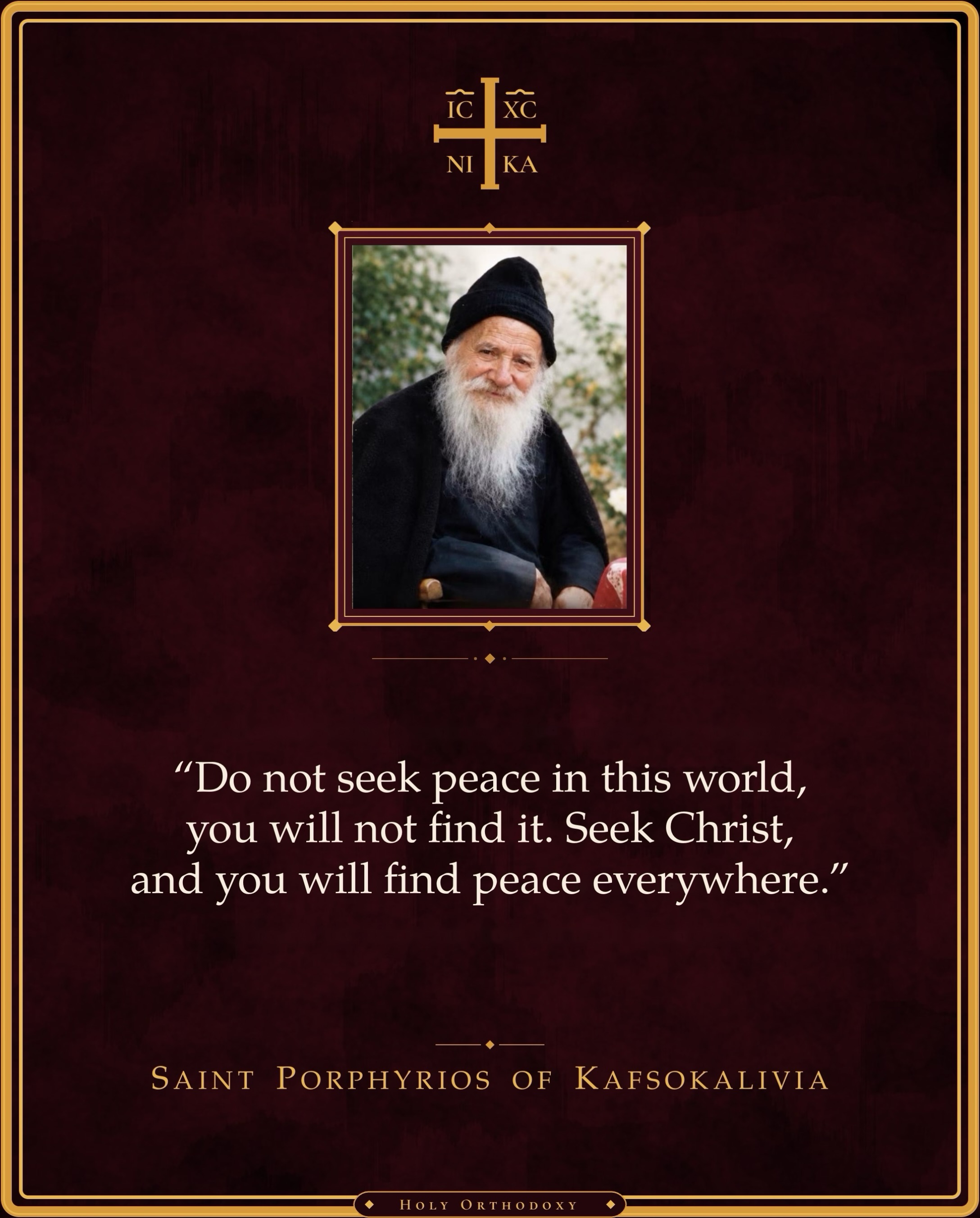
Saint Porphyrios: Peace Comes Only Through Christ

The post introduces Saint Porphyrios of Kavsokalyvia (1906-1991), a Greek Orthodox monk and elder known for his life of prayer, humility, and service. It shares his statement that peace cannot be found in worldly things but only in Christ, and that by turning one's heart to Christ, peace is found even amid life's struggles. The post ends with a request for the saint's intercession.

  • Saint Porphyrios of Kavsokalyvia lived from 1906 to 1991 as a monk and elder on Mount Athos.
  • He taught that true peace is not found in the world but only in Christ.
  • The quote "Do not seek peace in this world, you will not find it. Seek Christ, and you will find peace everywhere" is attributed to him.
  • The post asks for his prayers.
Read more

Elder Aimilianos: Prayer brings steadfastness in poverty, wealth, praise, and slander

Elder Aimilianos of Simonopetra teaches that a person who resolves to pray becomes resilient to life's difficulties and trials. Such a person knows how to be comfortable in any circumstance, whether in poverty or wealth, among the good or the bad, among those who love him or those who hate and slander him. The more he prays, the more resilient he becomes, until he no longer feels the hardships he endures. The audio comes from the Holy Resurrection of Christ Serbian Orthodox Church channel.

Key moments

  1. A person who resolves to pray becomes resilient to life's difficulties and trials, knowing how to be comfortable in any circumstance.
  2. The more he prays, the more resilient he becomes, reaching a point where he no longer feels the hardships he endures.
Read more

A convert's return home through baptism

The author shares a personal testimony of conversion and baptism in the Orthodox Church. The post opens with a rhetorical question drawing on the parable of the Prodigal Son: whether the Father waits no matter how far one has wandered. The author quotes Luke 15:24, where the father declares his lost son dead and alive again, lost and found. A second quotation from Romans 6:4 connects baptism to burial with Christ and rising to newness of life.…

The author shares a personal testimony of conversion and baptism in the Orthodox Church. The post opens with a rhetorical question drawing on the parable of the Prodigal Son: whether the Father waits no matter how far one has wandered. The author quotes Luke 15:24, where the father declares his lost son dead and alive again, lost and found.

A second quotation from Romans 6:4 connects baptism to burial with Christ and rising to newness of life. The author then states personally: after all this searching, I am finally home, and gives glory to God.

  • Personal testimony of conversion and baptism
  • References the Prodigal Son parable (Luke 15:24)
  • Connects baptism to death and resurrection (Romans 6:4)
  • Expresses finding spiritual home after searching
  • Gives glory to God for the journey

Orthodox perspective on Halloween: light versus darkness

The post contrasts Halloween's themes of darkness, death, fear, demons, ghosts, and witchcraft with the Christian movement from darkness to light. It cites Ephesians 5:8, where Paul writes that believers were once darkness but are now light in the Lord, and John 8:12, where Christ calls himself the light of the world. The author notes that the Orthodox Church celebrates the Sunday of All Saints on the first Sunday after Pentecost, presenting the…

The post contrasts Halloween's themes of darkness, death, fear, demons, ghosts, and witchcraft with the Christian movement from darkness to light. It cites Ephesians 5:8, where Paul writes that believers were once darkness but are now light in the Lord, and John 8:12, where Christ calls himself the light of the world. The author notes that the Orthodox Church celebrates the Sunday of All Saints on the first Sunday after Pentecost, presenting the saints as the fruit of the Holy Spirit poured out on the Church.

In the West, the feast of All Saints came to be fixed on November 1 from the eighth and ninth centuries, making October 31 its eve, All Hallows' Eve, later Halloween. Saint John Chrysostom is quoted warning Christians not to imitate pagan or superstitious customs because society accepts them, but to let every part of life be shaped by Christ.

Second Corinthians 6:14 is cited: "What fellowship has light with darkness?" The post concludes that for an Orthodox Christian the goal is not to glorify fear, occult imagery, death, or demonic themes even as entertainment, but to celebrate Christ's victory over death, the holiness of his saints, and the light of eternal life.

  • Halloween centers on darkness, death, fear, and occult imagery as entertainment
  • Christian life moves from darkness to light, from death to life, from fear to hope in Christ
  • Orthodox All Saints Sunday after Pentecost shows saints as fruit of the Holy Spirit
  • Western All Saints fixed on November 1 from 8th-9th centuries; October 31 became All Hallows' Eve
  • St. John Chrysostom warned against adopting pagan customs; St. Paul asks what fellowship light has with darkness
Read more

The Jesus Prayer: Scripture, Monastic Practice, and Daily Use

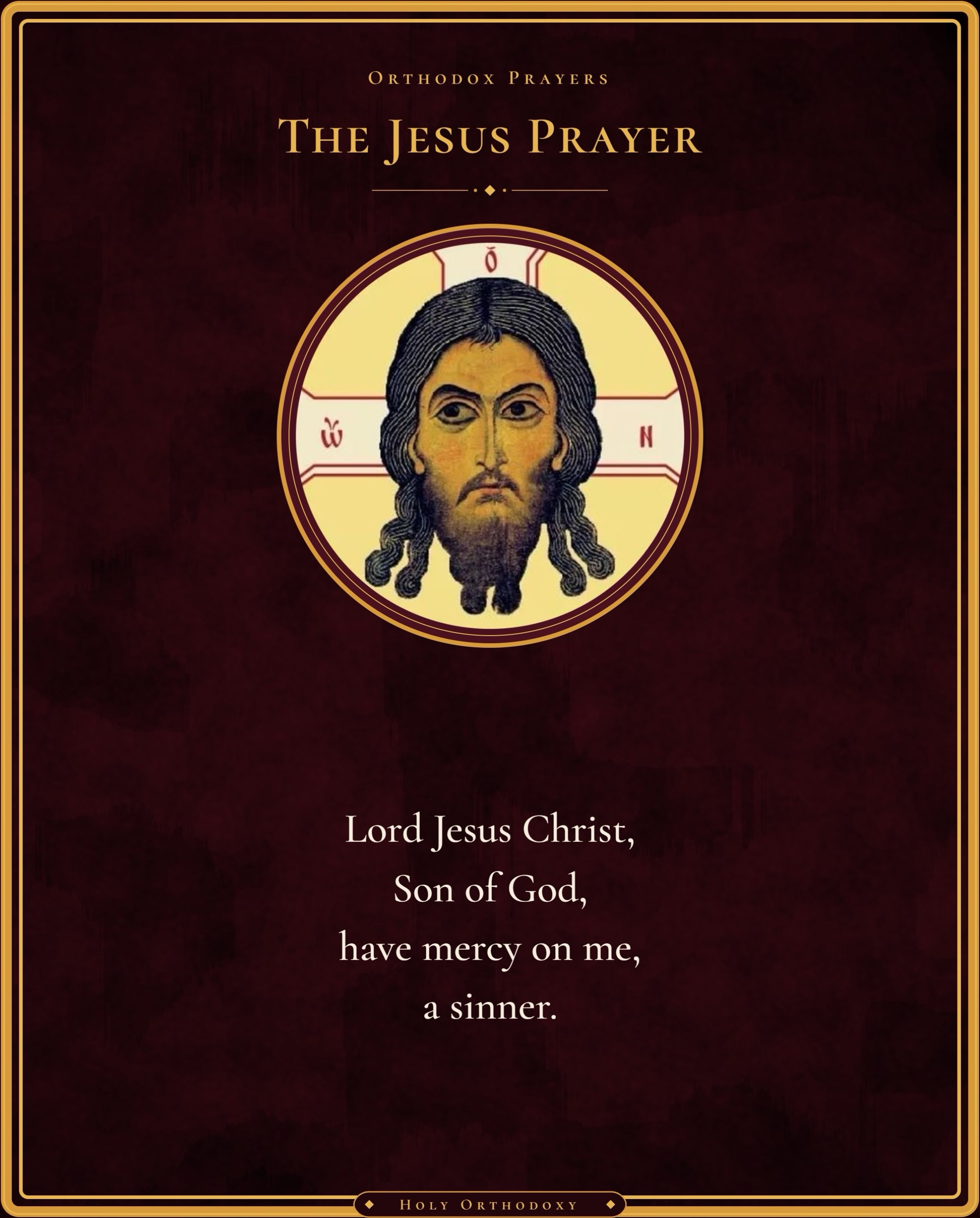
The post presents the Jesus Prayer, "Lord Jesus Christ, Son of God, have mercy on me, a sinner," and traces its roots to two gospel passages. The first is the cry of the blind man in Mark 10:47, who calls out, "Jesus, Son of David, have mercy on me!" The second is the prayer of the humble publican in Luke 18:13, who says, "God, be merciful to me a sinner!" The post notes that monks on Mount Athos pray this prayer continuously, day and night. It…

The post presents the Jesus Prayer, "Lord Jesus Christ, Son of God, have mercy on me, a sinner," and traces its roots to two gospel passages. The first is the cry of the blind man in Mark 10:47, who calls out, "Jesus, Son of David, have mercy on me!" The second is the prayer of the humble publican in Luke 18:13, who says, "God, be merciful to me a sinner!"

The post notes that monks on Mount Athos pray this prayer continuously, day and night. It encourages laypeople to adopt the same practice in daily life, on the bus, at work, before sleep. Many Orthodox Christians use a prayer rope, moving from knot to knot, as a way to follow Saint Paul's exhortation in 1 Thessalonians 5:17 to "pray without ceasing."

The image accompanying the text shows an icon of Christ's face with the prayer written beneath it, under the heading "Orthodox Prayers: The Jesus Prayer."

  • The Jesus Prayer text: "Lord Jesus Christ, Son of God, have mercy on me, a sinner."
  • Biblical roots: the blind man's cry (Mark 10:47) and the publican's prayer (Luke 18:13).
  • Monks on Mount Athos pray it unceasingly, day and night.
  • Laypeople can pray it anywhere, on the bus, at work, before sleep.
  • Use of a prayer rope with knots follows 1 Thessalonians 5:17 to "pray without ceasing."
Read more

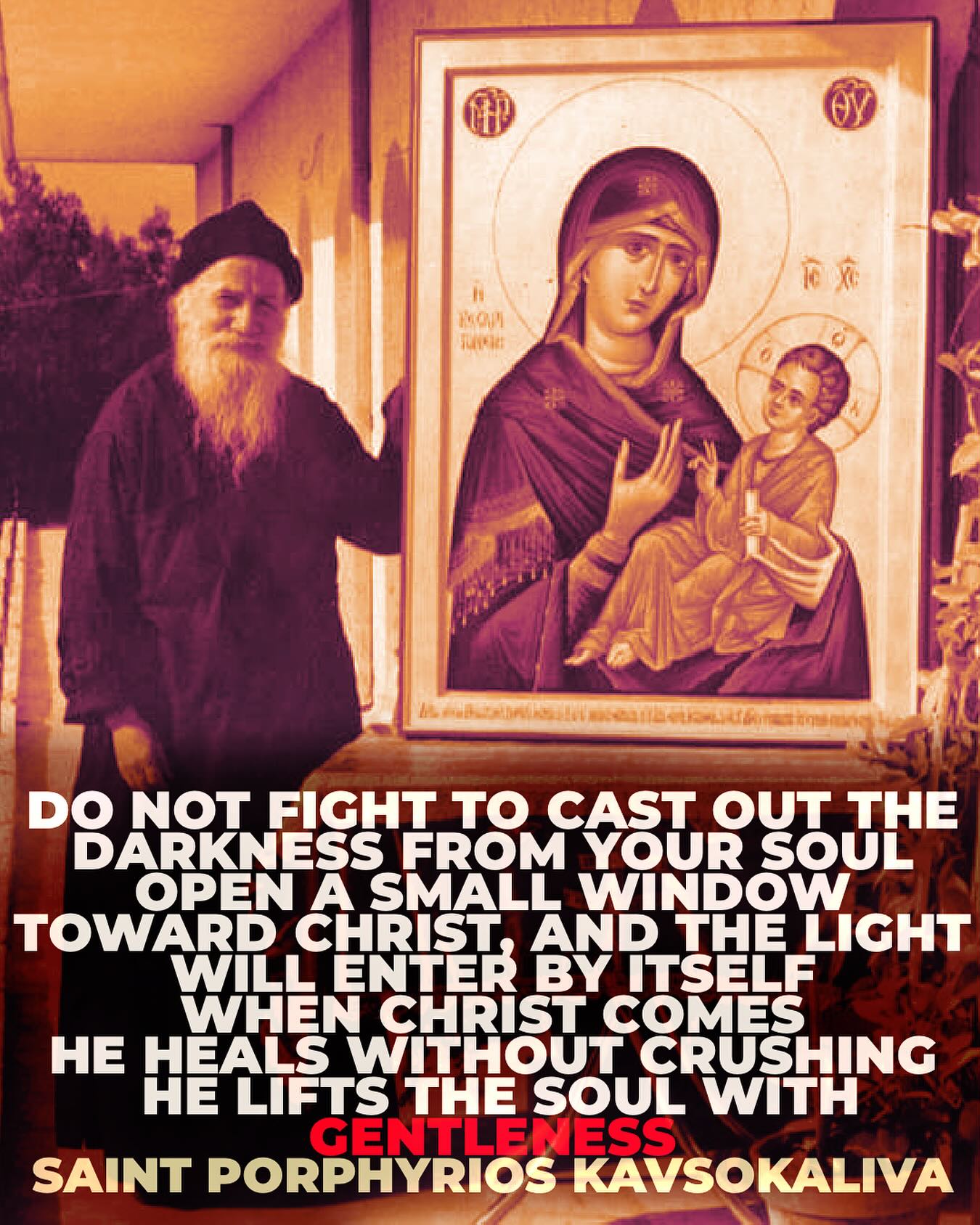
St. Porphyrios: open a window to Christ rather than fight darkness

The post presents a teaching from St. Porphyrios of Kavsokalyva. He writes that one should not fight to cast out darkness from the soul. Instead, one should open a small window toward Christ, and the light will enter by itself. When Christ comes, He heals without crushing; He lifts the soul with gentleness.

  • Do not fight darkness directly in the soul
  • Open a small window toward Christ
  • Christ's light enters by itself
  • Christ heals without crushing
  • Christ lifts the soul with gentleness
Read more

Saints on Greece's 1940 resistance: faith and the Theotokos' protection

The post collects words from three Orthodox elders on the Greek resistance to the Italian invasion of October 28, 1940. Blessed Father Athanasios Mytilineos states that the Greeks were not broken by tanks, artillery, or bombs because their souls were strengthened by faith in God and the Motherland. He recounts that soldiers at the front testified the Panagia covered and protected them, and that the soul of the Greek people, both at the front and…

The post collects words from three Orthodox elders on the Greek resistance to the Italian invasion of October 28, 1940. Blessed Father Athanasios Mytilineos states that the Greeks were not broken by tanks, artillery, or bombs because their souls were strengthened by faith in God and the Motherland. He recounts that soldiers at the front testified the Panagia covered and protected them, and that the soul of the Greek people, both at the front and behind the lines, was filled with faith and life.

Saint Paisios the Athonite is quoted twice: first, that by a handful of brave men the nation was sustained, and that those who die bravely do not die; second, that during the 1940 war Greeks at the front argued among themselves about who would go in the first line. Bishop Augustinos Kantiotis adds that the victory belonged to the Panagia and the honor belongs to her.

The passages present the 1940 conflict as a moment when spiritual strength and the intercession of the Theotokos were seen as decisive, with the elders emphasizing courage, self-sacrifice, and divine protection as the true sources of victory.

  • Fr. Athanasios Mytilineos: Greek souls prevailed over weapons through faith in God and the Motherland
  • Soldiers testified the Panagia covered and protected them at the front
  • St. Paisios: the nation was sustained by a handful of brave men; those who die bravely do not die
  • St. Paisios: Greeks at the front argued over who would take the first line
  • Bp. Augustinos Kantiotis: the victory belonged to the Panagia, the honor is hers
Read more

St. Mark the Ascetic: Forgiveness as the Sign of Sincere Love

The post presents two quotations from Orthodox saints. The first, from St. Porphyrios of Kausokalyvia, states that a person who is a man of God, makes confession, receives Holy Communion, and wears a cross suffers no harm even if all demons attack. The second, from St. Mark the Ascetic, identifies the sign of sincere love as the forgiveness of wrongs done to us, noting that Christ loved the world with such love. The post shares these teachings without additional commentary.

  • St. Porphyrios of Kausokalyvia teaches that confession, Communion, and wearing a cross protect a man of God from demonic harm.
  • St. Mark the Ascetic defines sincere love by the willingness to forgive offenses.
  • Christ's love for the world is given as the model of such forgiving love.
Read more

Saint Paisios on letting troubling thoughts pass like airplanes

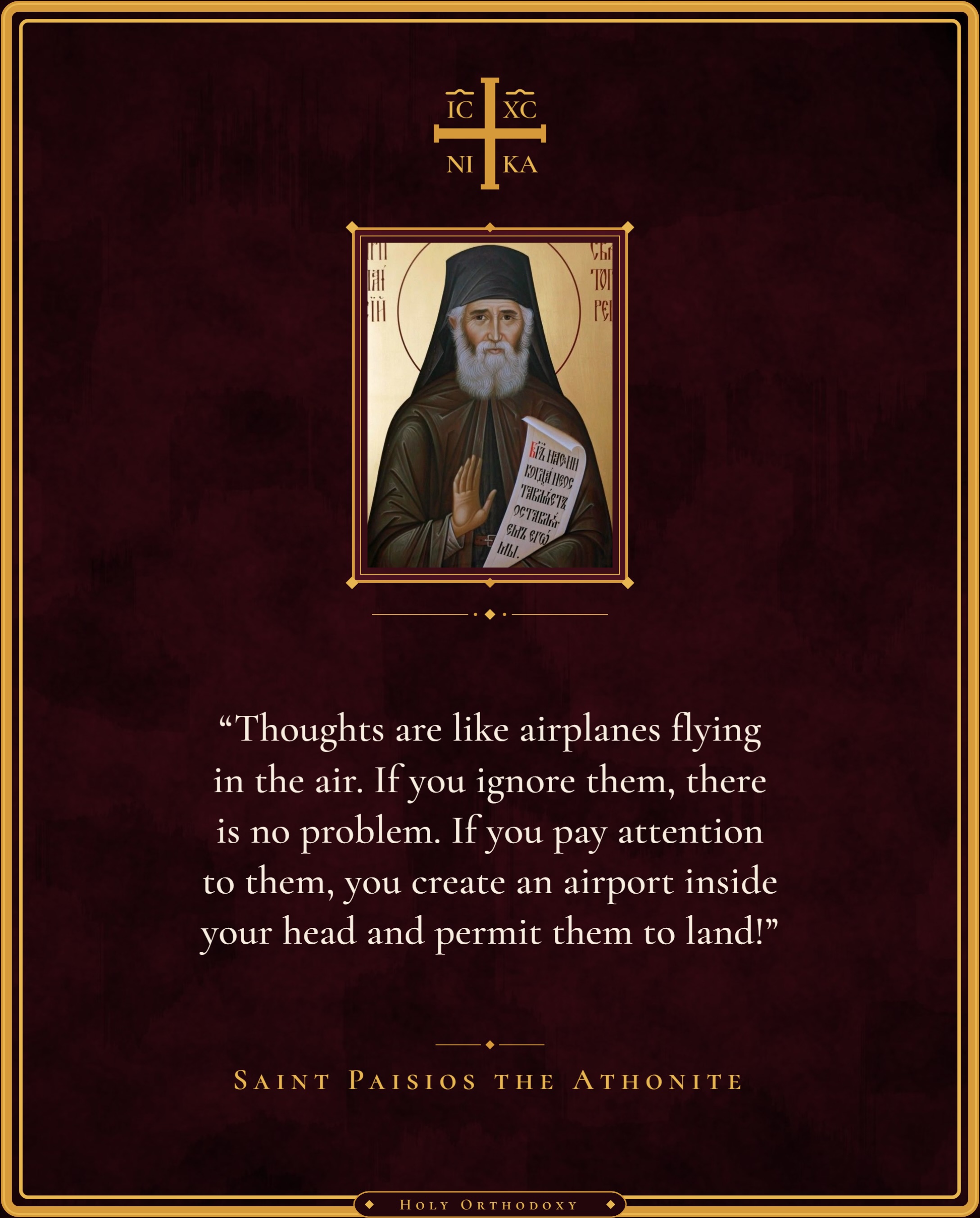
The post shares a teaching from Saint Paisios the Athonite comparing thoughts to airplanes flying overhead. The saint explains that thoughts will come, but we do not need to give them a place to land in our minds. When a troubling thought appears, the advice is not to argue with it or keep turning it over, but to let it pass and turn the mind to the Jesus Prayer: "Lord Jesus Christ, Son of God, have mercy on me." The image includes Greek text…

The post shares a teaching from Saint Paisios the Athonite comparing thoughts to airplanes flying overhead. The saint explains that thoughts will come, but we do not need to give them a place to land in our minds. When a troubling thought appears, the advice is not to argue with it or keep turning it over, but to let it pass and turn the mind to the Jesus Prayer: "Lord Jesus Christ, Son of God, have mercy on me."

The image includes Greek text with the same analogy: thoughts are like airplanes, and paying attention to them creates an airport in the head where they can land. The post encourages sending this to someone who overthinks and ends with a request for Saint Paisios's prayers.

  • Saint Paisios compares thoughts to airplanes that fly past unless given a landing strip
  • Troubling thoughts should not be argued with or dwelled upon
  • The response is to let the thought pass and turn to the Jesus Prayer
  • The image contains the same teaching in Greek with the airport analogy
  • The post encourages sharing this with those who overthink
Read more

Greek-Australian recalls WWII brotherhood and prays for the fallen

A first-generation Greek-Australian reflects on the historical military bond between Australia and Greece. He describes how, separated by thousands of kilometres, the two nations share a brotherhood forged in sacrifice and the defence of freedom. During the darkest hours of Greece's history, Australian and New Zealand soldiers stood alongside Greek forces on foreign soil. Many Australians made the ultimate sacrifice on Greek soil, and many…

A first-generation Greek-Australian reflects on the historical military bond between Australia and Greece. He describes how, separated by thousands of kilometres, the two nations share a brotherhood forged in sacrifice and the defence of freedom. During the darkest hours of Greece's history, Australian and New Zealand soldiers stood alongside Greek forces on foreign soil.

Many Australians made the ultimate sacrifice on Greek soil, and many ordinary Greek men and women risked their lives to shelter and protect Australian servicemen separated from their comrades. The author notes that nearly 90 Greek Australians served at Gallipoli and on the Western Front during World War I. In 1941, Australian soldiers fought alongside Greek and Cretan forces against the German invasion, and local families took fatal risks to shelter Australians.

The author emphasizes that this bond is more than a chapter in history; it is a bond written in blood, remembered through generations, and honoured by two nations that understand the true cost of freedom. He expresses pride in his Greek heritage and gratitude for the life his family has built in Australia. He states that he will never forget the men who fought and fell, the Greeks who stood beside them, or the families who never saw their loved ones return.

The reflection concludes with a prayer for the repose of the souls of all men, women, and children who died for Australia in the two world wars and other conflicts, asking forgiveness for their voluntary and involuntary transgressions and that the Lord establish their souls where the just repose.

Key moments

  1. Nearly 90 Greek Australians served at Gallipoli and the Western Front during World War I.
  2. In 1941, Australian soldiers fought alongside the local population in Greece and Crete against the invading German army, and many Greek and Cretan families took fatal risks to shelter Australian soldiers.
  3. A prayer is offered for the repose of the souls of all men, women, and children who died for Australia in the two world wars and other conflicts, asking for the forgiveness of their voluntary and involuntary transgressions and that the Lord establish their souls where the just repose.
Read more

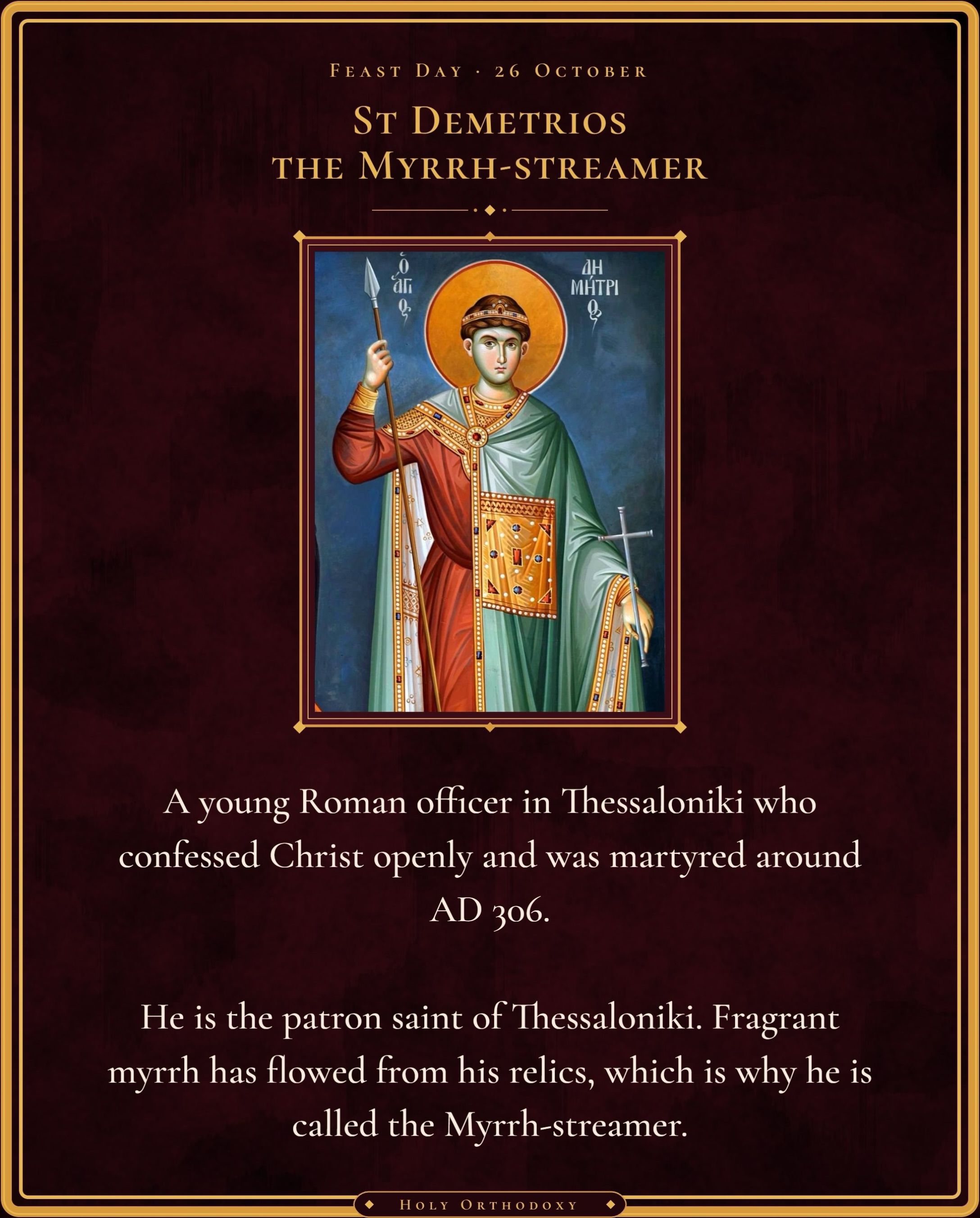
Feast of St Demetrios the Myrrh-streamer, 26 October

The post marks the feast of St Demetrios the Myrrh-streamer on 26 October. It recounts his life: born to a Christian family in Thessaloniki, he rose to high rank under Emperor Maximian, a persecutor of Christians. Demetrios taught Christ openly in the city, was arrested and imprisoned. From his cell he blessed Nestor, a young Christian who defeated the emperor's champion gladiator Lyaeus. In fury, Maximian ordered Demetrios put to death around…

The post marks the feast of St Demetrios the Myrrh-streamer on 26 October. It recounts his life: born to a Christian family in Thessaloniki, he rose to high rank under Emperor Maximian, a persecutor of Christians. Demetrios taught Christ openly in the city, was arrested and imprisoned.

From his cell he blessed Nestor, a young Christian who defeated the emperor's champion gladiator Lyaeus. In fury, Maximian ordered Demetrios put to death around AD 306; he was pierced with spears. Centuries later, fragrant myrrh began to flow from his tomb, earning him the title Myrrh-streamer.

He remains the beloved protector of Thessaloniki. The post concludes with a prayer to the saint and name-day greetings to those named Demetrios, Dimitris, Dimitra, and variants.

  • St Demetrios was a high-ranking officer in Thessaloniki who confessed Christ openly under Emperor Maximian.
  • He blessed Nestor, who defeated the gladiator Lyaeus, leading to Demetrios's martyrdom by spears around AD 306.
  • Fragrant myrrh later flowed from his relics, giving him the title Myrrh-streamer.
  • He is the patron saint and protector of Thessaloniki.
  • The post includes a prayer and name-day wishes for those bearing his name.
Read more

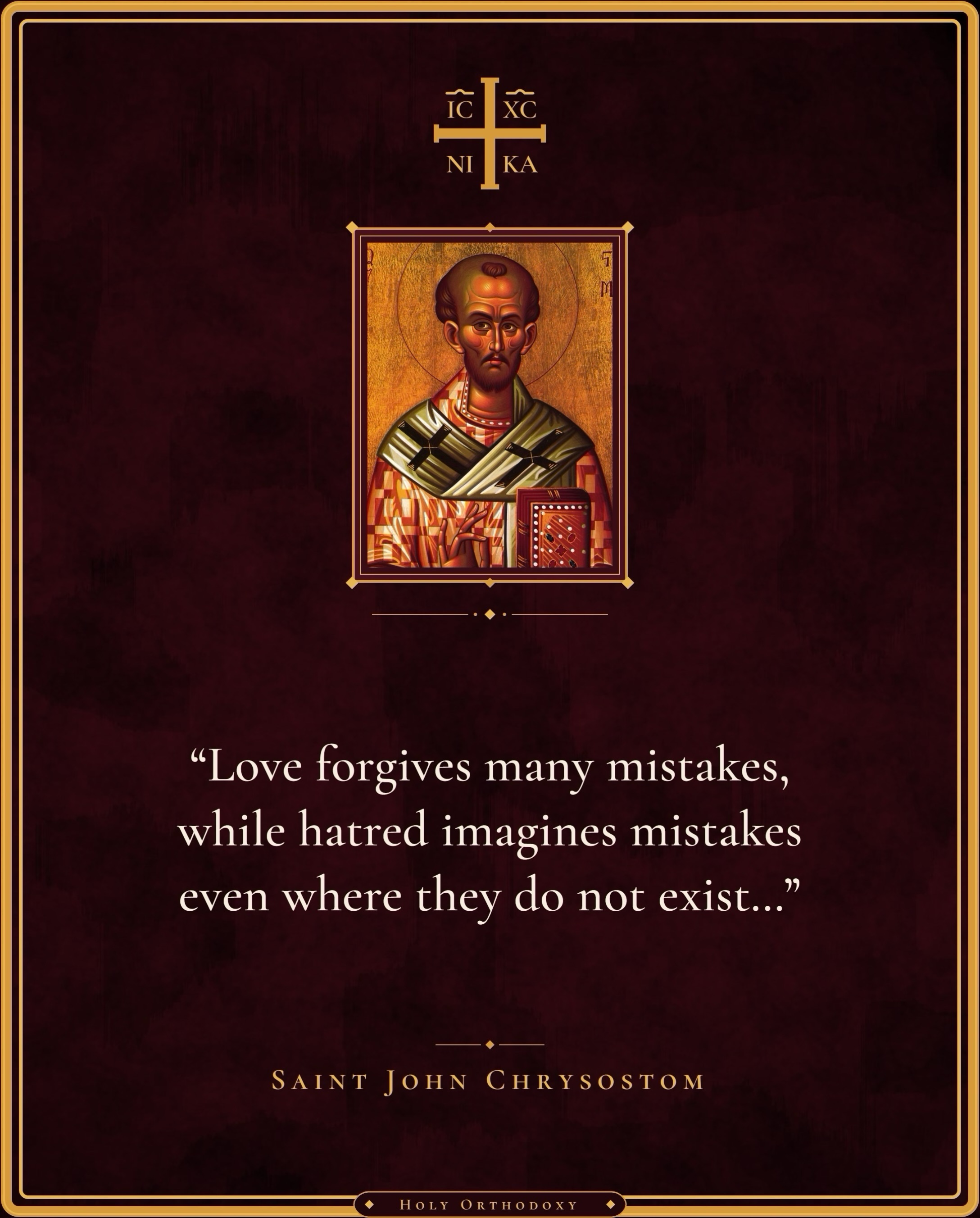
St. John Chrysostom on love and hatred

The post shares a saying attributed to St. John Chrysostom: "Love sees the person. Hatred invents the fault." It gives background on Chrysostom (c. 349-407), Archbishop of Constantinople, known as "golden-mouthed" for his preaching; the Divine Liturgy used most Sundays in Orthodox churches bears his name. The post links the saying to 1 Peter 4:8, "Love will cover a multitude of sins," and explains that love makes us slow to notice faults while…

The post shares a saying attributed to St. John Chrysostom: "Love sees the person. Hatred invents the fault." It gives background on Chrysostom (c. 349-407), Archbishop of Constantinople, known as "golden-mouthed" for his preaching; the Divine Liturgy used most Sundays in Orthodox churches bears his name. The post links the saying to 1 Peter 4:8, "Love will cover a multitude of sins," and explains that love makes us slow to notice faults while resentment makes us see faults that are not there.

It concludes with a reflective question: who could you see with gentler eyes today? The accompanying image carries a similar phrase: "Love forgives many mistakes, while hatred imagines mistakes even where they do not exist."

  • Quote attributed to St. John Chrysostom contrasting love and hatred
  • Biographical note on Chrysostom as Archbishop and preacher
  • Connection to 1 Peter 4:8 on love covering sins
  • Explanation of how love and resentment affect perception of faults
  • Reflective question about seeing others with gentler eyes
Read more

Fr. Spyridon Bailey on humility as foundation of virtues and peacemaking

Fr. Spyridon Bailey explains that Jesus begins the Beatitudes with "blessed are the poor," establishing humility as the foundation of all virtues. He notes that both Satan and Adam fell through pride, while Jesus raises humanity up through humility. To acquire this humility, each person must build into their life a time of separation for prayer and time alone with God, because true change cannot happen without time with God. Fr. Spyridon also…

Fr. Spyridon Bailey explains that Jesus begins the Beatitudes with "blessed are the poor," establishing humility as the foundation of all virtues. He notes that both Satan and Adam fell through pride, while Jesus raises humanity up through humility. To acquire this humility, each person must build into their life a time of separation for prayer and time alone with God, because true change cannot happen without time with God.

Fr. Spyridon also addresses the beatitude "blessed are the peacemakers," clarifying that it refers not simply to those at peace within themselves but to those who bring peace to others and to the world. He calls listeners to examine the effects they have on other people, asking whether those who encounter them leave angry and agitated or with peace.

Key moments

  1. Jesus begins the Beatitudes with "blessed are the poor," establishing humility as the foundation of all virtues.
  2. Both Satan and Adam fell through pride, and Jesus raises us up through humility.
  3. Everyone must build into their lives a time of separation for prayer and time alone with God to acquire humility.
  4. We cannot truly change unless we have time with God.
  5. Jesus says "blessed are the peacemakers", not those at peace within themselves, but those who bring peace to others and the world.
  6. This is a calling to examine the effects we have on other people.
  7. We must look at our lives closely and ask how we are affecting other people.
  8. When people encounter us, we must ask whether they leave angry and agitated or with peace.
Read more

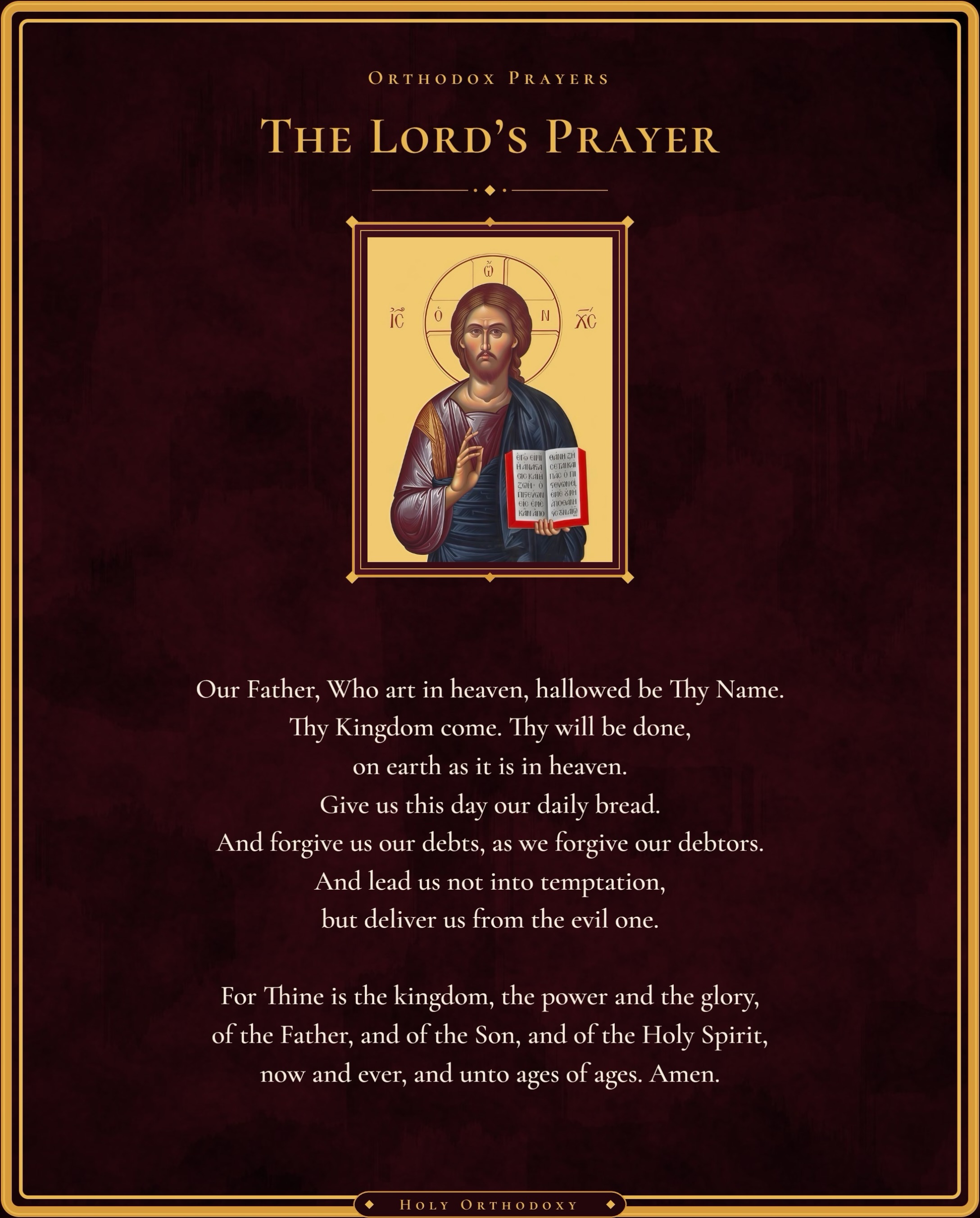
The Lord's Prayer in Orthodox worship and home

The post presents the Lord's Prayer, the prayer Christ gave, as it is used in the Orthodox Church. The text notes it is prayed at every Divine Liturgy and in every Orthodox home, and is often the first prayer a person learns. In the Liturgy, the priest concludes it with a doxology to the Holy Trinity. The accompanying image displays the full prayer: "Our Father, Who art in heaven, hallowed be Thy Name. Thy Kingdom come. Thy will be done, on…

The post presents the Lord's Prayer, the prayer Christ gave, as it is used in the Orthodox Church. The text notes it is prayed at every Divine Liturgy and in every Orthodox home, and is often the first prayer a person learns. In the Liturgy, the priest concludes it with a doxology to the Holy Trinity.

The accompanying image displays the full prayer: "Our Father, Who art in heaven, hallowed be Thy Name. Thy Kingdom come. Thy will be done, on earth as it is in heaven. Give us this day our daily bread. And forgive us our debts, as we forgive our debtors.

And lead us not into temptation, but deliver us from the evil one." It includes the concluding doxology: "For Thine is the kingdom, the power and the glory, of the Father, and of the Son, and of the Holy Spirit, now and ever, and unto ages of ages. Amen."

  • Christ gave the Lord's Prayer
  • Prayed at every Divine Liturgy
  • Prayed in every Orthodox home
  • Often the first prayer learned
  • Priest concludes with Trinitarian doxology
Read more