WeOrthodox
EN UA

Mireasma Athosului Η Ευωδία του Αγίου Όρους

Instagram 6 discussions · Open the original

Preasfântă Născătoare de Dumnezeu, miluiește-ne pe noi🙏☦️

Funeral at 425 AD Gaza church for mother and daughter killed in airstrike

The post reports on a funeral held October 4 at Saint Porfidios Church in Gaza City, built in 425 AD, for Maysa and Mary, a mother and daughter killed in an Israeli airstrike inside their apartment. The church, which has survived 1,600 years of empires, was bombed in October 2023 while sheltering 450 Christians and Muslims, killing 19 people including eight children and five women. In December 2023, Israeli snipers and tanks fired on Holy Family…

The post reports on a funeral held October 4 at Saint Porfidios Church in Gaza City, built in 425 AD, for Maysa and Mary, a mother and daughter killed in an Israeli airstrike inside their apartment. The church, which has survived 1,600 years of empires, was bombed in October 2023 while sheltering 450 Christians and Muslims, killing 19 people including eight children and five women.

In December 2023, Israeli snipers and tanks fired on Holy Family Catholic Church and the Sisters of Charity, killing an elderly woman and her daughter as they walked to the bathroom. The pattern extends to 1979 when Father Philomenos, a Cypriot priest serving as hegumen at Jacob's Well in Nablus, the site where Jesus met the Samaritan woman, was murdered during Vespers by an attacker who threw a grenade and killed him with an axe.

Father Philomenos was canonized by the Patriarch of Jerusalem in 2009 as Saint Philomenos, a new hieromartyr of Jacob's Well. The speaker identifies a continuous pattern of attacks on churches and clergy: bombs on churches, snipers on nuns, axes in monasteries. The post argues that Christianity in the Holy Land is not dead but is being martyred in real time, and that the true church has bled there for over 2,000 years while the West teaches Christianity started 500 years ago in Europe.

The post concludes with a call to light a candle for Maysa, Mary, and Saint Philomenos, saying "Memory eternal."

  • Funeral held October 4 at Saint Porfidios Church (built 425 AD) for Maysa and Mary, killed in Israeli airstrike inside their apartment.
  • Same church bombed October 2023 while sheltering 450 Christians and Muslims; 19 killed including eight children and five women.
  • December 2023: Israeli snipers and tanks fired on Holy Family Catholic Church and Sisters of Charity, killing elderly woman and her daughter.
  • 1979: Father Philomenos, hegumen at Jacob's Well in Nablus, murdered during Vespers with grenade and axe; canonized 2009 as Saint Philomenos.
  • Speaker identifies continuous pattern of attacks on Holy Land churches and clergy over decades; calls to light candles for the dead.

Key moments

  1. 0:00 Christianity in the Holy Land is being martyred in real time; funeral for Maysa and Mary held at Saint Porfidios on October 4th after Israeli airstrike.
  2. 0:32 Saint Porfidios, built in 425 AD, bombed in October 2023 while sheltering 450 Christians and Muslims; 19 killed including eight children and five women.
  3. 0:32 In December 2023, Israeli snipers and tanks opened fire on Holy Family Catholic Church and Sisters of Charity, killing an elderly woman and her daughter.
  4. 1:07 In 1979, Father Philomenos, Hegumen at Jacob's Well in Nablus, was murdered during Vespers by a man who threw a grenade and killed him with an axe.
  5. 1:07 Father Philomenos was canonized by the Patriarch of Jerusalem in 2009 as Saint Philomenos, new hieromartyr of Jacob's Well.
  6. 1:40 The speaker identifies a pattern: 1979 Jacob's Well, 2023 Saint Porfidios, 2023 Holy Family, October 4th Saint Porfidios again; bombs, snipers, axes.
  7. 1:40 The West teaches Christianity started 500 years ago, but the true church has bled in the Holy Land for over 2000 years and never left.
  8. 1:40 Call to light a candle for Maysa, Mary, and Saint Philomenos; "Memory eternal. God bless you all."
10 opinions in the discussion It's not just about that. It's about the ethnic cleansing of native ethnic Christians who have kept these traditions since the time of Jesus, and replacing them with Western Jews. Before… Read the discussion

Vigil for Saint Romanos the Melodist at Hagia Sophia in Thessaloniki

The post shares an excerpt from a sacred all-night vigil (Agrypnia) held in honor of Saint Romanos the Melodist at the Church of Hagia Sophia in Thessaloniki. The caption is given in both Greek and English, identifying the saint and the church where the vigil took place. Saint Romanos the Melodist is remembered in the Orthodox Church as a hymnographer, and a vigil in his honor centers on the singing of hymnography in the tradition associated…

The post shares an excerpt from a sacred all-night vigil (Agrypnia) held in honor of Saint Romanos the Melodist at the Church of Hagia Sophia in Thessaloniki. The caption is given in both Greek and English, identifying the saint and the church where the vigil took place. Saint Romanos the Melodist is remembered in the Orthodox Church as a hymnographer, and a vigil in his honor centers on the singing of hymnography in the tradition associated with his name.

The excerpt captures the chant of the service as it was sung in the church, allowing viewers to hear the vigil as it sounded in that setting. The post does not give a date for the vigil, the names of the clergy or chanters, or further details about the program of the service; it presents the recording itself as the content. The church named in the post, Hagia Sophia in Thessaloniki, is a historic Byzantine church in the city, distinct from the cathedral of the same name in Constantinople.

The recording is offered without additional commentary, so the discussion around it, if any, would concern the chant heard in the excerpt and the liturgical tradition of vigils held for the Melodist. Viewers opening the post will find the excerpt from the vigil and the bilingual caption identifying the occasion, the saint being honored, and the place where the service was held.

  • The post shares an excerpt from a vigil (Agrypnia) in honor of Saint Romanos the Melodist.
  • The vigil was held at the Church of Hagia Sophia in Thessaloniki.
  • The caption appears in Greek and in English translation.
  • The excerpt presents the chant of the service as recorded in the church.
  • No date, names of clergy or chanters, or service program are given in the post.

Key moments

  1. Whoever lives in the shelter of the Most High rests in the shadow of the Almighty: 'I will say of the Lord: He is my refuge and my fortress, my God, in whom I trust.'
  2. God delivers from the fowler's snare and deadly pestilence, covering with His feathers; His truth is shield and buckler.
  3. No fear of the terror by night, the arrow by day, the pestilence in darkness, or the destruction at midday; a thousand fall at one side and ten thousand at the other, but it will not come near.
  4. The Lord is my refuge and the Most High my habitation; no evil shall befall, no plague come near the tent.
  5. God gives His angels charge to guard all ways; they bear one up in their hands so the foot does not stumble on a stone.
  6. One will tread on the lion and the asp, trampling the young lion and the serpent.
  7. Because he loved Me, I will deliver him and set him on high, for he has known My name.
  8. He shall call on Me and I will answer; I will be with him in trouble, deliver and glorify him, satisfy him with long days, and show him My salvation.
Read more

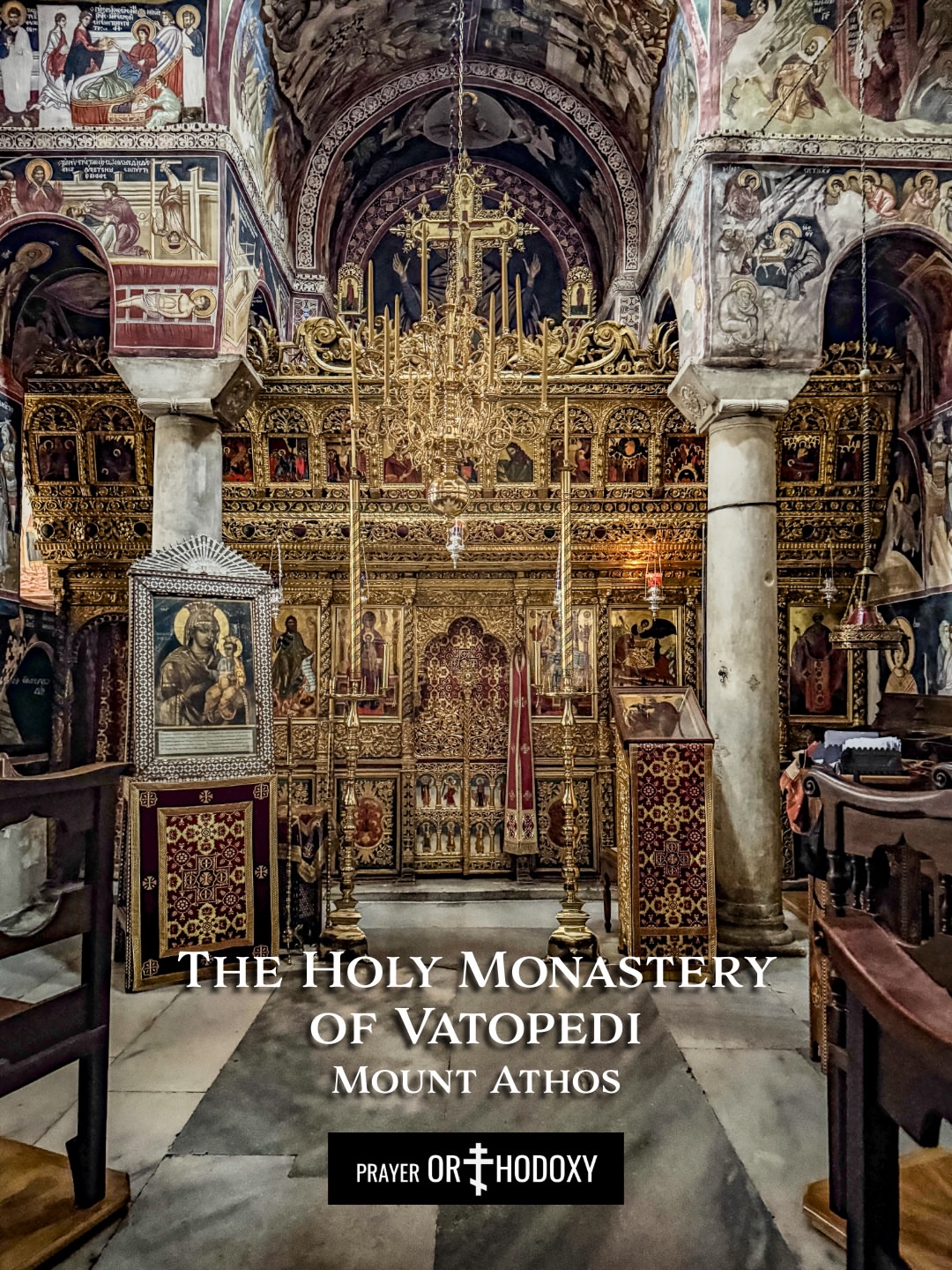
Inside the Katholikon of Vatopedi Monastery on Mount Athos

The post presents the katholikon, the main church, of the Holy and Great Monastery of Vatopedi. It describes the interior of the church, where sacred icons, frescoes, and centuries of Orthodox prayer surround the faithful who enter. The katholikon is dedicated to the Annunciation of the Theotokos, and the post states that it remains the spiritual heart of the monastery. The text appears in both English and Greek, with the Greek version carrying…

The post presents the katholikon, the main church, of the Holy and Great Monastery of Vatopedi. It describes the interior of the church, where sacred icons, frescoes, and centuries of Orthodox prayer surround the faithful who enter. The katholikon is dedicated to the Annunciation of the Theotokos, and the post states that it remains the spiritual heart of the monastery.

The text appears in both English and Greek, with the Greek version carrying the same content under the title 'Το Καθολικό της Ιεράς Μονής Βατοπαιδίου'. The post is tagged with references to Orthodoxy, Vatopedi, the Theotokos, Athos, and monasticism, and is credited as an original production of Prayer Orthodoxy. There is no discussion in the source beyond the description itself; the post serves as a short presentation of the church and its dedication, naming the monastery on Mount Athos and the feast to which its main church is dedicated.

No dates, builders, or historical events are given, and no claims are made beyond what the text states about the icons, frescoes, and the church's role in the life of the monastery.

  • The katholikon is the main church of the Holy and Great Monastery of Vatopedi.
  • Its interior holds sacred icons and frescoes, and centuries of Orthodox prayer surround the faithful.
  • The church is dedicated to the Annunciation of the Theotokos.
  • The post calls the katholikon the spiritual heart of the monastery.
  • The text is given in both English and Greek and is credited to Prayer Orthodoxy.
Read more

Vigil for St Roman the Melodist at Holy Sophia in Thessaloniki

The post shares a fragment of an all-night vigil held in honor of St Roman the Melodist at the Church of Holy Sophia in Thessaloniki. The description is given in Romanian and Greek, naming the saint, the church and the city. The transcript of the recording contains sung lines, repeated throughout, that ask for light. The singer repeats the word 'luz', light, asking for it 'em nós', in us, and calls it 'a luz da alvorada', the light of dawn. The…

The post shares a fragment of an all-night vigil held in honor of St Roman the Melodist at the Church of Holy Sophia in Thessaloniki. The description is given in Romanian and Greek, naming the saint, the church and the city. The transcript of the recording contains sung lines, repeated throughout, that ask for light.

The singer repeats the word 'luz', light, asking for it 'em nós', in us, and calls it 'a luz da alvorada', the light of dawn. The lyrics also speak of 'essa imensidão de amarguras', this immensity of bitterness, and ask that the light lead the singer. There is no spoken teaching or narration in the transcript, only these repeated sung lines.

The recording therefore pairs the vigil setting with a chanted or sung text centered on the request for light amid bitterness.

  • The video shows a fragment of a vigil in honor of St Roman the Melodist.
  • The vigil was held at the Church of Holy Sophia in Thessaloniki.
  • The transcript consists of repeated sung lines about light, with no spoken teaching.
  • The singer asks for light 'em nós', in us, and calls it 'a luz da alvorada', the light of dawn.
  • The lyrics mention 'essa imensidão de amarguras', this immensity of bitterness, and ask the light to lead the singer.

Key moments

  1. The lyrics repeat the word 'luz', light, throughout.
  2. The singer asks for light 'em nós', in us.
  3. The light is called 'a luz da alvorada', the light of dawn.
  4. The singer mentions 'essa imensidão de amarguras', this immensity of bitterness, and asks the light to lead them.
Read more