WeOrthodox
EN UA

Fr.TEDTalks

Instagram ↗ 38 discussions

Orthodoxy Worth Spreading

Fr.TEDTalks Instagram

The Church Is Conciliar: Authority in Communion, Not One Man's Rule

The post presents the Orthodox understanding of conciliarity as the foundation of Church governance. From the earliest centuries, the Church has operated through councils of bishops gathered together to discern and safeguard the Apostolic Faith. This is not merely procedural but reflects the theology that the Church is the Body of Christ, not the institution of any single person. Bishops are not independent rulers, priests are not spiritual…

The post presents the Orthodox understanding of conciliarity as the foundation of Church governance. From the earliest centuries, the Church has operated through councils of bishops gathered together to discern and safeguard the Apostolic Faith. This is not merely procedural but reflects the theology that the Church is the Body of Christ, not the institution of any single person.

Bishops are not independent rulers, priests are not spiritual dictators, and individual Christians cannot invent their own Orthodoxy. Authority exists in communion with others, grounded in Holy Tradition, and exercised through responsibility, accountability, and humility.

The historical model is the five ancient patriarchates, Rome, Constantinople, Jerusalem, Antioch, and Alexandria, resolving universal questions through ecumenical councils where all participated equally under the guidance of the Holy Spirit. The Orthodox Church maintains this decentralized, conciliar governance today. The filioque clause was introduced unilaterally by the pope of Rome without consulting the other four patriarchates, breaking the conciliar pattern.

This single act of one patriarchate claiming authority to speak for the whole Church became the root of subsequent divisions over who has the power to decree doctrine. The resulting cascade of problems all traces back to that fundamental question of authority.

Key moments

  1. The five original patriarchates (Rome, Constantinople, Jerusalem, Antioch, Alexandria) resolved universal issues through ecumenical councils where all participated equally, guided by the Holy Spirit.
  2. The Orthodox Church maintains this decentralized, conciliar governance today.
  3. The filioque was added by the pope of Rome alone, without consultation of the other four patriarchates.
  4. This unilateral action asserted one patriarchate's authority to speak for the entire church.
  5. The resulting cascade of problems all trace back to the question of who has the authority to decree doctrine.
Fr.TEDTalks Instagram

Why the Orthodox Church Keeps Ancient Rituals: Organic Tradition Over Empty Habit

The post introduces a Fr.TEDTalks discussion on why the Orthodox Church continues ancient rituals such as incense, candles, vestments, chanting, and processions. The author notes that to a modern observer these practices may seem outdated or merely ceremonial, but within Orthodoxy they serve a deeper purpose. The Church does not preserve ancient rituals simply because they are old; they are expressions of theology that connect the physical and…

The post introduces a Fr.TEDTalks discussion on why the Orthodox Church continues ancient rituals such as incense, candles, vestments, chanting, and processions. The author notes that to a modern observer these practices may seem outdated or merely ceremonial, but within Orthodoxy they serve a deeper purpose. The Church does not preserve ancient rituals simply because they are old; they are expressions of theology that connect the physical and spiritual dimensions of worship.

The discussion makes a distinction: rituals are not magical formulas, and tradition is not mere repetition. When the faithful understand the meaning, the practices can draw them closer to Christ; when performed without understanding, they risk becoming empty religious habits. The speaker explains that ritual is important as an organic tradition passed down for twenty centuries, not simply because the Church mandates it.

The Orthodox Church focuses on what was normative from the beginning, looking to the practices of the apostles and apostolic fathers and the reasons behind them. Deviating from established theology or practice opens the door to experimentation, as seen in other denominations. The speaker's community therefore strives to avoid new things and stay in line with tradition to maintain unbroken continuity both liturgically and theologically.

The goal of the discussion is not simply to preserve ancient practices, but to allow them to transform the lives of those who participate.

Key moments

  1. Ritual is important as an organic tradition passed down for twenty centuries, not simply because the church says so.
  2. The Orthodox Church focuses on what was normative from the beginning, specifically what the apostles and apostolic fathers did and why they did it.
  3. Deviating from established theology or practice leads to experimentation, which the speaker observes in other denominations.
  4. The speaker's community tries to avoid new things and stay in line with tradition to maintain unbroken continuity liturgically and theologically.
Fr.TEDTalks Instagram

Repentance orients us toward God; rebellion leads to eternal separation

The author explains that repentance means turning toward God, and consistent repentance sets a trajectory toward heaven. The goal is to become like the angels, with an eternal orientation toward God and communion with Him at death. Dying in rebellion against God means that state continues forever, which is hell.

The author emphasizes the importance of eternal obedience to God's will, listening and following it. We must avoid the habit of rebellion, because once accustomed to it, the condition worsens progressively.

Key moments

  1. We try to repent as much as possible in this life.
  2. The goal is to be like the angels when eternal life begins after earthly life ends.
  3. We want our decision and orientation to be eternally toward God, upward.
  4. We want communion with God at death, not rebellion.
  5. Dying in rebellion means remaining in rebellion forever, which is hell.
  6. We want to be eternally obedient to God's will, to listen and do His will.
  7. We should not get into the habit of being rebellious all the time.
  8. Once accustomed to rebellion, it gets worse and worse.
Read more
Fr.TEDTalks Instagram

Orthodox Teaching on Contraception and Marital Discernment

The post examines how the Orthodox Church approaches contraception through the lens of marriage as a vocation of responsibility, selflessness, and spiritual discernment rather than a rigid list of permitted and forbidden practices. The speaker states that procreation is a primary reason for marriage in the Orthodox tradition, though not the only one, and that contraception is generally discouraged within a functioning marriage because the goal…

The post examines how the Orthodox Church approaches contraception through the lens of marriage as a vocation of responsibility, selflessness, and spiritual discernment rather than a rigid list of permitted and forbidden practices. The speaker states that procreation is a primary reason for marriage in the Orthodox tradition, though not the only one, and that contraception is generally discouraged within a functioning marriage because the goal should be to have children.

The Church calls married couples to approach intimacy and family planning with love, mutual respect, openness to life, and pastoral guidance. When a couple does not want children, they must discuss the reasons with their spiritual father. Severe health concerns may lead a spiritual father to give a blessing for contraception because the alternative would be more dangerous.

However, the speaker notes that often the reluctance to have children stems from selfish attachment to lifestyle rather than selfless love, pulling toward self-expression instead of the selflessness of loving and having a family. The discussion explores why the Orthodox approach requires more than a simple yes-or-no answer and why context, intention, and spiritual maturity matter. Faith is described as learning to live responsibly in Christ, not finding loopholes.

Key moments

  1. Procreation is one of the main reasons for marriage, but it is not the only reason.
  2. The Orthodox generally do not encourage contraception in a functioning marriage.
  3. One of the goals in marriage should be to have children.
  4. If a couple does not want children, the question of why is discussed between the couple and their spiritual father.
  5. Severe health reasons may lead a spiritual father to give a blessing for contraception because the alternative would be more dangerous.
  6. Often the reasons for not wanting children are selfish, such as wanting to maintain a certain lifestyle.
  7. Selfish reasons pull toward self-expression rather than the selflessness of loving and having a family.
Read more

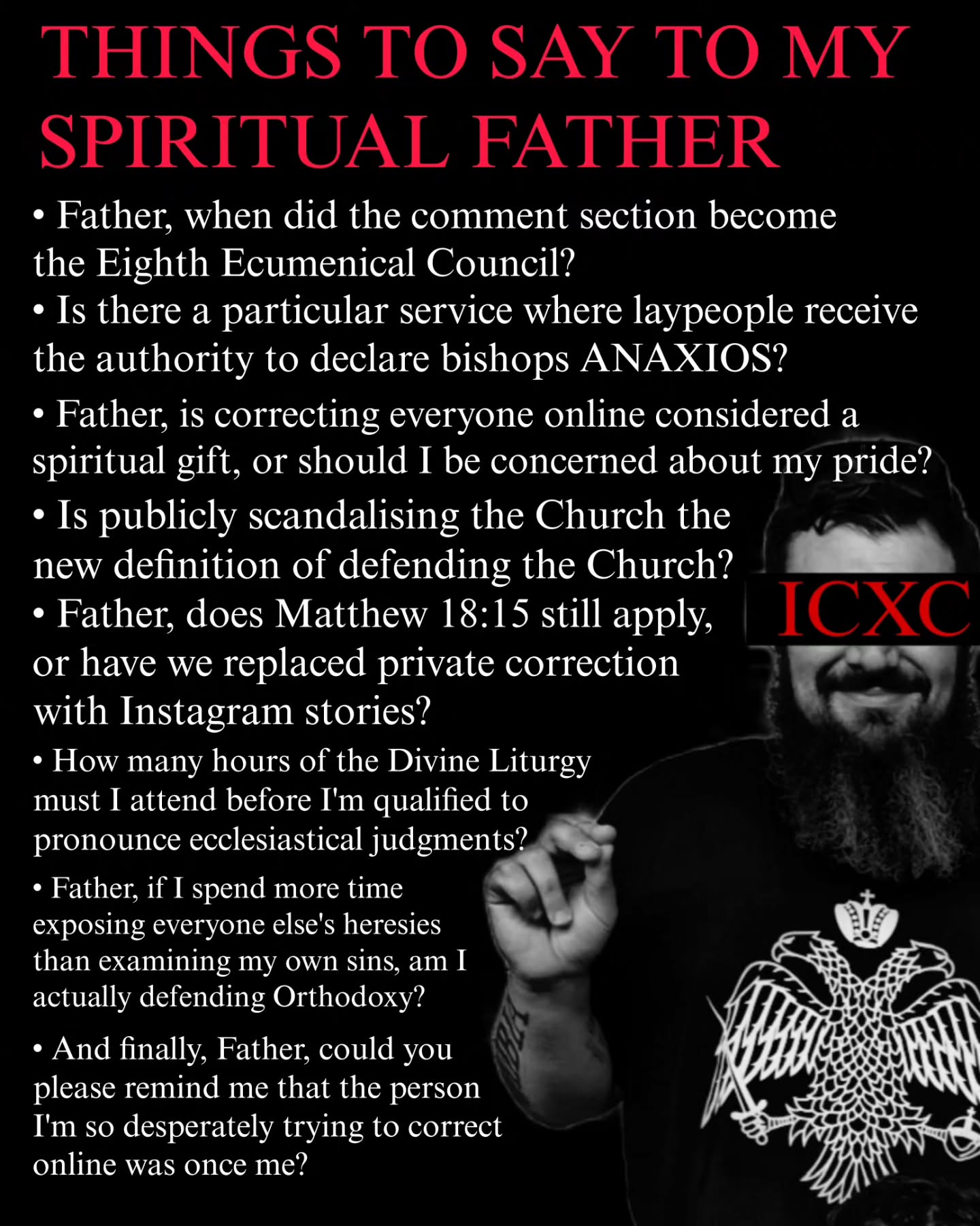
Questions for a Spiritual Father About Correcting Strangers Online

A satirical list framed as 'Things to say to my spiritual father' turns the lens on Orthodox Christians who spend their time correcting, exposing and condemning others online. One question cites Matthew 18:15, where Christ commands private correction before public rebuke, and asks whether Instagram stories have replaced it. Another asks how many hours of the Divine Liturgy qualify a person to pronounce ecclesiastical judgments. The sharpest…

A satirical list framed as 'Things to say to my spiritual father' turns the lens on Orthodox Christians who spend their time correcting, exposing and condemning others online. One question cites Matthew 18:15, where Christ commands private correction before public rebuke, and asks whether Instagram stories have replaced it. Another asks how many hours of the Divine Liturgy qualify a person to pronounce ecclesiastical judgments.

The sharpest question turns inward: if I spend more time exposing everyone else's heresies than examining my own sins, am I actually defending Orthodoxy? The list ends by asking the priest to remind the speaker that the person he is desperately trying to correct online was once himself. The author frames the post with 'Lord have mercy upon us all, especially myself' and the Greek 'Δόξα τῷ Θεῷ πάντων ἕνεκεν' (Glory to God for all things), closing with ICXC.

The piece reads as a self-directed examination of conscience about online polemics, pride and the commandment to correct in private.

  • The list poses satirical questions to a spiritual father about judging bishops and other Orthodox online
  • It asks which service grants laypeople authority to declare bishops 'anaxios'
  • It invokes Matthew 18:15 on private correction versus Instagram stories
  • It asks whether exposing others' heresies while neglecting one's own sins counts as defending Orthodoxy
  • It closes by asking to be reminded that the person one corrects online was once oneself
5 opinions in the discussion "I will not be asked how many hungry I fed, how many I clothed, or how many sick I nursed, but rather how many people I called heretics for making small mistakes online" -St Maria of Paris… Read the discussion
Fr.TEDTalks Instagram

The Illusion of Control Is a Form of Idolatry

The post identifies the illusion of control as a great spiritual problem behind everyday anxiety. It notes that intelligent, ambitious young people are especially vulnerable because they have been taught that hard work, careful planning, and right decisions can secure their future. This mindset confuses responsibility with omnipotence. A person is responsible for effort, not for controlling every outcome; responsible for treating others with…

The post identifies the illusion of control as a great spiritual problem behind everyday anxiety. It notes that intelligent, ambitious young people are especially vulnerable because they have been taught that hard work, careful planning, and right decisions can secure their future. This mindset confuses responsibility with omnipotence. A person is responsible for effort, not for controlling every outcome; responsible for treating others with love and respect, not for making everyone like them; responsible for studying, not for a guaranteed perfect grade; responsible for pursuing meaningful relationships, not for forcing another person to love them.

When someone demands complete control over life, they attempt to occupy a position that belongs to God, becoming a true idolater by replacing God with themselves.

Key moments

  1. The great spiritual problem behind much everyday anxiety is the illusion of control.
  2. This is especially difficult for intelligent, ambitious young people.
  3. They have been taught that if they work hard enough, plan carefully enough, and make the right decisions, they can control their future.
  4. This confuses responsibility with omnipotence.
  5. When we demand complete control over our lives, we essentially try to occupy a position that belongs to God.
Read more