WeOrthodox
EN UA

Orthodox posts, videos and discussions

We follow Orthodox channels, communities and blogs across the web, summarise every post and video, and highlight the conversations with real substance.

Greek-Australian recalls WWII brotherhood and prays for the fallen

A first-generation Greek-Australian reflects on the historical military bond between Australia and Greece. He describes how, separated by thousands of kilometres, the two nations share a brotherhood forged in sacrifice and the defence of freedom. During the darkest hours of Greece's history, Australian and New Zealand soldiers stood alongside Greek forces on foreign soil. Many Australians made the ultimate sacrifice on Greek soil, and many…

A first-generation Greek-Australian reflects on the historical military bond between Australia and Greece. He describes how, separated by thousands of kilometres, the two nations share a brotherhood forged in sacrifice and the defence of freedom. During the darkest hours of Greece's history, Australian and New Zealand soldiers stood alongside Greek forces on foreign soil.

Many Australians made the ultimate sacrifice on Greek soil, and many ordinary Greek men and women risked their lives to shelter and protect Australian servicemen separated from their comrades. The author notes that nearly 90 Greek Australians served at Gallipoli and on the Western Front during World War I. In 1941, Australian soldiers fought alongside Greek and Cretan forces against the German invasion, and local families took fatal risks to shelter Australians.

The author emphasizes that this bond is more than a chapter in history; it is a bond written in blood, remembered through generations, and honoured by two nations that understand the true cost of freedom. He expresses pride in his Greek heritage and gratitude for the life his family has built in Australia. He states that he will never forget the men who fought and fell, the Greeks who stood beside them, or the families who never saw their loved ones return.

The reflection concludes with a prayer for the repose of the souls of all men, women, and children who died for Australia in the two world wars and other conflicts, asking forgiveness for their voluntary and involuntary transgressions and that the Lord establish their souls where the just repose.

Key moments

  1. Nearly 90 Greek Australians served at Gallipoli and the Western Front during World War I.
  2. In 1941, Australian soldiers fought alongside the local population in Greece and Crete against the invading German army, and many Greek and Cretan families took fatal risks to shelter Australian soldiers.
  3. A prayer is offered for the repose of the souls of all men, women, and children who died for Australia in the two world wars and other conflicts, asking for the forgiveness of their voluntary and involuntary transgressions and that the Lord establish their souls where the just repose.
Read more
Holy Resurrection YouTube

St. Paisios on the Thoughts of the Sanctified vs. the Wicked

St. Paisios on the Thoughts of the Sanctified vs. the Wicked 4:21

St. Paisios the Athonite distinguishes the thoughts of a sanctified person from those of a wicked person. A holy person recognizes wickedness but discerns that evil comes from the tempter and enters from outside, not from the inner man. With the eyes of his soul he sees his own faults as great and those of others as small. He genuinely finds excuses for the wicked person, does not despise him, and may consider him better than himself. He may…

St. Paisios the Athonite distinguishes the thoughts of a sanctified person from those of a wicked person. A holy person recognizes wickedness but discerns that evil comes from the tempter and enters from outside, not from the inner man. With the eyes of his soul he sees his own faults as great and those of others as small.

He genuinely finds excuses for the wicked person, does not despise him, and may consider him better than himself. He may think a criminal fell because he lacked help, acknowledging that he himself might have done the same without God's help. The wicked person cannot know the good thoughts of a holy person, just as the devil cannot know them.

The person doing refined spiritual work justifies others but not himself. As he progresses he becomes freer, loves God and men more, and cannot even understand malice because he always thinks purely. He benefits from the falls of others as a brake for his own watchfulness.

By contrast, the unpurified person thinks maliciously, contaminates good things with his own darkness, and troubles himself and those around him. Such a person needs purification of mind and heart for spiritual clarity. Man is changeable, sometimes wicked, sometimes good. Evil thoughts come either from the tempter or from the person himself.

The tempter often creates situations to provoke evil thoughts. St. Paisios gives an example: an archimandrite visited the elder's kalyvi twice; when the elder was ill and asked him to return later, the archimandrite entertained the thought that the elder rejected him, complained to the monastery, and all this came from the tempter.

Key moments

  1. 0:06 A holy person recognizes the wicked person just as he recognizes the holiness of a saint, seeing the evil but discerning it comes from the tempter and enters from outside, not from the inner man.
  2. 0:38 With the eyes of his soul he sees his own faults as great and those of others as small, genuinely finding excuses for the wicked person, not despising him, and may even consider him better than himself.
  3. 1:09 He sees a criminal's wickedness but thinks the man reached that point because he did not receive needed help, and that he himself might have been in the same position had God not helped him.
  4. 1:40 The wicked person cannot know the good thoughts of a holy person, just as the devil cannot know them.
  5. 1:40 The person doing refined spiritual work justifies others but not himself; the more he progresses, the freer he becomes, the more he loves God and men, and he cannot even understand malice because he always thinks purely.
  6. 2:10 He benefits from the falls of his fellow men, using them as a strong brake upon himself to stay watchful; the unpurified person thinks maliciously, contaminates good things, and does not benefit even from others' virtues.
  7. 2:41 The unpurified person is always troubled and troubles those around him with his spiritual darkness; he must understand his need for purification of mind and heart so spiritual clarity may come.
  8. 3:42 An archimandrite visited the elder's kalyvi twice; when the elder was ill and asked him to return, the archimandrite entertained the thought that the elder did not want to see him, complained to the monastery, and all this came from the tempter.
Read more
Prayer Orthodoxy ® with Live Orthodox Instagram

Saint Demetrios' myrrh still fragrant after a year

The author marks the feast of Saint Demetrios of Thessaloniki by recalling a visit to the saint's church in Thessaloniki last year. During that visit the author received holy myrrh from the saint's relics. The myrrh's fragrance has remained unchanged since then. The post ends with a feast-day greeting and a doxology.

  • Author visited the Holy Church of Saint Demetrios in Thessaloniki last year
  • Received holy myrrh from the saint's relics during the visit
  • The myrrh's fragrance has persisted to the present day
  • Post offered as a feast-day greeting for Saint Demetrios
  • Closes with "Glory to God for all things"
Read more
George Instagram discussion

When prayer feels empty: showing up matters more than emotion

The speaker responds to viewer questions about daily prayer after his video on becoming a monk. He explains that the challenge to pray more arises because most days he does not feel like praying. He describes two kinds of days: some when words flow and conversation with God happens, others when he stands before icons with nothing to say and feels nothing. His goal is to reach prayer so real and emotional that tears come, but he is not there…

The speaker responds to viewer questions about daily prayer after his video on becoming a monk. He explains that the challenge to pray more arises because most days he does not feel like praying. He describes two kinds of days: some when words flow and conversation with God happens, others when he stands before icons with nothing to say and feels nothing.

His goal is to reach prayer so real and emotional that tears come, but he is not there every day, and that is okay. He notes that even Christ in Gethsemane prayed while exceedingly sorrowful, saying his soul is exceedingly sorrowful even to death, yet he still prayed, and the Psalms are full of people crying out when God feels far away.

He concludes that feeling nothing is part of the process and not a failure. On empty days he opens a prayer book containing prayers written by saints and prayed by millions, or he says the Jesus prayer slowly, and he is honest with God: "Lord, I don't feel anything today, but I'm here." He emphasizes that the prayers in the book have been used by countless believers across generations, giving them weight when his own words fail.

He states that God does not measure prayer by how you feel but sees that you showed up. He then asks viewers what they do when prayer feels empty.

Key moments

  1. The speaker says many viewers asked how to keep praying daily after his video about becoming a monk.
  2. He admits the reason he challenges himself to pray more is that most of the time he does not really feel like praying.
  3. He describes days when prayer flows easily and days when he stands before icons with nothing to say and feels nothing.
  4. His goal is to reach prayer so real and emotional that tears come, but he is not there every day, and that is okay.
  5. He cites Christ in Gethsemane saying his soul is exceedingly sorrowful even to death, yet he still prayed, and the Psalms are full of people crying out when God feels far away.
  6. He concludes that feeling nothing is part of the process and not a failure.
  7. On days when he has no words, he opens his prayer book containing prayers written by saints and prayed by millions, or he says the Jesus prayer slowly, and he is honest with God: "Lord, I don't feel anything today, but I'm here."
  8. He states that God does not measure prayer by how you feel but sees that you showed up, and he asks viewers what they do on days when prayer feels empty.
8 opinions in the discussion When I've got nothing left in me I go back to the OG... the Lord's Prayer 🙏 Read the discussion
Mount Athos Legacy Facebook

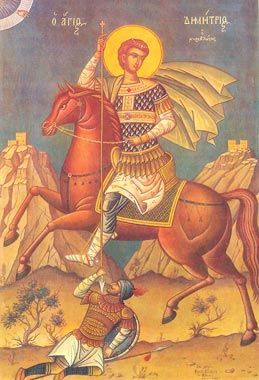
Saint Demetrios of Thessaloniki: soldier, martyr, myrrh-streamer

The Orthodox Church commemorates Saint Demetrios today. He was born around 280-284 AD into an aristocratic family in Thessaloniki. He rose quickly in the Roman army and held the rank of chiliarch by age twenty-two. Serving under the tetrarch Galerius Maximian during the reign of Diocletian, he became a Christian and was imprisoned in 303 AD for refusing to obey Diocletian's edict to renounce Christianity. Before his arrest he had founded a group…

The Orthodox Church commemorates Saint Demetrios today. He was born around 280-284 AD into an aristocratic family in Thessaloniki. He rose quickly in the Roman army and held the rank of chiliarch by age twenty-two. Serving under the tetrarch Galerius Maximian during the reign of Diocletian, he became a Christian and was imprisoned in 303 AD for refusing to obey Diocletian's edict to renounce Christianity.

Before his arrest he had founded a group of young people for the study of Holy Scripture. In prison he met a young Christian named Nestor, who was to face the feared gladiator Lyaios in single combat. Nestor asked Demetrios for help; the saint gave him his blessing.

Nestor defeated Lyaios, provoking the emperor's anger. Both Nestor and Demetrios were then sentenced to death. The most probable date of Demetrios's martyrdom is 306 AD. He is venerated as a myrrh-streaming martyr.

  • Born c. 280-284 AD in Thessaloniki to an aristocratic family
  • Reached rank of chiliarch at age 22 in the Roman army
  • Imprisoned in 303 AD for refusing to renounce Christianity under Diocletian's edict
  • Blessed Nestor before his combat with the gladiator Lyaios; Nestor won
  • Executed together with Nestor, most likely in 306 AD
Read more
Orthodox Health Instagram

Dietary rigor can feed pride instead of cultivating humility

The post warns that a person can follow a perfectly optimized diet yet remain spiritually malnourished. It grants that nutrition and metabolic health matter, but cautions that dietary discipline easily becomes self-righteousness. The Orthodox Church teaches fasting to expose passions and cultivate humility, not to congratulate oneself on correct food choices. The author notes the irony that Orthodox Christians should know better, yet can turn…

The post warns that a person can follow a perfectly optimized diet yet remain spiritually malnourished. It grants that nutrition and metabolic health matter, but cautions that dietary discipline easily becomes self-righteousness. The Orthodox Church teaches fasting to expose passions and cultivate humility, not to congratulate oneself on correct food choices.

The author notes the irony that Orthodox Christians should know better, yet can turn dietary convictions into another occasion for pride. Winning arguments about seed oils means little if one loses the struggle with their own passions. Diet should serve life, not become a monument to itself. If dietary convictions require excommunicating everyone who disagrees, reconsideration is needed.

The post references Episode 84 of the Orthodox Health Podcast, which examines how dietary movements mirror religious narratives: an original state of health, a fall such as agriculture or industrialization, forbidden foods, and a prescribed path to restoration. When a dietary framework becomes essential to identity, contradictory evidence is experienced as a personal attack rather than a factual challenge, shifting debate from efficacy to worldview defense.

Key moments

  1. The speaker outlines a common structure: an original state of health, a fall from that state, an explanation for suffering, and a prescribed path back to restoration.
  2. Different movements locate the fall differently, agriculture, industrialization, seed oils, or animal exploitation, but the narrative pattern remains similar.
  3. When a dietary framework becomes essential to identity, contradictory evidence is experienced as a personal attack rather than a factual challenge.
Athonite Audio YouTube

Discretion as the Greatest Virtue in Evergetinos Hypothesis 31

Discretion as the Greatest Virtue in Evergetinos Hypothesis 31 28:54

The third volume of the Evergetinos presents Hypothesis 31, which declares discretion the greatest virtue. The hypothesis gathers sayings from the Gerontikon, Abba Mark, Abba Cassian citing St. Moses the Ethiopian, St. Maximos, St. Ephraim, and St. Isaac. The cover art shows St. Moses the Ethiopian with the verse from Hebrews 11:37-38 about those who wandered in deserts and caves. Abba Anthony, Abba Ammonas, and the elders affirm that discretion…

The third volume of the Evergetinos presents Hypothesis 31, which declares discretion the greatest virtue. The hypothesis gathers sayings from the Gerontikon, Abba Mark, Abba Cassian citing St. Moses the Ethiopian, St. Maximos, St. Ephraim, and St. Isaac. The cover art shows St. Moses the Ethiopian with the verse from Hebrews 11:37-38 about those who wandered in deserts and caves.

Abba Anthony, Abba Ammonas, and the elders affirm that discretion steadies the mind, curbs the passions, and directs every action toward God's will. Abba Cassian states the immediate purpose of monastic life is purity of heart and the ultimate end is the kingdom of heaven; all thoughts, words, and deeds must be measured against this purpose like a carpenter's plumb line.

Abba Nisro the Great tells a brother that not all activities suit everyone: Abraham was hospitable, Elias loved stillness, David was humble, so each should choose the work his soul prefers provided it accords with God's will and guard his heart. Discretion is a gift of the Holy Spirit, the acropolis and queen of virtues, the eye and lamp of the soul.

It distinguishes snares from providence and keeps one on the royal path between excessive asceticism and indolence. Without it, even severe asceticism leaves one far from God. Elder Heron fell after fifty years of extreme austerity, two brothers perished in the desert through undiscerning zeal, and an ascetic nearly sacrificed his son to a demon.

Abba Longos wishes to dwell remotely, fast strictly, and flee men; an elder replies that controlling the tongue makes one remote anywhere, controlling evil thoughts is better than extreme fasting, and one must first succeed living among men before living alone. True humility consists in revealing both deeds and thoughts to a spiritual father and not trusting one's own judgment; following the fathers' counsel leads to discretion, which avoids excess in diet, sleep, and every aspect of ascetic life.

St. Maximos teaches giving each part its due: readings and prayer to the rational faculty, spiritual love to the incensive, chastity to the appetitive, food and clothing to the body; godliness profits all things, bodily exercise little.

Key moments

  1. 0:00 Discretion is the greatest virtue; without it even severe asceticism leaves one far from God, and remedies for the passions (reading, vigil, prayer, hunger, toil, solitude) are effective only when applied at the proper time and in due measure.
  2. 1:40 Abba Longos wishes to dwell remotely, fast strictly, and flee men; the elder replies that controlling the tongue makes one remote anywhere, controlling evil thoughts is better than extreme fasting, and one must first succeed living among men before living alone.
  3. 4:17 Abba Nisro the Great tells a brother that not all activities suit everyone, Abraham was hospitable, Elias loved stillness, David was humble, so each should choose the work his soul prefers, provided it is consonant with God's will, and guard his heart.
  4. 5:50 Abba Cassian states the preceding purpose of the monastic profession is purity of heart and the ultimate end is the kingdom of heaven; all thoughts, words, and deeds must be directed to this purpose like a carpenter's plumb line.
  5. 11:30 Discretion is a gift of the Holy Spirit (1 Cor 12:8-10), the acropolis and queen of virtues, the eye and lamp of the soul that distinguishes snares from providence and keeps one on the royal path between excessive asceticism and indolence.
  6. 14:05 Many exhausted themselves with extreme fasts, vigils, solitude, and almsgiving but fell into vice because they lacked discretion; Elder Heron fell after fifty years, two brothers perished in the desert, and an ascetic nearly sacrificed his son to a demon.
  7. 22:02 True humility is revealing both deeds and thoughts to spiritual fathers and not trusting one's own judgment; following the fathers' counsel leads to discretion, which avoids excess in diet, sleep, and every aspect of ascetic life.
  8. 24:11 St. Maximos teaches giving each part its due: readings and prayer to the rational faculty, spiritual love to the incensive, chastity to the appetitive, food and clothing to the body; godliness profits all things, bodily exercise little.
Prayer Orthodoxy ® with radioimlemesou Instagram

Metropolitan Athanasios: Our relationship with Christ is love, not ideology

Metropolitan Athanasios of Limassol explains that the Christian relationship with God is a relationship of love, not an ideology or a movement of followers. The Gospel is not an ideology. In the Church we learn to love Christ, and because we love Him we want to see Him and His holy form, as well as the forms of the saints, the friends of Christ. That is why the Church has holy icons depicting Christ. The Metropolitan recalls that the Church has…

Metropolitan Athanasios of Limassol explains that the Christian relationship with God is a relationship of love, not an ideology or a movement of followers. The Gospel is not an ideology. In the Church we learn to love Christ, and because we love Him we want to see Him and His holy form, as well as the forms of the saints, the friends of Christ.

That is why the Church has holy icons depicting Christ. The Metropolitan recalls that the Church has stated clearly that Christians do not worship icons, nor are icons idols. Instead, the faithful offer honorific and relative veneration to the icons that depict the Lord Christ and His friends, the saints.

Key moments

  1. Our relationship with God is a relationship of love, not a relationship between an ideology and its adherent.
  2. The Gospel is not an ideology.
  3. In the Church we learn to love Christ.
  4. Because we love Christ, we want to see Him; we have a need to see His holy form and the forms of the saints, the friends of Christ.
  5. Therefore we have holy icons that depict Christ.
  6. The Church said clearly that we do not worship icons, nor are icons idols.
  7. We venerate icons honorifically and relatively, with maternal veneration, giving honor to the holy icons that depict the Lord Christ and His friends, the saints.
Read more

Monothelitism: The Failed Compromise That Condemned Popes and Divided the Maronites

The post traces the history of Monothelitism, a seventh-century attempt to reconcile Chalcedonian and Miaphysite Christians by confessing two natures in Christ but only one will. Emperor Heraclius and Patriarch Sergius of Constantinople promoted the formula, first as Monoenergism (one operation) then as Monothelitism (one will). The imperial patriarch Cyrus of Alexandria negotiated a reunion with some non-Chalcedonian clergy in 633, but the…

The post traces the history of Monothelitism, a seventh-century attempt to reconcile Chalcedonian and Miaphysite Christians by confessing two natures in Christ but only one will. Emperor Heraclius and Patriarch Sergius of Constantinople promoted the formula, first as Monoenergism (one operation) then as Monothelitism (one will). The imperial patriarch Cyrus of Alexandria negotiated a reunion with some non-Chalcedonian clergy in 633, but the Coptic patriarch Benjamin I refused to participate.

St. Sophronius of Jerusalem opposed the teaching, and St. Maximus the Confessor argued that a complete human nature requires a human will; without it, the Incarnation cannot heal the human will. Maximus was tortured, his hand and tongue removed, and exiled. Pope Martin I condemned Monothelitism at the Lateran Council of 649, was arrested by imperial authorities, brought to Constantinople, and exiled to Cherson, where he died in 655. Pope Honorius I had endorsed the one-will language in correspondence with Sergius; the Sixth Ecumenical Council (680-681) condemned Monothelitism and anathematized Honorius by name, a condemnation ratified by Pope Leo II.

The post also examines the Maronites, a Syriac monastic community historically Chalcedonian, who became associated with Monothelitism during the seventh and eighth centuries. Eleventh-century Maronite liturgical texts and the Kitab al-Huda explicitly confess one will in Christ, distinguishing them from the Melkites who confessed two wills.

Around 1182, William of Tyre reported that approximately 40,000 Maronites renounced Monothelitism and entered communion with Rome. The author uses these historical facts to challenge claims of papal supremacy and infallibility.

  • Monothelitism emerged as an imperial attempt to unite Chalcedonians and Miaphysites by confessing two natures but one will in Christ.
  • St. Maximus the Confessor and Pope St. Martin I defended two wills; both were persecuted by imperial authorities.
  • Pope Honorius I was posthumously condemned for heresy by the Sixth Ecumenical Council.
  • The Maronites held a one-will Christology for centuries, documented in their own liturgical and theological texts.
  • Around 1182, large numbers of Maronites formally renounced Monothelitism and entered communion with Rome.
Read more
Disgruntled Docs with Trust God ☦︎︎︎ Instagram

Saint Demetrios the Myrrh-Gusher: Great-Martyr and Patron of Thessaloniki

On October 26 the Church commemorates the Great-Martyr and Myrrh-Gusher Saint Demetrios, patron of Thessaloniki and one of the most revered military saints alongside Saint George. The post recounts his life: born around 270 to devout Christian parents who kept their faith in secret, his father a military commander in Thessaloniki. After his father's death, the pagan emperor Galerius Maximian appointed Demetrios to the same command, charging him…

On October 26 the Church commemorates the Great-Martyr and Myrrh-Gusher Saint Demetrios, patron of Thessaloniki and one of the most revered military saints alongside Saint George. The post recounts his life: born around 270 to devout Christian parents who kept their faith in secret, his father a military commander in Thessaloniki.

After his father's death, the pagan emperor Galerius Maximian appointed Demetrios to the same command, charging him to defend the city from barbarians and to eradicate Christianity. Instead, Demetrios used his authority to teach the Christian faith to the inhabitants and converted many pagans by his eloquence and wisdom. Following a victory over the Sarmatians, Maximian came to Thessaloniki for celebrations and pagan sacrifices.

Envious pagans denounced Demetrios; he confessed his faith before the emperor and was thrown into prison. As part of the festivities, Maximian arranged gladiatorial combat featuring the giant Lyaios, undefeated in the arena. A young Christian named Nestor, seeking to show that true strength lies in Christ, visited Demetrios in prison for his blessing.

In the fight Nestor evaded Lyaios's charge and fatally stabbed him in the heart. Enraged, Maximian ordered Nestor's beheading. Hearing Nestor call upon the God of Demetrios, the emperor sent soldiers to thrust lances into Demetrios's chest, and he died in 306. At the church built over his tomb in Thessaloniki, now the Basilica of Saint Demetrius, fragrant myrrh has flowed miraculously from his reliquary, giving him the title Myrrh-Gusher.

He is honored as protector of the city, appearing in visions during invasions, and as patron of warriors, soldiers, and Thessaloniki.

Key moments

  1. Demetrius was born around 270 AD in Thessaloniki to a noble military family.
  2. He was secretly raised as a Christian when that meant persecution or death.
  3. He rose through the ranks to become a commander in the Roman army.
  4. Emperor Galerius found out about his faith and had him arrested.
  5. In prison Demetrius met Nestor, who was being forced to fight the gladiator Lias.
  6. Demetrius blessed Nestor, and Nestor miraculously defeated Lias.
  7. Galerius ordered both men executed; Demetrius was speared to death in his prison cell around 306 AD.
  8. A church was built over his tomb at Thessaloniki, now known as the Basilica of Saint Demetrius.
Read more
Timothy Instagram discussion

Debate on baptism: believer's baptism versus infant baptism

A video presents two speakers debating the theology of baptism. The first speaker argues that Scripture teaches believer's baptism, which requires personal faith before baptism. He describes being baptized as an infant in a Presbyterian church and later rebaptized as an adult because an infant cannot understand what is happening. He also states that anyone has authority to baptize, though many churches disagree. The second speaker responds that…

A video presents two speakers debating the theology of baptism. The first speaker argues that Scripture teaches believer's baptism, which requires personal faith before baptism. He describes being baptized as an infant in a Presbyterian church and later rebaptized as an adult because an infant cannot understand what is happening.

He also states that anyone has authority to baptize, though many churches disagree. The second speaker responds that Scripture never limits baptism to those who can articulate a mature profession of faith. He cites Acts 2:39, where Peter says the promise is for you and your children, and points to Paul connecting baptism to circumcision in Colossians 2. He also references household baptisms in Acts.

The second speaker argues that believer's baptism is a theological tradition not found in Scripture, while infant baptism reflects early church practice. He questions why a holy sacrament would depend on intellectual comprehension and references Ephesians 4:5, "one Lord, one faith, one baptism." He concludes by asking whether one's interpretation matches the faith the church received and practiced from the beginning.

Key moments

  1. The first speaker states Scripture is clear that baptism follows personal faith in Christ, calling it believer's baptism, and notes he was baptized as an infant in a Presbyterian church.
  2. The first speaker explains he was rebaptized as an adult because an infant cannot understand what is happening during baptism.
  3. The first speaker says anyone has authority to baptize, acknowledging many churches disagree with this view.
  4. The second speaker responds that Scripture never says baptism is only valid with a mature profession of faith, citing Peter's words in Acts 2 that the promise is for you and your children.
  5. The second speaker points to Paul connecting baptism to circumcision in Colossians 2 and to entire households being baptized in Acts.
  6. The second speaker argues believer's baptism is a theological tradition nowhere found in Scripture, while infant baptism reflects early church practice.
  7. The second speaker questions why a holy sacrament would depend on intellectual comprehension, referencing "one Lord, one faith, one baptism."
  8. The second speaker says the real question is whether one's interpretation matches the faith the church received and practiced from the beginning.
37 opinions in the discussion When you're baptized as an infant, your parents take on the duty of raising you in a sacramental way. That's literally spelled out to you before and during the rite. Read the discussion
Kyle YouTube

St. Peter the Aleut: Martyrdom by Spanish Soldiers in California

St. Peter the Aleut: Martyrdom by Spanish Soldiers in California 12:52

St. Peter the Aleut, a Kodiak Alaskan native originally named Chinang Nang, was baptized into the Orthodox faith by St. Herman or his clergy and received the Christian name Peter at that time. He worked as a hunter for the Russian-American Company, which operated in the region. He was among a party of 24 hunters who were sent by ship to hunt sea otter near San Gabriel in Spanish California. Their boat was damaged during the voyage, forcing them…

St. Peter the Aleut, a Kodiak Alaskan native originally named Chinang Nang, was baptized into the Orthodox faith by St. Herman or his clergy and received the Christian name Peter at that time. He worked as a hunter for the Russian-American Company, which operated in the region. He was among a party of 24 hunters who were sent by ship to hunt sea otter near San Gabriel in Spanish California.

Their boat was damaged during the voyage, forcing them to go ashore, where Spanish soldiers arrested them for hunting illegally in Spanish territory. The soldiers separated Peter and another Native Alaskan named Kouglak, placing them in a cell while the other hunters were later released without charge. The Spanish authorities repeatedly attempted to force Peter to convert to Roman Catholicism, pressing him to abandon his Orthodox faith.

Peter refused, declaring both verbally and by gestures that his faith was with God and that he remained Orthodox. He was subjected to brutal torture and died from his wounds. At the exact moment of his death a note arrived from the Russian-American Company ordering the release of the remaining prisoners who were still held.

The Spanish officer ordered Peter's body to be thrown out without burial, denying him a Christian interment. Kouglak escaped after several weeks, was rescued by the same ship, and reported the events to Ivan Kuskov, the manager of Fort Ross, upon his return. Fort Ross had been established in 1794 by a group of ten monks that included St. Herman and St. Juvenaly; it is recognized as the first Orthodox church in North America outside Alaska, serving as a spiritual center for the region.

St. Innocent later spent five weeks at Fort Ross documenting daily life and recording baptisms at Sandy Creek, preserving a record of the mission's activity. The film Sacred Alaska documents this history, the Alaskan Orthodox mission, the creation of a Yup'ik alphabet by St. Innocent, the church's defense of native rights against the Russian-American Company, and the lives of saints such as St. Olga of Alaska, highlighting the enduring legacy of the Orthodox presence in America.

Key moments

  1. 0:31 St. Peter was a Kodiak Alaskan native, originally named Chinang Nang, who was baptized Orthodox by St. Herman or his clergy and became a hunter for the Russian-American Company.
  2. 2:10 Peter was among 24 hunters taken by ship to the San Gabriel area, but their boat was damaged and they went ashore, where Spanish soldiers arrested them for hunting illegally.
  3. 3:46 Peter and another Native Alaskan were placed in a cell while the others were later released; the Spanish repeatedly tried to convert Peter.
  4. 4:17 Peter refused to convert, stating verbally and by gestures that his faith lies with God and he is Orthodox.
  5. 4:47 Peter was brutally tortured and died, and at the exact moment of his death a note arrived from the Russian-American Company ordering the release of the other prisoners.
  6. 6:21 The Spanish officer ordered Peter's body thrown out without burial, and his companion Kouglak escaped after weeks, was rescued by the same ship, and reported the events to Ivan Kuskov at Fort Ross.
  7. 7:55 Fort Ross, established in 1794 by ten monks including St. Juvenaly and St. Herman, is the first Orthodox church in North America outside Alaska, and St. Innocent spent five weeks there documenting daily life and baptisms at Sandy Creek.
  8. 10:01 The film Sacred Alaska highlights the Alaskan Orthodox mission, the creation of a Yup'ik alphabet by St. Innocent, the church's protection of native rights against the Russian-American Company, and the lives of saints such as St. Olga of Alaska.
Read more
George Instagram

Saint Demetrios: Noble Roman, Martyr, and Myrrh-Streamer

Saint Demetrios was born over 1,700 years ago into a noble family and held a high position in the Roman Empire. He loved Christ and spoke about him openly, leading many to believe. When the emperor visited his city, Demetrios was arrested and thrown into prison. The emperor had a champion fighter who fought Christians in the arena. A young Christian sought Demetrios's blessing before facing him. Demetrios made the sign of the cross over the…

Saint Demetrios was born over 1,700 years ago into a noble family and held a high position in the Roman Empire. He loved Christ and spoke about him openly, leading many to believe. When the emperor visited his city, Demetrios was arrested and thrown into prison.

The emperor had a champion fighter who fought Christians in the arena. A young Christian sought Demetrios's blessing before facing him. Demetrios made the sign of the cross over the young man, who then defeated the giant like David and Goliath.

Centuries later, his stone began to pour out fragrant myrrh, which is why he is called the myrrh-streamer. His relics remain in Thessaloniki, and his feast on October 26 is celebrated as Mitrovdan in Serbia, one of the biggest days of the year.

Key moments

  1. He was born over 1,700 years ago into a noble family and had a high position in the Roman Empire.
  2. He loved Christ and spoke about him openly, and many people came to believe.
  3. When the emperor came to his city, he was arrested and thrown into prison.
  4. The emperor had a champion, a huge fighter who loved to fight Christians in the arena.
  5. A young Christian went to the prison and asked the saint for his blessing before facing the champion.
  6. The saint made the sign of the cross over him and said go, and the young man, small and unknown, defeated the giant like David and Goliath.
  7. Centuries later, his stone began to pour out fragrant mirror, which is why he is called the mirror streamer.
  8. His relics are still in his city of Thessaloniki, and his feast on 26 October is called Mitrovdan in Serbia, one of the biggest days of the year.
Read more

Have I done something wrong?

I have been attending Divine Liturgy for a few months. About six weeks ago a woman told me to go forward during communion and ask for a blessing, so I have been doing that ever since. The priest seems fine with it and always gives me a blessing.

Yesterday I heard that some people are complaining to the priest, saying I should not come up for a blessing. What should I do?

22 opinions in the discussion What you should do is talk to your priest about it and ignore literally everyone else. If your priest says "No, it's ok" then keep doing it, if he says "well, I'd rather you not but I'm not… Read the discussion

Saints Eulampius and Eulampia: Martyrs of Nicomedia under Maximian

The post recounts the martyrdom of Saints Eulampius and Eulampia, a brother and sister from Nicomedia during the persecution under Emperor Maximian. Many Christians had fled the city and hidden themselves. Young Eulampius was sent to bring bread to the faithful. He saw an imperial decree ordering the persecution and execution of Christians posted on a wall. Filled with righteous courage, he tore it down and destroyed it. He was immediately…

The post recounts the martyrdom of Saints Eulampius and Eulampia, a brother and sister from Nicomedia during the persecution under Emperor Maximian. Many Christians had fled the city and hidden themselves. Young Eulampius was sent to bring bread to the faithful. He saw an imperial decree ordering the persecution and execution of Christians posted on a wall.

Filled with righteous courage, he tore it down and destroyed it. He was immediately arrested and brought before a judge. The judge urged him to renounce Christ; Eulampius instead urged the judge to abandon the lifeless idols and recognize Jesus Christ as the one true and living God. Enraged, the judge ordered him beaten and subjected to terrible tortures.

When Eulampia heard of his suffering, she rushed to him and openly declared that she too was a Christian, desiring to suffer alongside her brother rather than abandon him or her faith. Both were cruelly beaten and thrown into boiling pitch and a blazing furnace. Through the power of the name of Jesus Christ and the sign of the Holy Cross, the flames could not harm them.

Witnessing their courage and the miracles of God, two hundred people came to believe in Christ. Finally, Saint Eulampius was beheaded, while Saint Eulampia surrendered her soul to God before the sword struck her. The two hundred new believers were also martyred. Together they received the eternal crowns of martyrdom in the Kingdom of Heaven.

The post ends with a reflection that true faith is measured by firmness when everything is taken, and a prayer asking the holy martyrs to pray to God for us.

  • Eulampius tears down an imperial decree against Christians in Nicomedia
  • He is arrested, tortured, and refuses to renounce Christ
  • Eulampia joins him, declaring her faith and sharing his sufferings
  • Both survive boiling pitch and furnace unharmed; two hundred witnesses convert
  • Eulampius is beheaded, Eulampia dies before the sword; the converts are also martyred
Read more

Saint Philip the Deacon: Apostle to Samaria and the Ethiopian Eunuch

The post recounts the life of Saint Philip the Deacon, one of the Seventy Apostles. Born in Caesarea of Palestine, he was married and had four daughters who were consecrated virgins with the gift of prophecy. The apostles chose him as one of the first seven deacons to serve the poor and widows. When persecution scattered the Jerusalem church, Philip went to Samaria, where he preached the Gospel, performed healings, cast out demons, and baptized…

The post recounts the life of Saint Philip the Deacon, one of the Seventy Apostles. Born in Caesarea of Palestine, he was married and had four daughters who were consecrated virgins with the gift of prophecy. The apostles chose him as one of the first seven deacons to serve the poor and widows.

When persecution scattered the Jerusalem church, Philip went to Samaria, where he preached the Gospel, performed healings, cast out demons, and baptized many, including Simon the sorcerer. He then met an Ethiopian eunuch, a court official of Queen Candace, explained the Scriptures concerning Christ, and baptized him. Afterward, the Spirit transported Philip to Azotus, where he continued preaching.

Later he was appointed bishop in Lydia, where he baptized many and guided the church until his peaceful repose at an advanced age. The account emphasizes that serving Christ begins with love for others, whether through charity or evangelism.

  • One of the Seventy Apostles, born in Caesarea of Palestine, married with four prophetic daughters.
  • Chosen as one of the first seven deacons to serve the poor and widows.
  • Preached in Samaria with miracles, baptizing Simon the sorcerer among others.
  • Explained Scripture to and baptized the Ethiopian eunuch, then was miraculously carried to Azotus.
  • Served as bishop in Lydia until his peaceful repose at an advanced age.
Read more

Seventh Ecumenical Council (787) affirmed veneration of holy icons

The Seventh Ecumenical Council convened in Nicaea in 787 during the reign of Empress Irene and her son Constantine VI, under Patriarch Tarasius of Constantinople. The council addressed the iconoclast controversy, which rejected and destroyed holy icons. Three hundred sixty-seven Holy Fathers gathered to defend the Orthodox teaching on sacred images. They affirmed that veneration of icons is lawful, grounding the decision in Holy Scripture, the…

The Seventh Ecumenical Council convened in Nicaea in 787 during the reign of Empress Irene and her son Constantine VI, under Patriarch Tarasius of Constantinople. The council addressed the iconoclast controversy, which rejected and destroyed holy icons. Three hundred sixty-seven Holy Fathers gathered to defend the Orthodox teaching on sacred images.

They affirmed that veneration of icons is lawful, grounding the decision in Holy Scripture, the writings of the Holy Fathers, and accounts of miracles associated with icons. The Fathers clarified that Christians do not worship the material of an icon, wood, paint, or stone, but direct honor toward the holy person depicted, while worship belongs to God alone.

Among the miracles cited was an account from Bishop Constantine of Cyprus: a shepherd influenced by iconoclast teaching struck an icon of the Theotokos with an iron staff, damaging the right eye of the image; as he walked away, he stumbled and injured his own right eye with the same staff, leading him to repent. The council also decreed that holy relics of martyrs be placed within the antimension used for the Divine Liturgy.

Through these definitions, the council upheld the truth that the Son of God truly became man and, because Christ took visible human flesh, He can be depicted in sacred images. The Holy Fathers of the Seventh Ecumenical Council are commemorated for preserving the apostolic faith and teaching the proper honor due to saints while directing worship to the Holy Trinity. Holy Fathers of the Seventh Ecumenical Council, pray to God for us.

  • Council held in Nicaea in 787 under Empress Irene, Constantine VI, and Patriarch Tarasius
  • 367 Holy Fathers defended veneration of icons against iconoclasm
  • Council distinguished worship (due to God alone) from honor given to icons directed to the prototype
  • Miracle of the shepherd who damaged an icon of the Theotokos and injured his own eye
  • Decree that relics of martyrs be placed in the antimension for the Divine Liturgy
Read more
Lives of the Saints 🙏 Instagram

Saint Zlata of Meglen: Martyrdom for Christ

The post recounts the life and martyrdom of Saint Zlata of Meglen. Born in the village of Slatina in the Meglen region to poor Christian parents, she was one of four daughters. Her name, meaning "golden," reflected her precious heart before God. While fetching water, she was abducted by men who tried to force her to renounce Christianity and marry one of them. She answered that she believed in Christ, knew only Him as her Bridegroom, and would…

The post recounts the life and martyrdom of Saint Zlata of Meglen. Born in the village of Slatina in the Meglen region to poor Christian parents, she was one of four daughters. Her name, meaning "golden," reflected her precious heart before God.

While fetching water, she was abducted by men who tried to force her to renounce Christianity and marry one of them. She answered that she believed in Christ, knew only Him as her Bridegroom, and would never deny Him even under a thousand torments. When threats failed, her captors brought her parents and sisters, whose tears and pleas urged her to save her life by an outward denial.

Zlata refused, declaring she could never abandon the Lord Jesus Christ even for those she loved most. She was imprisoned for three months and beaten repeatedly, yet remained steadfast. Finally, her persecutors hung her upside down and exposed her to fire and smoke, but she did not yield.

The post states she was martyred in 1796, surrendering her soul to God. The faithful later preserved portions of her holy relics as a blessing. An accompanying image text gives her birth name as Irina, her village as Maglina, and the year of martyrdom as 1760 at the hands of Turks.

The post concludes that the world can take freedom, comfort, and earthly life, but cannot take Christ from a heart that refuses to abandon Him, and asks for her prayers.

  • Born in Slatina, Meglen, to poor Christian parents; name means "golden"
  • Abducted while fetching water, pressured to renounce Christ and marry
  • Refused despite family pleas, declaring Christ as her only Bridegroom
  • Imprisoned three months, beaten, hung upside down, exposed to fire and smoke
  • Martyred in 1796 (image text says 1760); relics preserved; remembered for steadfast love of Christ
Read more

Debate clip challenges non-denominational view on early church and Scripture

A questioner confronts a non-denominational Protestant who identifies himself as simply following the Bible. The questioner asks what church he attends and challenges him to name anyone in the first nine hundred years of church history who held a comparable theological position. The Protestant repeats that he goes by the Bible alone. The questioner calls this a blunder, stating that Christians did not have the Bible for almost seven hundred…

A questioner confronts a non-denominational Protestant who identifies himself as simply following the Bible. The questioner asks what church he attends and challenges him to name anyone in the first nine hundred years of church history who held a comparable theological position. The Protestant repeats that he goes by the Bible alone. The questioner calls this a blunder, stating that Christians did not have the Bible for almost seven hundred years and relied on tradition and icons.

He argues that denying the church is denying the very foundation Christ built for his followers. The exchange centers on the historical availability of Scripture, the role of tradition in the early church, and the claim that a Bible-only approach lacks historical precedent in the first millennium.

Key moments

  1. The questioner asks "What is your church?" and says "We don't even know. What church are you attending?"
  2. The Protestant identifies as a non-denominational Protestant, and the questioner challenges him to name anybody in the first 900 years of the church who had his theological non-denominational position.
  3. The Protestant responds "I just go with the Bible, man. I just go..."
  4. The questioner calls this a huge blunder because people didn't even have the Bible for almost 700 years later.
  5. The questioner states that early Christians relied on tradition and icons.
  6. The questioner argues that denying the church is denying the very foundation that Christ built for us to follow him.
30 opinions in the discussion What would a non-denominational believer have used before compilation and canonization? Tradition. Read the discussion

True conversion demands deep study, not single issues

The post begins with a blunt critique of people who treat conversion to Orthodoxy as a reaction to a single doctrinal disagreement, such as the mode of baptism or the principle of sola scriptura. The author observes that many modern Protestants already hold views similar to the historic Orthodox position on baptism, so adopting that view does not by itself justify leaving a Protestant community. The author also mocks the vague label "Christ…

The post begins with a blunt critique of people who treat conversion to Orthodoxy as a reaction to a single doctrinal disagreement, such as the mode of baptism or the principle of sola scriptura. The author observes that many modern Protestants already hold views similar to the historic Orthodox position on baptism, so adopting that view does not by itself justify leaving a Protestant community.

The author also mocks the vague label "Christ follower" and the lack of urgency in discovering what that title actually entails, noting the inconsistency of accepting the Eucharist while rejecting the Church that defines it. The author also questions the "GCR social gospel" regardless of good intentions, and calls for the Lord's mercy.

The accompanying video summary expands on these themes. The speaker argues that comments about conversion are often ill-informed because people "jump ship without knowing the ship they are jumping into." They insist that converting over one conviction is not enough and recommend reading "Orthodoxy and the Religion of the Future" as a starting point for understanding the differences between traditions.

The speaker emphasizes that the Eucharist cannot be celebrated in any home or informal gathering, contrary to some evangelical podcast claims. True seeking, they say, requires removing bias, putting truth above comfort and relationships, and engaging deeply with patristic and contemporary Orthodox writings. When these sources are read without prejudice, a single concept can shatter an entire worldview.

The discussion that follows centers on the necessity of thorough study before conversion, the danger of picking and choosing beliefs, and the priority of truth over personal preference. The video points list eight specific observations, each reinforcing the central argument that conversion must be grounded in comprehensive study and a willingness to have one's paradigm broken.

Key moments

  1. Comments about conversion are sometimes the dumbest because people jump ship without knowing the ship they are jumping into.
  2. Converting over one conviction is not enough; changing a view on baptism does not require abandoning Protestant beliefs since many Protestants hold that view.
  3. You need to read Orthodoxy and the Religion of the Future and learn about the other traditions before deciding.
  4. Contrary to common evangelical podcast belief, you cannot just have the Eucharist in any home or per synagoga.
  5. Truly seeking means challenging your beliefs and reading the abundant resources available, patristics, contemporary saints, and historic Orthodox perspectives.
  6. When reading these sources without bias, you may find contradictions that destroy your paradigm.
  7. All it takes is one concept to shatter an entire worldview.
  8. You have to put truth above comfort and relationships; that is what following God is.
20 opinions in the discussion I never understood how people can still be Protestant nowadays, Google exists Read the discussion