WeOrthodox
EN UA

Orthodox posts, videos and discussions

We follow Orthodox channels, communities and blogs across the web, summarise every post and video, and highlight the conversations with real substance.

George Instagram discussion

Responding to Mockery with Christ's Silence and Prayer

The speaker addresses how Christians often react with angry arguments when their faith is mocked online or in daily life. Jesus responded to mockery, spitting, and humiliation with silence, not from weakness but because he did not need to win. He taught that those insulted for his sake are blessed and have a great reward in heaven. Saint Peter instructs believers to be ready to explain their hope with gentleness and respect. The speaker urges…

The speaker addresses how Christians often react with angry arguments when their faith is mocked online or in daily life. Jesus responded to mockery, spitting, and humiliation with silence, not from weakness but because he did not need to win. He taught that those insulted for his sake are blessed and have a great reward in heaven.

Saint Peter instructs believers to be ready to explain their hope with gentleness and respect. The speaker urges prayer for those who mock instead of writing angry comments, trusting that peace speaks louder than argument. The mocker may one day ask for prayer.

Key moments

  1. Christians online often get into fights and endless arguments when someone makes fun of their faith.
  2. The best response to mockery is not an argument but the example of Jesus.
  3. In everyday life, friends, colleagues, or family may laugh at practices like making the sign of the cross or going to church.
  4. When Jesus was laughed at, spat on, and dressed as a fake king, he stayed silent, not from weakness but because he did not need to win.
  5. Jesus said blessed are you when they insult you and say all kinds of evil against you because of him, and to rejoice because great is your reward in heaven.
  6. When someone laughs at your faith, you are not losing; you are walking the same road Jesus walked.
  7. Saint Peter tells us to always be ready to explain the hope we have, but with gentleness and respect.
  8. Before writing an angry comment, pray for the mocker instead, because your peace will speak louder than any argument, and the mocker may one day ask you to pray for them.
6 opinions in the discussion I think part of why we try to explain and argue about this is our pride, we want to win and be proven right in front of them. But we forget that what matters most is our inner faith, and… Read the discussion

Scripture Is Tradition, but Tradition Is Not Limited to Scripture

The post presents the Orthodox understanding of the relationship between Scripture and Holy Tradition through a series of points. It states that Scripture and Holy Tradition are not competing authorities; rather, Scripture is the divinely inspired written expression of Holy Tradition, and both transmit the same apostolic faith entrusted to the Church through Christ and the apostles. Scripture exists within Tradition, not outside or independent…

The post presents the Orthodox understanding of the relationship between Scripture and Holy Tradition through a series of points. It states that Scripture and Holy Tradition are not competing authorities; rather, Scripture is the divinely inspired written expression of Holy Tradition, and both transmit the same apostolic faith entrusted to the Church through Christ and the apostles.

Scripture exists within Tradition, not outside or independent of it. Before the New Testament was written and compiled, the Church was already preaching, baptizing, celebrating the Eucharist, and transmitting apostolic doctrine. The apostles did not establish Christianity by handing out a completed Bible; they transmitted the faith through preaching, worship, oral instruction, and eventually written testimony.

The Church did not emerge from the New Testament canon; the New Testament emerged from the Church. St. Paul commands Christians to preserve the apostolic teachings transmitted both orally and in writing, citing 2 Thessalonians 2:15: "So then, brethren, stand firm and hold to the traditions which you were taught by us, either by word of mouth or by letter."

The Greek word παραδόσεις (paradoseis) means "that which is handed down" or "transmitted." St. Paul makes no distinction in authority between apostolic teachings delivered orally and those delivered through written epistles. The post also addresses the formation of the canon, noting that the New Testament did not arrive with an inspired table of contents labeling its own canon.

The Church received, preserved, and circulated the apostolic writings over centuries. The same Church that transmitted the apostolic faith also recognized its authoritative written testimony as Tradition. To accept the canon of Scripture is to acknowledge the historical process of its transmission through Church Tradition.

The final point reiterates: Scripture is Tradition, but Tradition is not limited to Scripture.

  • Scripture and Holy Tradition are not competing authorities; Scripture is the written expression of Tradition.
  • The Church existed and transmitted the faith before the New Testament canon was formed.
  • St. Paul commands holding to traditions taught both orally and in writing (2 Thessalonians 2:15).
  • The Church recognized the canon of Scripture over centuries through Tradition.
  • Scripture is Tradition, but Tradition is not limited to Scripture.
Read more
Giovanni Guaita YouTube

Hieromonk John (Guaita) on the Parable of the Rich Man and Lazarus

Hieromonk John (Guaita) on the Parable of the Rich Man and Lazarus 14:03

The post shares a sermon by Hieromonk John (Guaita) delivered on 8 November 2026 on the parable of the rich man and Lazarus from Luke 16:19-31. The sermon reads the Gospel passage and divides it into three sections. The first contrasts the rich man, clothed in purple and fine linen and feasting daily, with Lazarus, a named beggar covered in sores who lies at the gate longing for crumbs while dogs lick his wounds. The second section describes…

The post shares a sermon by Hieromonk John (Guaita) delivered on 8 November 2026 on the parable of the rich man and Lazarus from Luke 16:19-31. The sermon reads the Gospel passage and divides it into three sections. The first contrasts the rich man, clothed in purple and fine linen and feasting daily, with Lazarus, a named beggar covered in sores who lies at the gate longing for crumbs while dogs lick his wounds.

The second section describes their deaths: angels carry Lazarus to Abraham's side, while the rich man is buried and suffers in Hades. Abraham explains the reversal of fortunes and a fixed chasm that prevents crossing, which the speaker identifies as the chasm of the rich man's lifelong indifference to Lazarus. The third section shows the rich man asking Abraham to send Lazarus to warn his five brothers, but Abraham replies that if they do not listen to Moses and the Prophets they will not be convinced even by a resurrection, an allusion to Christ's own rising.

The speaker applies the parable to the Church: the rich man is condemned not for wealth but for indifference, and Lazarus appears at our doorstep in the homeless and needy we ignore. The five brothers represent those still alive who can still change; Luke does not tell us what they did, but we see ourselves in them and it is not too late for us.

The post provides the sermon text in Russian, Italian, French, English, and Spanish, along with a video link on Boosty and the daily Scripture reading from Azbyka.

Key moments

  1. 0:39 The rich man was dressed in purple and fine linen and feasted every day, while Lazarus lay at his gate covered with sores, longing for crumbs, and dogs licked his sores.
  2. 1:55 Lazarus has a name and therefore a face, a personality, and a story, but the rich man has no name at all.
  3. 2:26 When they die, the angels carry Lazarus to Abraham's side, but the rich man is only said to have been buried, likely with a lavish funeral.
  4. 3:32 In Hades the rich man sees Abraham and Lazarus and asks for water, but Abraham replies that a great chasm has been fixed so that no one can cross from either side.
  5. 4:46 The chasm is the rich man's own indifference, he did not see Lazarus during his life, and now that indifference makes it impossible to cross.
  6. 5:58 The rich man then asks Abraham to send Lazarus to warn his five brothers, but Abraham says they have Moses and the Prophets and will not be convinced even if someone rises from the dead.
  7. 7:39 The parable is addressed to us in the Church: the rich man is condemned not for his wealth but for his indifference, and Lazarus is at our doorstep in the homeless and the needy we ignore.
  8. 12:49 The five brothers are still alive and can still change; Luke does not tell us what they did, but we see ourselves in them and it is not too late for us.
Read more
Robel࿇🕊️ Instagram

Saint Anthony the Great: God's unchanging goodness and our separation through sin

The post presents Saint Anthony the Great's teaching on the nature of God. The saint explains that God is good, dispassionate, and immutable; He does not change, rejoice, or grow angry, since these are human passions. God only bestows blessings and never does harm, remaining always the same. Saint Anthony uses the analogy that to say God turns away from sinners is like saying the sun hides itself from the blind. The teaching continues that we…

The post presents Saint Anthony the Great's teaching on the nature of God. The saint explains that God is good, dispassionate, and immutable; He does not change, rejoice, or grow angry, since these are human passions. God only bestows blessings and never does harm, remaining always the same.

Saint Anthony uses the analogy that to say God turns away from sinners is like saying the sun hides itself from the blind. The teaching continues that we are united to God through goodness but separated from Him through wickedness. Our own sins prevent God from shining within us, leaving us exposed to demons who punish us.

This is a concise presentation of classic Desert Father theology on divine impassibility and the human condition.

Key moments

  1. To say God turns away from sinners is like saying the sun hides itself from the blind.
  2. God is good, dispassionate, and immutable; he does not change.
  3. God neither rejoices nor grows angry, for these are human passions.
  4. He is always good and only bestows blessings, never doing harm, remaining always the same.
  5. We are united to God through goodness but separated from him through wickedness.
  6. Our own sins prevent God from shining within us, leaving us exposed to demons who punish us.
Read more
radioimlemesou Instagram

Metropolitan Athanasios of Limassol: Humility receives Christ's love

The post presents a saying of Metropolitan Athanasios of Limassol. He asks who receives the love of Christ and answers that Christ makes no distinctions and loves everyone. Those who receive His love are those who have faith. Those who believe are the humble. The proud person does not believe because he believes in himself, and pride does not allow him to believe. The humble person believes because he experiences his humility and understands…

The post presents a saying of Metropolitan Athanasios of Limassol. He asks who receives the love of Christ and answers that Christ makes no distinctions and loves everyone. Those who receive His love are those who have faith. Those who believe are the humble.

The proud person does not believe because he believes in himself, and pride does not allow him to believe. The humble person believes because he experiences his humility and understands that he needs the presence and mercy of Christ. The accompanying video summary notes that Christ is present in media and loves all people.

It repeats that the proud person cannot believe because pride prevents faith and he does not even believe in himself. The humble person believes because he lives his humility and recognizes his need for Christ's presence and mercy. The discussion likely reflects on the Orthodox understanding of humility as the foundation of faith and pride as an obstacle to receiving divine love.

Key moments

  1. Christ is in Media and loves everyone.
  2. The proud person does not believe; pride prevents him from believing, and he does not believe in himself.
  3. The humble person believes because he lives his humility and understands his need for Christ's presence and mercy.
Read more
Timothy Instagram

Early Christian Worship of Jesus as God Refutes Roman Invention Claim

The speaker addresses the claim that Christianity was created by Rome with a specific narrative, reshaping Jesus's teachings to serve the empire by deifying him. He argues that the historical problem for this claim is that Christians believed Jesus was divine centuries before Rome had any interest in making the religion serve the empire. The speaker presents several lines of evidence. First, Jesus's own statements: he says, "Before Abraham was,…

The speaker addresses the claim that Christianity was created by Rome with a specific narrative, reshaping Jesus's teachings to serve the empire by deifying him. He argues that the historical problem for this claim is that Christians believed Jesus was divine centuries before Rome had any interest in making the religion serve the empire.

The speaker presents several lines of evidence. First, Jesus's own statements: he says, "Before Abraham was, I am," claiming preexistence, and "I and the Father are one," claiming unity with the Father. Second, the confession of Saint Thomas, who calls Jesus "my Lord and my God," and Jesus accepts the title without rebuke. Third, the testimony of Saint Ignatius of Antioch, who wrote in 107 AD, "For our God, Jesus Christ, was conceived in the womb by Mary."

This patristic witness comes two hundred years before the Edict of Milan in 313 AD legalized Christianity. Fourth, the historical fact that Rome spent centuries persecuting Christians for worshiping Jesus as God. The speaker concludes that Rome could not have invented the divinity of Christ later for political gain, because the empire persecuted the very belief that the claim says it invented.

The argument rests on the chronological impossibility: the belief predates imperial endorsement by generations and was the cause of imperial hostility, not its product.

Key moments

  1. The claim is that Christianity was created by Rome with a specific narrative, reshaping Jesus's teachings to serve the empire by deifying him.
  2. The historical problem is that Christians believed Jesus was divine centuries before Rome had any interest in making the religion serve the empire.
  3. Jesus says, "Before Abraham was, I am," claiming preexistence, and "I and the Father are one."
  4. Saint Thomas calls Jesus "my Lord and my God" and Jesus accepts the title.
  5. Saint Ignatius of Antioch wrote in 107 AD, "For our God, Jesus Christ, was conceived in the womb by Mary."
  6. This testimony comes 200 years before the Edict of Milan legalized Christianity.
  7. Rome spent centuries persecuting Christians for worshiping Jesus as God, so Rome could not have invented the divinity of Christ.
Read more
Prayer Orthodoxy ® Instagram

Five Greek Words That Draw Us Closer to Christ

The post introduces five Greek terms that the author identifies as central to drawing nearer to Christ. The list appears in English with a parallel Greek translation, and each term is given with its Greek spelling, a phonetic pronunciation guide, and a short definition. The first term, metanoia (μετάνοια, pronounced meh-TAH-nee-ah), is defined as repentance: a change of heart that turns a person away from sin and back toward God. The second,…

The post introduces five Greek terms that the author identifies as central to drawing nearer to Christ. The list appears in English with a parallel Greek translation, and each term is given with its Greek spelling, a phonetic pronunciation guide, and a short definition. The first term, metanoia (μετάνοια, pronounced meh-TAH-nee-ah), is defined as repentance: a change of heart that turns a person away from sin and back toward God.

The second, philotimo (φιλώτιμο, fee-LO-tee-mol), is rendered as love of honor, described as the grateful desire to do what is good by giving freely of oneself out of love for God and others. The third, nepsis (νήψις, NEEP-sees), means watchfulness: guarding one's thoughts and heart while staying attentive to what draws one toward Christ or away from Him.

The fourth, hesychia (ἡσυχία, ee-see-HEE-ah), is stillness: the quieting of the heart so that beyond the noise of the world one can attend to God. The fifth, theosis (θέωσις, THEH-oh-sees, with the 'th' as in 'think'), is union with God: sharing in God's life through His grace, becoming more like Christ while remaining His creation.

The post presents these five concepts as a faith that believers are called to live daily. The image reproduces the same five entries with their definitions. No additional commentary or discussion is included.

  • Metanoia (repentance) is a change of heart that turns a person from sin back to God.
  • Philotimo (love of honor) is the grateful desire to do good freely out of love for God and others.
  • Nepsis (watchfulness) means guarding thoughts and heart while attending to what draws one toward or away from Christ.
  • Hesychia (stillness) is the quieting of the heart to attend to God beyond worldly noise.
  • Theosis (union with God) is sharing in God's life through grace, becoming like Christ while remaining His creation.
Read more

Grace Comes Through Persistent Liturgy Attendance, Not Private Prayer Alone

The speaker explains that reading all the prayers of the world cannot substitute for being present at the liturgy and united in its communal prayer. Without that liturgical unity, it is difficult to heal from spiritual shortcomings. He observes that a person's paths and vistas open when they keep returning to the liturgy, even if they feel nothing the first time; grace comes with the second or third visit and draws the person back. He gives…

The speaker explains that reading all the prayers of the world cannot substitute for being present at the liturgy and united in its communal prayer. Without that liturgical unity, it is difficult to heal from spiritual shortcomings. He observes that a person's paths and vistas open when they keep returning to the liturgy, even if they feel nothing the first time; grace comes with the second or third visit and draws the person back.

He gives examples of people who previously did not attend but now come regularly, and others who have continued coming. Without God, without faith, and without love among all people, there is no salvation and no survival. Hatred must be pushed back because it brings nothing good; it brings only the pride for which the devil was cast out of heaven.

Key moments

  1. Reading all worldly prayers cannot replace being at the liturgy and united in that prayer.
  2. Without liturgical unity, it is hard to heal from spiritual shortcomings.
  3. A person's paths open when they persist in attending liturgy even if they feel nothing at first.
  4. God's grace is felt by the second or third visit, drawing the person to return.
  5. The speaker knows people who once did not attend but now come regularly, and others who have kept coming.
  6. Without God, faith, and mutual love, there is neither salvation nor survival.
  7. We must urgently return to love among ourselves.
  8. Hatred must be suppressed because it brings nothing good, only the pride that cast the devil from heaven.
Read more

Commemoration of the 33 Holy Martyrs of Melitene

The post notes the commemoration on 7 November of the 33 Holy Martyrs of Melitene. No further details about their lives, martyrdom, or the feast are provided in the text.

Key moments

  1. The speaker loves the Lord and calls Him strength, foundation, refuge, and deliverer.
  2. The speaker identifies God as helper and places hope in Him.
  3. The opening declaration of love and the titles for God are repeated at the end.
Fr.TEDTalks Instagram

Not Every Thought Is True: The Orthodox Teaching on Logismos

The post addresses the gap between our thoughts and actual reality, drawing on Orthodox spiritual tradition. The speaker explains the concept of logismos, thoughts or inner suggestions that arise unbidden and can lead us into destructive patterns if accepted without discernment. The Church Fathers teach that not every thought should be believed or acted upon. Common examples include fears of failing an exam, believing nobody likes you, thinking…

The post addresses the gap between our thoughts and actual reality, drawing on Orthodox spiritual tradition. The speaker explains the concept of logismos, thoughts or inner suggestions that arise unbidden and can lead us into destructive patterns if accepted without discernment. The Church Fathers teach that not every thought should be believed or acted upon.

Common examples include fears of failing an exam, believing nobody likes you, thinking you will never find love, or feeling that your life is going nowhere. These are not necessarily true; they are experiences of fear passing through the mind. The practical guidance is to recognize a thought as a fear being experienced rather than as truth, and then gently return attention to what is actually present in the moment.

This approach helps reduce anxiety by breaking the habit of building imaginary futures around every fearful suggestion. The teaching emphasizes that we do not have to retain every idea that enters the mind or construct narratives around them. Instead, we can observe the thought, name it for what it is, a fear, a suggestion, a logismos, and refocus on the concrete reality before us.

The speaker presents this as a daily practice of attention: when a distressing thought arises, acknowledge it as a thought, not as a fact, and turn back to the task, person, or situation actually at hand. This patristic approach to the interior life offers a concrete method for dealing with anxiety and intrusive thoughts without suppressing them or following them into fantasy.

Key moments

  1. Just because something enters your mind does not mean it is true.
  2. Examples of such thoughts include thinking you will fail an exam, that nobody likes you, that you will never find love, or that your life is going nowhere.
  3. These are logismos, thoughts or suggestions that arise within us and may tempt us toward destructive patterns.
  4. The fathers teach us not to accept every thought uncritically.
  5. You do not have to retain every idea that enters your head or build an imaginary future around every fear.
  6. You can recognize a thought and say, that is a fear I am experiencing, it is not necessarily the truth.
  7. Then return your attention to what is actually in front of you.
Read more
CHRISTIANITY UNITED Instagram

Saint Xanthias on humility: a dog loves without judging

The post reflects on a simple encounter between an Orthodox monk and a dog that approaches him without hesitation, seeking only a little affection. The monk gently welcomes the animal, pets him, and shares a moment of genuine warmth. This scene brings to mind words attributed to Saint Xanthias: "A dog is better than I am, for he has love and does not judge." At first the comparison may sound strange, but behind it lies a lesson about humility.…

The post reflects on a simple encounter between an Orthodox monk and a dog that approaches him without hesitation, seeking only a little affection. The monk gently welcomes the animal, pets him, and shares a moment of genuine warmth. This scene brings to mind words attributed to Saint Xanthias: "A dog is better than I am, for he has love and does not judge."

At first the comparison may sound strange, but behind it lies a lesson about humility. Human beings are often quick to judge one another, noticing mistakes, criticizing weaknesses, remembering past sins, and sometimes considering themselves better than those around them, while rarely examining their own hearts with the same attention.

A dog does not care about wealth, reputation, or social position; it simply recognizes kindness and responds with affection. The Orthodox spiritual tradition teaches that humility begins when we stop placing ourselves above others and start recognizing our own need for God's mercy. Christ Himself warned: "Judge not, that ye be not judged" (Matthew 7:1).

This does not mean we should ignore sin or abandon discernment; it means we must never forget that we too are sinners in need of repentance. The saints did not become holy by looking down on others but grew in holiness through humility, prayer, repentance, and love. The reflection suggests that the moment with the dog is a reminder to be gentler, more forgiving, and less eager to judge.

Before judging another person's heart, we should first ask God to purify our own. The post concludes with a prayer: "Lord, teach us to love without pride and to show mercy as You have shown mercy to us. Lord, for Your glory, not mine."

  • A monk's gentle interaction with a dog recalls Saint Xanthias' saying that a dog is better because it loves without judging.
  • Humans often judge others while neglecting self‑examination.
  • Orthodox teaching holds that humility starts with recognizing one's own need for God's mercy.
  • Christ's warning against judgment (Matthew 7:1) calls for discernment without condemnation.
  • The saints attained holiness through humility, prayer, repentance, and love.
Read more
Discover Orthodox Christianity Facebook

St. John Chrysostom on Angels at the Altar and Reverence in Church

The post consists of a quotation attributed to St. John Chrysostom and two lines of Greek text displayed in an image. The quotation addresses the worshipper who stands before the altar where Christ reposes. Chrysostom says that such a person ought no longer to think they are among men, but should believe that troops of angels and archangels are standing by, trembling with respect before the sovereign Master of Heaven and earth. From this reality…

The post consists of a quotation attributed to St. John Chrysostom and two lines of Greek text displayed in an image. The quotation addresses the worshipper who stands before the altar where Christ reposes. Chrysostom says that such a person ought no longer to think they are among men, but should believe that troops of angels and archangels are standing by, trembling with respect before the sovereign Master of Heaven and earth.

From this reality he draws a practical conclusion: when you are in church, be there in silence, fear, and veneration. The Greek text in the image provides a liturgical context. The first line identifies the Archangel Michael as the commander and historian of the angelic order. The second line names the Synaxis of the Archangels, which is the feast day commemorating the gathering of the archangels and all the bodiless powers, observed on November 8 in the Orthodox calendar.

The juxtaposition suggests that the quote is being shared in connection with that feast. It simply presents the patristic words and the feast reference together, linking the theological vision of the angelic presence at the Eucharist with the Church's annual celebration of the archangelic hosts.

  • St. John Chrysostom describes angels and archangels present at the altar.
  • He urges silence, fear, and veneration in church.
  • Image text names Archangel Michael as commander of the angelic order.
  • Image text references the Synaxis of the Archangels feast.
  • The post connects the patristic quote with the feast of the bodiless powers.
Read more
George Instagram

Why Jesus Prayed to the Father If He Is God

The video addresses the objection that Jesus cannot be God because he prayed to the Father. It presents the Church's teaching that Jesus is fully God and fully man at the same time. As God, he is eternally one with the Father; as man, he lived a genuine human life with hunger, fatigue, grief, and the need to pray. The Gospels show Jesus praying frequently: alone on a mountain, all night before choosing the apostles, and in Gethsemane saying,…

The video addresses the objection that Jesus cannot be God because he prayed to the Father. It presents the Church's teaching that Jesus is fully God and fully man at the same time. As God, he is eternally one with the Father; as man, he lived a genuine human life with hunger, fatigue, grief, and the need to pray.

The Gospels show Jesus praying frequently: alone on a mountain, all night before choosing the apostles, and in Gethsemane saying, "Father, not my will, but yours be done." He was not praying to himself but as a son to his Father, demonstrating how a human life should be lived in complete trust in God. The speaker reflects that if the Son of God needed to withdraw and pray, ordinary believers need prayer even more, noting the common temptation to think one is too busy to pray when Jesus never was.

Key moments

  1. The question "If Jesus is God, then who was he praying to?" is a common objection to his divinity.
  2. The gospels show Jesus praying frequently: alone on a mountain, all night before choosing apostles, and in Gethsemane saying, "Father, not my will, but yours be done."
  3. The church has always taught that Jesus is fully God and fully man at the same time.
  4. As God, he is one with the Father from all eternity; as man, he lived a real human life with hunger, tiredness, tears, and prayer.
  5. He was not praying to himself but praying as a son to his Father.
  6. His prayer shows how a human life should be lived in complete trust in God.
  7. The speaker realized that if Jesus, the Son of God, needed to go away and pray, then the speaker needs prayer even more.
  8. The speaker admits sometimes thinking they are too busy to pray, but Jesus never was.
Read more
Disgruntled Docs with Holy Orthodoxy Instagram

The devil's aim is to stop repentance, not just cause sin

The post explains that the devil's primary goal is not merely to lead people into sin but to prevent them from repenting afterward. The speaker states that every fall can become a return to God, so the enemy works to fill people with shame, excuses, and despair to keep them from confession. The remedy is to run to confession and back to Christ. The post invites readers to share whether they have experienced this struggle.

Key moments

  1. The devil's main goal is to make you unrepentant so that after you sin, you do not repent at all.
  2. Leading you deep into sin and keeping you from Scripture are secondary goals, not the primary one.
Read more

Parable of the Sower: Heart Condition Determines Response to God's Word

The speaker introduces the parable by noting that not everyone who hears the word of God allows it to transform their life. He then reads the passage from Luke 8:4-15 where Jesus tells the crowd the parable of a sower scattering seed on four types of ground. Jesus later explains to the disciples that the mysteries of the kingdom are given to them while others hear in parables so they may not understand. The speaker reads the explanation: the…

The speaker introduces the parable by noting that not everyone who hears the word of God allows it to transform their life. He then reads the passage from Luke 8:4-15 where Jesus tells the crowd the parable of a sower scattering seed on four types of ground. Jesus later explains to the disciples that the mysteries of the kingdom are given to them while others hear in parables so they may not understand.

The speaker reads the explanation: the seed is the word of God; the wayside hearers lose the word to the devil, the rocky hearers fall away in temptation, the thorny hearers are choked by cares, riches, and pleasures, and the good-ground hearers keep the word and bear fruit with patience. From an Orthodox perspective, the speaker draws three lessons.

First, the condition of the heart matters; pride, resentment, and unrepented sin harden the heart so the word cannot bear fruit. Second, faith must develop deep roots through participation in the sacraments of the Church to persevere through suffering, rejection, and difficulties. Third, the cares, riches, and pleasures of life can choke spiritual life when they consume the heart and gradually push God out.

The Orthodox spiritual life calls for cultivating the heart through repentance, prayer, fasting, participation in the Holy Mysteries, and perseverance. Christ reminds the listeners that those who receive his word with a good heart and hold onto it will bear fruit with patience. The talk ends with Christ's question to every listener: what kind of soil is your heart?

Key moments

  1. 0:00 The speaker introduces the Parable of the Sower in Luke 8, explaining that the four soils represent the spiritual condition of the human heart.
  2. 0:30 The speaker reads Luke 8:4-10: a sower scatters seed on the wayside, rock, thorns, and good ground; Jesus tells the disciples the mysteries of the kingdom are given to them, while others hear in parables so they may not understand.
  3. 1:10 The speaker reads Luke 8:11-15: the seed is the word of God; the wayside hearers lose the word to the devil, the rocky hearers fall away in temptation, the thorny hearers are choked by cares, riches, and pleasures, and the good-ground hearers keep the word and bear fruit with patience.
  4. 1:40 From an Orthodox perspective, the speaker presents three lessons: first, the condition of the heart matters, pride, resentment, or unrepented sin harden the heart so the word cannot bear fruit.
  5. 2:14 Second, faith must develop deep roots through participation in the sacraments of the church to persevere through suffering, rejection, and difficulties.
  6. 2:45 Third, the cares, riches, and pleasures of life can choke spiritual life; when they consume the heart, they gradually push God out.
  7. 2:45 The speaker concludes with Christ's question to every listener: what kind of soil is your heart?
Read more
Saint Wisdom Instagram

Saint Maximus the Confessor: Self-Love as Mother of the Passions

The post presents a teaching from Saint Maximus the Confessor on self-love. He identifies self-love as the mother of the passions. According to the saint, whoever drives out self-love will, with God's help, easily be freed from the other passions such as anger, irritation, and resentment. Conversely, whoever is ruled by self-love is overpowered by the other passions, even against his will. The teaching emphasizes the foundational role of…

The post presents a teaching from Saint Maximus the Confessor on self-love. He identifies self-love as the mother of the passions. According to the saint, whoever drives out self-love will, with God's help, easily be freed from the other passions such as anger, irritation, and resentment. Conversely, whoever is ruled by self-love is overpowered by the other passions, even against his will.

The teaching emphasizes the foundational role of self-love in the spiritual struggle and the necessity of overcoming it to gain freedom from the passions.

Key moments

  1. Self-love is the mother of the passions; driving it out with God's help makes it easy to rid oneself of anger, irritation, resentment and the rest.
  2. A person dominated by self-love is overpowered by the other passions even against his will.
Read more
Orthodox Health Instagram

Orthodox fasting discernment over marketed product loopholes

The post from the Orthodox Health Podcast episode 85 addresses the intersection of Orthodox fasting practice and modern food marketing. The speaker argues that food processing is a broad category and not automatically inferior; cooking a potato, fermenting sourdough, and grinding wheat into flour are all forms of processing. For legumes, soaking, sprouting, and fermenting improve safety and digestibility. The relevant question is what was done,…

The post from the Orthodox Health Podcast episode 85 addresses the intersection of Orthodox fasting practice and modern food marketing. The speaker argues that food processing is a broad category and not automatically inferior; cooking a potato, fermenting sourdough, and grinding wheat into flour are all forms of processing. For legumes, soaking, sprouting, and fermenting improve safety and digestibility.

The relevant question is what was done, why it was done, and what the resulting food contributes. This matters during Orthodox fasting because a market exists of products technically compatible with fasting restrictions, such as vegan cookies, plant-based snack cakes, dairy-free pastries, and meatless frozen meals. Some of these products contain ingredients the speaker would not recommend for regular consumption, whether one is fasting or not, yet they carry a little green leaf on the package implying they are acceptable.

The post emphasizes that somewhere along the way dietary labels became moral endorsements, but Orthodox fasting calls for discernment, not a scavenger hunt for cleverly marketed loopholes. We can honor the fast, nourish ourselves properly, and avoid turning food into another obsession. The fast should make us freer, not easier to market to.

Key moments

  1. Processing is an incredibly broad category; cooking a potato is processing, fermenting sourdough is processing, grinding wheat into flour is also processing.
  2. For legumes, soaking, sprouting, fermenting improves the safety and digestibility of the food.
  3. The question is what we've done, why we've done it, and what the resulting food actually contributes.
  4. During Orthodox fasting there is an entire market of products technically compatible with fasting restrictions: vegan cookies, plant-based snack cakes, dairy-free pastries, meatless frozen meals.
  5. Some of these products are formulated with ingredients the speaker wouldn't recommend consuming regularly, whether somebody is fasting or not, but they've got the little green leaf on the package which apparently means everything's okay.
Prayer Orthodoxy ® with Hannah Porter Instagram

Three months Orthodox: humility replaces self-reliance

Three months after baptism and chrismation, the speaker describes Orthodox life as humbling yet deeply satisfying. As a former Protestant, the speaker could quote Scripture extensively but always felt ashamed of inadequate spiritual discipline and reliance on social media to cope. Those coping mechanisms no longer have any grip, which the speaker attributes to being held accountable and being rid of self-reliance. The Protestant mindset of being…

Three months after baptism and chrismation, the speaker describes Orthodox life as humbling yet deeply satisfying. As a former Protestant, the speaker could quote Scripture extensively but always felt ashamed of inadequate spiritual discipline and reliance on social media to cope. Those coping mechanisms no longer have any grip, which the speaker attributes to being held accountable and being rid of self-reliance.

The Protestant mindset of being one's own interpreter and sole accountability partner, without a prayer rule or set disciplines, made the speaker feel like their own worst enemy. Accepting that one knows nothing and that mysteries remain until death is relieving, removes self-pride, and makes dependence on Christ and his Church the healing path.

Key moments

  1. 0:00 It has been three months since baptism and chrismation into the Orthodox Church, and the experience is humbling but loved.
  2. 0:34 As a former Protestant, the speaker could quote Scripture extensively but always felt ashamed of inadequate spiritual discipline and reliance on social media to cope.
  3. 1:06 Those coping mechanisms no longer have any grip, which the speaker attributes to being held accountable and being rid of self-reliance.
  4. 1:44 The Protestant mindset of being one's own interpreter and sole accountability partner, without a prayer rule or set disciplines, made the speaker feel like their own worst enemy.
  5. 1:44 Accepting that one knows nothing and that mysteries remain until death is relieving, removes self-pride, and makes dependence on Christ and his Church the healing path.
Read more

Orthodox view of family order: equal dignity, complementary roles, and feminism's challenge

The post presents Orthodox teaching on marriage and family structure, citing Scripture and Church Fathers. It argues that men and women are equal in dignity before God but have distinct, complementary roles: the husband as head who loves sacrificially like Christ, the wife who respects and submits, children who honor parents. It contrasts this with radical feminism, which it says inverts God's order by treating traditional roles as oppression,…

The post presents Orthodox teaching on marriage and family structure, citing Scripture and Church Fathers. It argues that men and women are equal in dignity before God but have distinct, complementary roles: the husband as head who loves sacrificially like Christ, the wife who respects and submits, children who honor parents. It contrasts this with radical feminism, which it says inverts God's order by treating traditional roles as oppression, encouraging conflict between sexes, and presenting sexualization as empowerment.

The post includes quotes from Elder Thaddeus on wives' obedience, Fr. Athanasios Mitilineos on feminism, and references to the Virgin Mary as the highest honor for women. It warns of a "spirit of Jezebel" in rebellious wives and cites 1 Timothy on modest dress. The discussion centers on whether Christian teaching degrades women or offers a path to holiness through mutual self-sacrifice under Christ.

  • Men and women equal in dignity before God, created with distinct complementary roles
  • Husband called to sacrificial love as Christ loved the Church; wife called to respect and submit
  • Radical feminism criticized for rejecting God's order, treating marriage as oppression, fostering division
  • Orthodox Church honors Virgin Mary as highest among humans, showing Christianity does not degrade women
  • True freedom found in submission to God's design, not rebellion; warnings against "spirit of Jezebel"
27 opinions in the discussion Why does this sound so protestant? Read the discussion

Zadušnice: The Orthodox Saturdays for the Departed

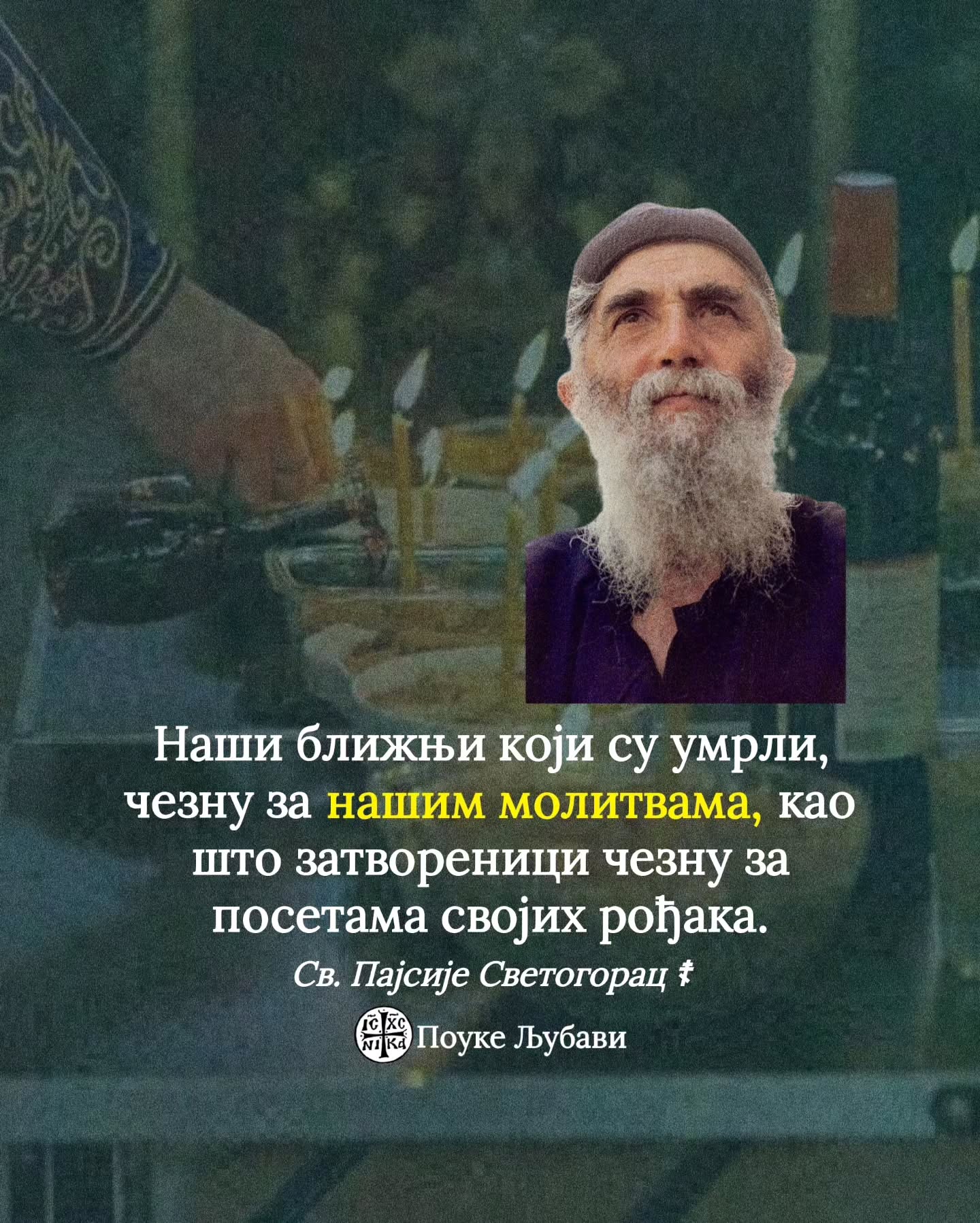
The post explains Zadušnice, the designated Saturdays in the Orthodox Church set aside for commemorating the dead. It opens with a saying attributed to Saint Nikolai Velimirovich: if the dead could speak, they would ask only for prayers, because they can no longer pray for themselves. The text describes the practice: on these Saturdays the Church serves the Divine Liturgy and parastas (memorial service), and the faithful bring koliva (boiled,…

The post explains Zadušnice, the designated Saturdays in the Orthodox Church set aside for commemorating the dead. It opens with a saying attributed to Saint Nikolai Velimirovich: if the dead could speak, they would ask only for prayers, because they can no longer pray for themselves. The text describes the practice: on these Saturdays the Church serves the Divine Liturgy and parastas (memorial service), and the faithful bring koliva (boiled, sweetened wheat) and written lists of their departed baptized relatives.

The priest censes the offerings and prays for the repose of all departed Orthodox Christians. A second quotation from Saint Paisios the Athonite compares the longing of the departed for our prayers to the longing of prisoners for visits from family.

  • Zadušnice are specific Saturdays dedicated to memorial services for the departed
  • The faithful bring koliva and lists of names to be commemorated at Liturgy and parastas
  • Saint Nikolai Velimirovich is quoted on the dead's inability to pray for themselves
  • Saint Paisios the Athonite likens the departed's desire for prayers to prisoners awaiting visits
  • The Church prays for all departed Orthodox Christians every Saturday, not only on Zadušnice
Read more