WeOrthodox
EN UA

St Anthony’s Youth SA ☦︎

Instagram ↗ 37 discussions

☦︎ Youth of St Anthony’s ☦︎ ☦︎ Greek Orthodox Church ☦︎ ☦︎ Prospect, South Australia ☦︎

Trials Reveal True Faithfulness to Christ Over Worldly Compromise

The author writes that God allows every generation to face trials that reveal the condition of hearts and the sincerity of faith. Christians throughout history confront choices between faithfulness to Christ and compromise with the fallen world, whether through worldly celebrations, entertainment, false teachings, normalization of sin, persecution, or last-days trials. Many profess love for Christ but choose worldly approval when obedience…

The author writes that God allows every generation to face trials that reveal the condition of hearts and the sincerity of faith. Christians throughout history confront choices between faithfulness to Christ and compromise with the fallen world, whether through worldly celebrations, entertainment, false teachings, normalization of sin, persecution, or last-days trials.

Many profess love for Christ but choose worldly approval when obedience requires sacrifice. The author cites Jesus' words that no one can serve two masters (Matthew 6:24) and Paul's statement that divisions exist so the approved may be recognized (1 Corinthians 11:19). Trials do not inform God but reveal spiritual condition and call to repentance.

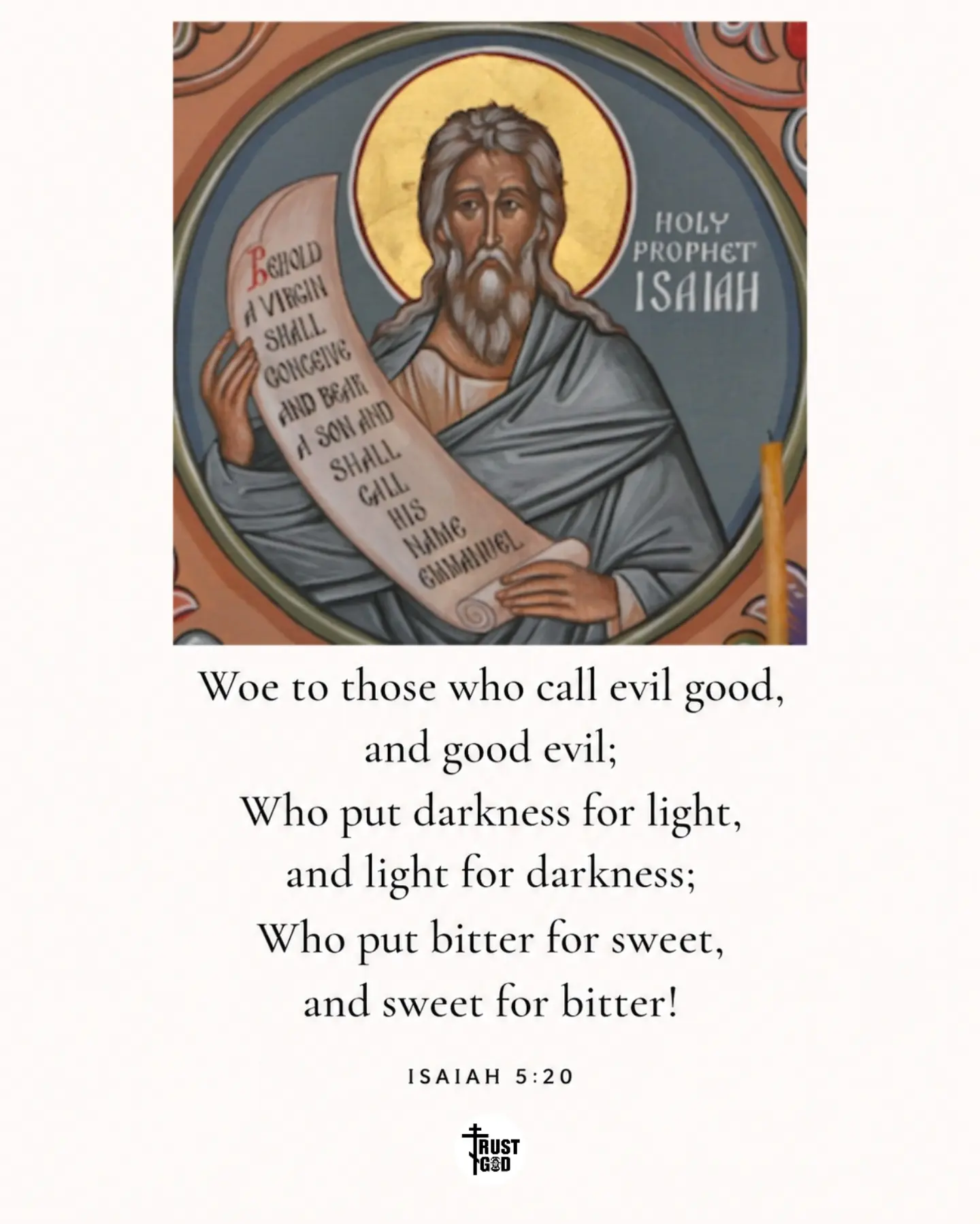
True Christianity is following Christ through repentance, obedience, humility, and love even when the world opposes His commandments. The image text applies this to the video game Grand Theft Auto VI, stating it glorifies what Christ came to free us from, and asks why Christians entertain themselves with the very sins Christ delivers from.

It quotes Isaiah 5:20 on calling evil good and good evil, and includes the full text of 2 Timothy 3:1-5 describing perilous last days: lovers of self, covetous, boasters, proud, blasphemers, disobedient to parents, unthankful, unholy, without natural affection, trucebreakers, false accusers, incontinent, fierce, despisers of good, traitors, heady, highminded, lovers of pleasures more than lovers of God, having a form of godliness but denying its power.

The post concludes with Revelation 2:10: be faithful until death to receive the crown of life.

  • God allows trials to reveal the true condition of hearts and faith.
  • True Christianity requires obedience and sacrifice, not merely verbal confession.
  • Worldly entertainment like GTA VI glorifies sins Christ came to deliver us from.
  • Scripture warns of divisions that distinguish the approved from the lukewarm.
  • Believers must not conform to the world but remain faithful until death.
Read more

The Entry of the Theotokos: Christmas begins in the Temple

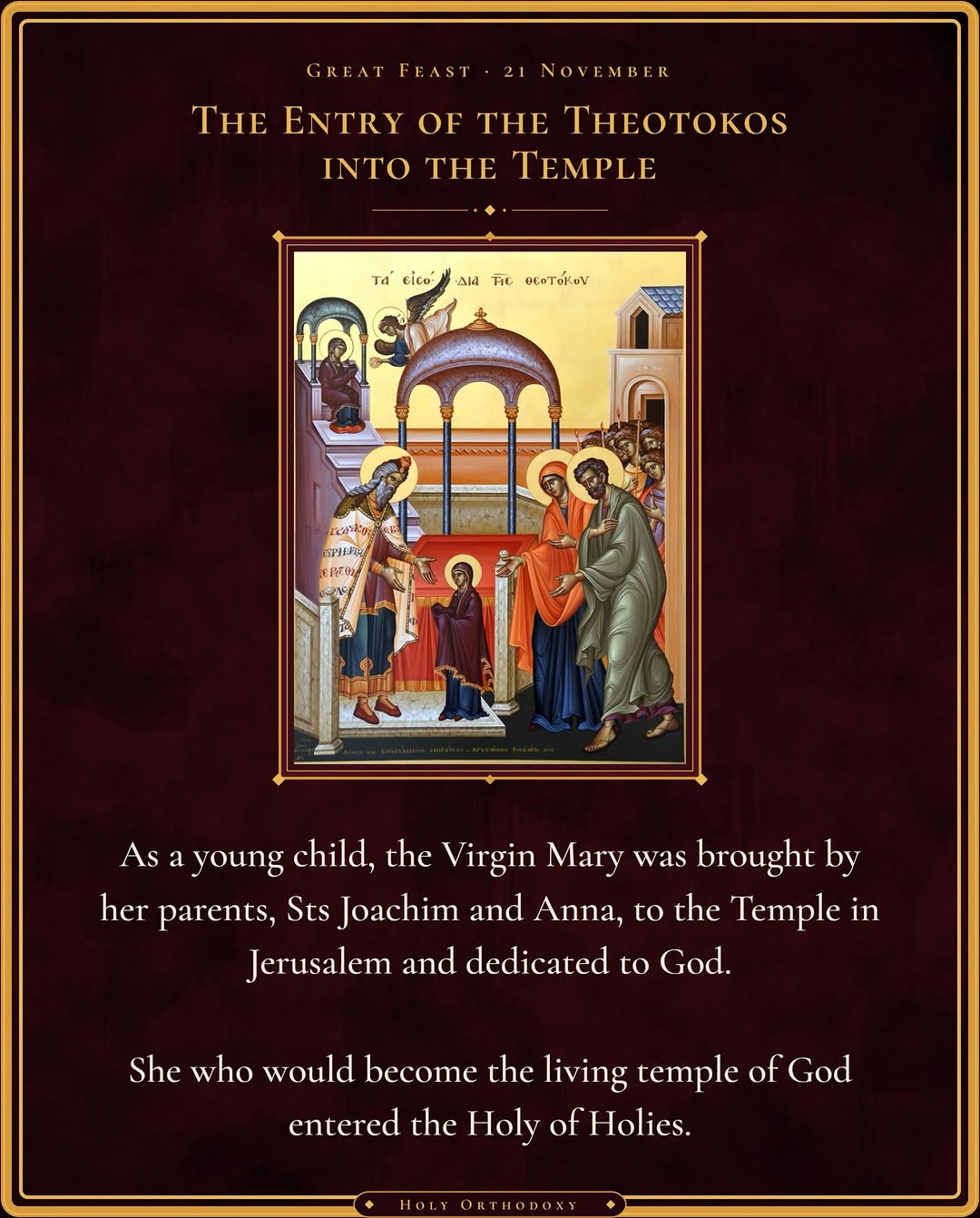
The post reflects on the Great Feast of the Entry of the Theotokos into the Temple, celebrated on 21 November. It describes how the Virgin Mary, as a young child, was brought by her parents, Sts Joachim and Anna, to the Temple in Jerusalem and dedicated to God. She entered the Holy of Holies, prefiguring her role as the living temple of God who would dwell in the flesh. The feast marks the first time in the liturgical year that the Church sings…

The post reflects on the Great Feast of the Entry of the Theotokos into the Temple, celebrated on 21 November. It describes how the Virgin Mary, as a young child, was brought by her parents, Sts Joachim and Anna, to the Temple in Jerusalem and dedicated to God. She entered the Holy of Holies, prefiguring her role as the living temple of God who would dwell in the flesh.

The feast marks the first time in the liturgical year that the Church sings the Nativity katavasia, "Christ is born, glorify Him!", signalling that the Nativity is already in sight. The author draws a parallel for the faithful: like Joachim and Anna, we are invited to offer what is most precious to us to God; like the Theotokos, we are called to make our hearts a place where He can live.

The post ends with the invocation, "Most Holy Theotokos, save us." The accompanying image text summarises the feast, noting that the Virgin Mary entered the Holy of Holies as a child and became the living temple of God.

  • Feast of the Entry of the Theotokos into the Temple on 21 November
  • Mary brought by Sts Joachim and Anna, entered the Holy of Holies
  • Prefigures her as the living temple of the Incarnation
  • Church begins singing "Christ is born, glorify Him!" for the first time
  • Invitation to offer our hearts to God as Joachim, Anna, and the Theotokos did
Read more
St Anthony’s Youth SA ☦︎ with Dylan☦️ Instagram

Father Seraphim Rose: suffering points to the Kingdom of Heaven

The post shares a quotation from Father Seraphim Rose, an Orthodox hieromonk and writer. He states that suffering indicates another Kingdom which Christians look toward. If being Christian meant happiness in this life, the Kingdom of Heaven would not be needed. The quote presents suffering as a sign that directs believers toward the eternal Kingdom rather than earthly comfort.

  • Suffering points to the Kingdom of Heaven
  • Christian faith is not about happiness in this life
  • The Kingdom of Heaven is necessary because this life involves suffering
  • The quote comes from Father Seraphim Rose, an Orthodox Christian teacher
Read more

Antonis Manolis, first Greek naturalized in Australia, honored by Archdiocese

The post recounts the life of Antonios (Andonis) Manolis, who arrived in Sydney on 27 August 1829 as one of seven Greek sailors from Hydra transported as convicts. They had been convicted of piracy during the Greek War of Independence after intercepting a British vessel they said was carrying supplies to Ottoman forces. After Greek independence brought a pardon, five of the men returned to Greece. Manolis and his countryman Gikas Voulgaris chose…

The post recounts the life of Antonios (Andonis) Manolis, who arrived in Sydney on 27 August 1829 as one of seven Greek sailors from Hydra transported as convicts. They had been convicted of piracy during the Greek War of Independence after intercepting a British vessel they said was carrying supplies to Ottoman forces. After Greek independence brought a pardon, five of the men returned to Greece.

Manolis and his countryman Gikas Voulgaris chose to remain. Manolis settled as a farmer and viticulturist in the Picton-Camden region of New South Wales. In 1854 he became the first Greek to be naturalised as a British subject in Australia. He died on 22 September 1880 at age 76 in Picton and was buried in Upper Picton Cemetery.

Though he had no family nearby, the local community erected a substantial headstone inscribed with the lines: "In a strange land the stranger finds a grave / Far from his home beyond the rolling wave." The Greek Orthodox Archdiocese of Australia later honoured Manolis during commemorations for the bicentenary of the Greek War of Independence, recognising his place as one of the first Greek settlers in the country.

  • Arrived in Sydney in 1829 as a convict with six other Hydra sailors
  • Pardoned after Greek independence; five returned to Greece, Manolis and Gikas Voulgaris stayed
  • Became a farmer and viticulturist in the Picton-Camden region
  • Naturalised as a British subject in 1854, the first Greek to do so in Australia
  • Honoured by the Greek Orthodox Archdiocese of Australia during the 1821 bicentenary
Read more

Elder Ephraim: Catch Temptation Early, Like an Ant Before It Becomes a Lion

Elder Ephraim teaches that sin starts with one thought we let stay a little too long. The devil's method is to introduce a tiny thought or fantasy that appears harmless, like a little ant. If a person does not chase away and kill that small thought while it is easy to do so, it grows slowly and unnoticed. The small thought eventually becomes like a wild, large lion that is very difficult and dangerous to fight. The moment to deal with temptation…

Elder Ephraim teaches that sin starts with one thought we let stay a little too long. The devil's method is to introduce a tiny thought or fantasy that appears harmless, like a little ant. If a person does not chase away and kill that small thought while it is easy to do so, it grows slowly and unnoticed.

The small thought eventually becomes like a wild, large lion that is very difficult and dangerous to fight. The moment to deal with temptation is at the very start, while it is still easy to brush away. Leave it, and it grows quietly until the fight is much harder.

The teaching urges striking at evil from the beginning, because once it becomes a lion it can inflict serious harm. This Nativity Fast, the post encourages trying to catch the small thoughts early and saying the Jesus Prayer the moment one arrives. When a person ignores a minor sinful thought or fantasy instead of rejecting it immediately, that thought grows imperceptibly from an ant into a lion.

By the time the person tries to confront it, the struggle has become difficult and dangerous. The teaching urges striking at evil from the very beginning while it is still small and easy to overcome.

Key moments

  1. The devil's method is to introduce a tiny thought or fantasy that appears harmless, like a little ant.
  2. If a person does not chase away and kill that small thought while it is easy to do so, it grows slowly and unnoticed.
  3. The small thought eventually becomes like a wild, large lion that is very difficult and dangerous to fight.
  4. One must strike at the evil from the beginning, because once it becomes a lion it can inflict serious harm.
Read more

St. Nektarios: Pure heart finds God in the Church's grace

The post shares a saying attributed to St. Nektarios the Wonderworker. It states that a person impelled by a pure heart discovers God in the world of grace of the Church, while the evil man remains far from that grace.

  • St. Nektarios teaches that a pure heart leads to discovering God in the Church's grace.
  • The evil man is far removed from that grace.

Why God Became Man: The Orthodox Meaning of Christmas

The post explains the Orthodox understanding of the Incarnation celebrated at Christmas. It opens with John 1:14 and states that the eternal Son of God took human nature through the Virgin Mary, becoming truly man without ceasing to be truly God. The purpose was not merely to teach morality or establish a religion but to save humanity from sin, corruption, and death. Through Adam's fall humanity became subject to corruption and death; Christ,…

The post explains the Orthodox understanding of the Incarnation celebrated at Christmas. It opens with John 1:14 and states that the eternal Son of God took human nature through the Virgin Mary, becoming truly man without ceasing to be truly God. The purpose was not merely to teach morality or establish a religion but to save humanity from sin, corruption, and death.

Through Adam's fall humanity became subject to corruption and death; Christ, the New Adam, came to restore fallen nature, reconcile humanity with God, and open the way to eternal life, as Luke 19:10 affirms. By uniting human nature to His divinity, Christ conquered death through His voluntary suffering, death on the Cross, and Resurrection, opening the gates of Paradise.

The post quotes Saint Athanasius the Great from On the Incarnation 54: "For He was made man that we might be made God." This introduces the mystery of theosis (deification), central to Orthodox Christianity. Citing 2 Peter 1:4, it explains that believers are called to become partakers of the divine nature by grace, not by essence.

The Creator entered creation, the Eternal entered time, the Immortal accepted death so that humanity might receive eternal life. Christmas is therefore not simply the celebration of Christ's birth but the celebration of God's love and the beginning of the fulfillment of salvation through Jesus Christ.

  • The Incarnation is motivated by God's infinite love for humanity
  • Christ as the New Adam restores human nature corrupted by Adam's fall
  • Saint Athanasius teaches the Incarnation enables theosis (deification)
  • Theosis means participation in divine life by grace, not becoming God by essence
  • Christmas marks the beginning of salvation's fulfillment through Christ
Read more

Saint Gregory Palamas: Defender of Hesychasm and Theosis

The post commemorates Saint Gregory Palamas on his feast day, November 14. Born in Constantinople in 1296, he received an imperial education but left court life for monasticism on Mount Athos, where he practiced Hesychasm and the Jesus Prayer. In the 14th century he defended the Orthodox teaching that God's essence is inaccessible while His energies are uncreated and communicable to humanity. This controversy arose against Barlaam of Calabria,…

The post commemorates Saint Gregory Palamas on his feast day, November 14. Born in Constantinople in 1296, he received an imperial education but left court life for monasticism on Mount Athos, where he practiced Hesychasm and the Jesus Prayer. In the 14th century he defended the Orthodox teaching that God's essence is inaccessible while His energies are uncreated and communicable to humanity.

This controversy arose against Barlaam of Calabria, who challenged the hesychast claim that the light of Christ's Transfiguration on Mount Tabor is divine and uncreated. Palamas articulated that through grace human beings truly participate in God's life, the doctrine of theosis, without becoming God by essence. He suffered persecution and imprisonment for this teaching. In 1347 he became Archbishop of Thessalonica, and in 1351 a council solemnly affirmed his theology.

He died in 1359 and is also commemorated on the Second Sunday of Great Lent. The post includes numerous quotations from his homilies, treatises, and the Philokalia on faith and works, the true nature of fasting, the Filioque, the authority of the saints, spiritual struggle against passions, unceasing prayer for all Christians, human culpability beyond Adam, the illumination of the purified heart, and the necessity of repentance for sexual sins.

  • Commemorates Saint Gregory Palamas (1296-1359), Archbishop of Thessalonica, on November 14
  • Defended hesychast theology: God's essence inaccessible, His energies uncreated and participable
  • Taught the Transfiguration light is uncreated divine glory, affirmed at councils in 1347 and 1351
  • Quotations cover faith and works, true fasting, the Filioque, saintly authority, spiritual warfare, unceasing prayer for laity, and repentance
  • Also commemorated on the Second Sunday of Great Lent as a defender of Orthodoxy
Read more

Saint Gregory Palamas commemorated November 14 as defender of uncreated light

The post marks the November 14 commemoration of Saint Gregory Palamas, Archbishop of Thessaloniki, wonderworker, and major theologian. It notes his life devoted to prayer, asceticism, and defense of Orthodox faith. He is especially revered for upholding the teaching on the uncreated light of God and humanity's participation in divine grace. Through his teachings, Saint Gregory emphasizes that the Christian life aims not merely to know about God…

The post marks the November 14 commemoration of Saint Gregory Palamas, Archbishop of Thessaloniki, wonderworker, and major theologian. It notes his life devoted to prayer, asceticism, and defense of Orthodox faith. He is especially revered for upholding the teaching on the uncreated light of God and humanity's participation in divine grace.

Through his teachings, Saint Gregory emphasizes that the Christian life aims not merely to know about God but to know Him personally through prayer, repentance, humility, and purification of the heart. He teaches that all are called to holiness, to draw closer to Christ, and to become partakers of the divine nature. The post concludes with a prayer for his intercession.

Key moments

  1. The hymn addresses Jesus Christ as the joyful light of the holy glory of the immortal Father, the heavenly, holy, blessed one.
  2. The faithful arrive at the sunset and, seeing the evening light, sing praise to the Father, Son, and Holy Spirit as God.
  3. The Son of God is declared worthy to be praised with fitting voices at all times because he gives life.
  4. The world glorifies Christ as the giver of life.
Read more

St Gregory Palamas: Feast Day and Defense of Hesychasm

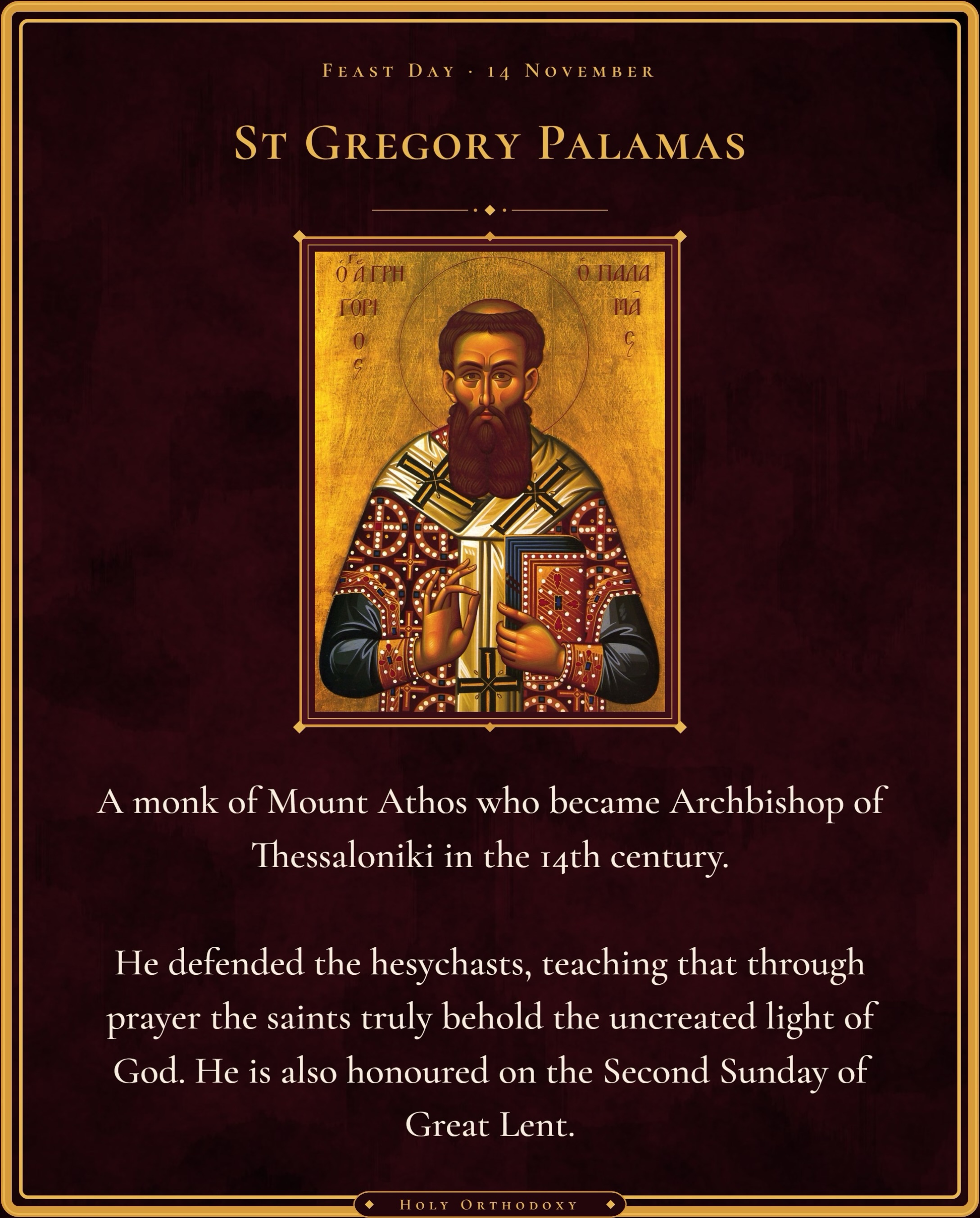
The post commemorates the feast of St Gregory Palamas on 14 November. Born in Constantinople in 1296 and raised near the imperial court, he abandoned a promising secular career for monastic life on Mount Athos. There he devoted himself to prayer. When the hesychast practice of prayer came under attack, Palamas defended it, teaching that through prayer the saints truly behold the uncreated light of God. His defense led to imprisonment. Later…

The post commemorates the feast of St Gregory Palamas on 14 November. Born in Constantinople in 1296 and raised near the imperial court, he abandoned a promising secular career for monastic life on Mount Athos. There he devoted himself to prayer. When the hesychast practice of prayer came under attack, Palamas defended it, teaching that through prayer the saints truly behold the uncreated light of God.

His defense led to imprisonment. Later appointed Archbishop of Thessaloniki, he faced initial rejection from his own city but remained faithful, humble, and loving toward his flock. The post notes that he is also honoured on the Second Sunday of Great Lent. It concludes with a reflective question: what are we willing to leave behind to draw closer to God?

  • Born 1296 in Constantinople, raised near imperial court
  • Left secular prospects for monastic life on Mount Athos
  • Defended hesychast prayer and the vision of uncreated light
  • Imprisoned for his defense; later made Archbishop of Thessaloniki
  • Also commemorated on the Second Sunday of Great Lent
Read more

St. John Chrysostom: Golden-Mouthed Preacher and Exiled Archbishop

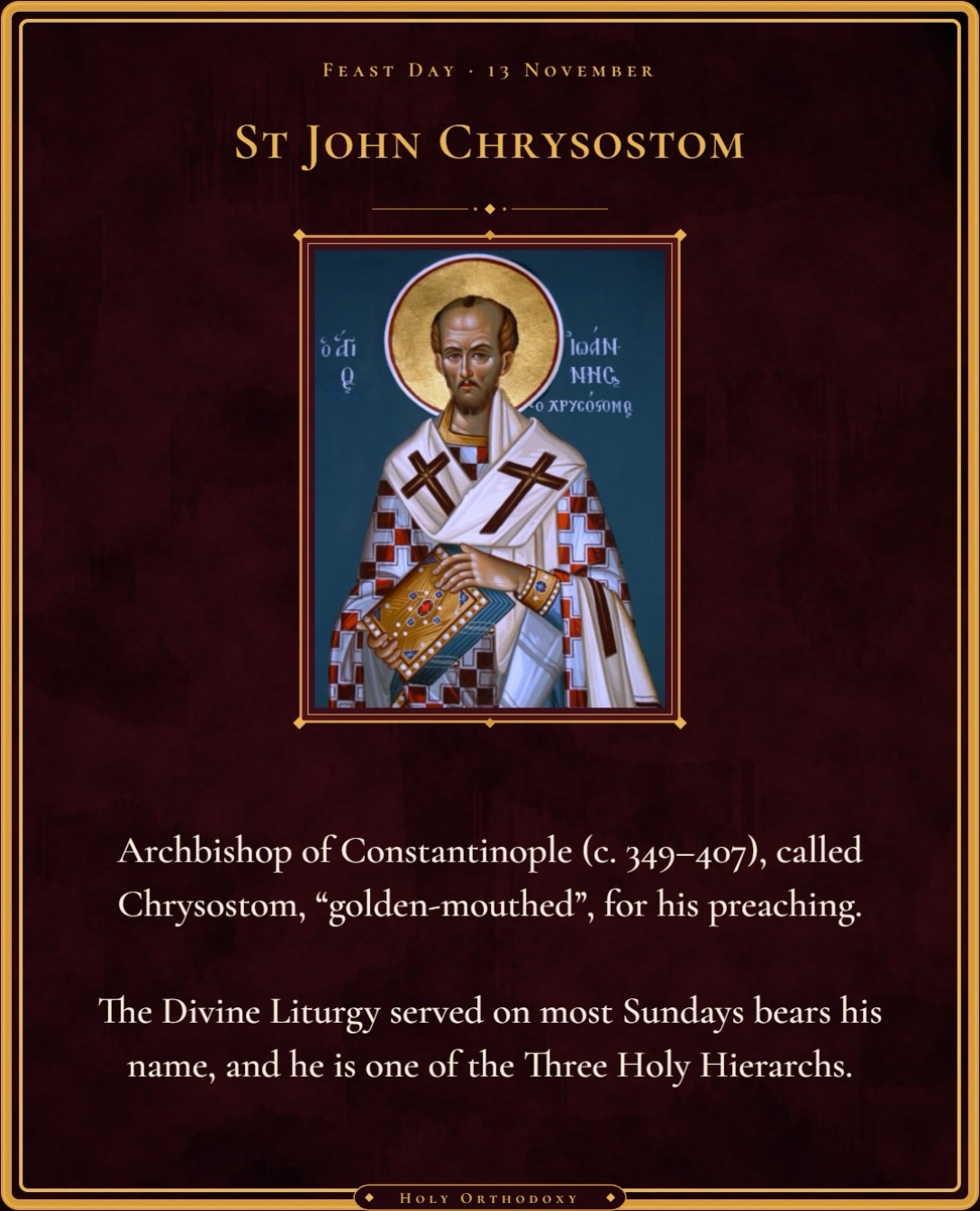
The post marks the feast day of St. John Chrysostom on 13 November. Born in Antioch around 349, he earned the name Chrysostom, meaning "golden-mouthed," for his preaching. As Archbishop of Constantinople, he cared for the poor and denounced greed and corruption among the powerful. His boldness led to exile, and he reposed in 407. The Divine Liturgy used on most Sundays bears his name, and he is honoured as one of the Three Holy Hierarchs. The…

The post marks the feast day of St. John Chrysostom on 13 November. Born in Antioch around 349, he earned the name Chrysostom, meaning "golden-mouthed," for his preaching. As Archbishop of Constantinople, he cared for the poor and denounced greed and corruption among the powerful.

His boldness led to exile, and he reposed in 407. The Divine Liturgy used on most Sundays bears his name, and he is honoured as one of the Three Holy Hierarchs. The accompanying image repeats these details, noting his dates as c. 349-407 and his title as Archbishop of Constantinople. The post ends with a request for his intercession.

  • Feast day observed on 13 November
  • Born in Antioch c. 349, named Chrysostom for his preaching
  • Served as Archbishop of Constantinople, defended the poor, opposed corruption
  • Exiled for his boldness, reposed in 407
  • Divine Liturgy bears his name; counted among the Three Holy Hierarchs
Read more

St Nicholas relic destroyed in France; theology of relic veneration explained

A small bone fragment of St Nicholas of Myra, approximately 1-2 cm long, was stolen from a display beneath his statue at the Basilica of Saint-Nicolas-de-Port in France and reportedly burned and crushed. The principal relics, including the arm-shaped reliquary, remain intact. The thief has been identified, arrested, confessed, and is expected to face trial in December 2026. The post traces the journey of St Nicholas' relics: the saint died in…

A small bone fragment of St Nicholas of Myra, approximately 1-2 cm long, was stolen from a display beneath his statue at the Basilica of Saint-Nicolas-de-Port in France and reportedly burned and crushed. The principal relics, including the arm-shaped reliquary, remain intact. The thief has been identified, arrested, confessed, and is expected to face trial in December 2026.

The post traces the journey of St Nicholas' relics: the saint died in 343 in Myra (modern Turkey); in 1087 Italian merchants from Bari took the relics from the monks who guarded them, despite local inhabitants begging for at least a small portion; some relics were later distributed regionally, including to France. The primary relics remain in the crypt tomb at the Basilica di San Nicola in Bari, where Orthodox services are held every Tuesday and Thursday, making it a significant site for Catholic-Orthodox dialogue.

The post explains Orthodox veneration of relics through the theology of theosis. Salvation is attained not by works or moral laws but through humility and repentance uniting us to God. At the Second Coming, Christ resurrects the dead in body and soul for judgment, so the body plays an equal role in salvation.

Those who lived in holiness receive grace that does not separate from their bodies after death. Archimandrite George Kapsanis of Mount Athos, citing St Gregory Palamas, writes that the grace of theosis preserves saints' bodies incorruptible; grace first unites with their souls, then takes up residence in their bodies, graves, icons, and churches.

This is why Orthodox Christians venerate and kiss relics, icons, graves, and churches, all retain something of the grace the saint possessed through union with God. The post also mentions relics at St Nicholas Monastery in Cyprus (4th century), a relics cabinet at St John's Monastery on Patmos containing part of St Nicholas' head, and the intact body of St Savvas in Kalymnos, Greece, with items in Sydney that exude myrrh.

  • A small relic fragment of St Nicholas was stolen and destroyed in France in 2026; the thief was arrested and confessed
  • St Nicholas' relics traveled from Myra (343) to Bari (1087) and were later distributed to France and other regions
  • Primary relics remain in Bari's Basilica di San Nicola, a site of Catholic-Orthodox dialogue with regular Orthodox services
  • Orthodox veneration of relics is grounded in theosis: grace remains in saints' bodies after death and extends to their graves, icons, and churches
  • The body is essential to salvation; at the Second Coming Christ resurrects body and soul for judgment
Read more

Putting Christ First: Daily Orthodox Habits of Prayer and Trust

The author urges believers to center daily life on Christ through three habitual expressions. Before any task, say "God willing" (Πρώτα ο Θεός). Upon receiving news, good or bad, say "Glory to God" (Δόξα τω Θεώ). When uncertain or worried, remember "God will provide" (Έχει ο Θεός). The speaker adds concrete practices: make the sign of the cross from within when sitting down to eat; cross the steering wheel when starting a car journey; before…

The author urges believers to center daily life on Christ through three habitual expressions. Before any task, say "God willing" (Πρώτα ο Θεός). Upon receiving news, good or bad, say "Glory to God" (Δόξα τω Θεώ). When uncertain or worried, remember "God will provide" (Έχει ο Θεός).

The speaker adds concrete practices: make the sign of the cross from within when sitting down to eat; cross the steering wheel when starting a car journey; before confirming an appointment, first ask God whether it will happen, and if speaking aloud might cause offense, keep the prayer in the heart. These habits aim to keep God at the centre of every action, trusting His providence and giving Him glory in all things.

Key moments

  1. 0:00 Put Christ first in all things; when you sit to eat, make the sign of the cross from within yourself.
  2. 0:00 When you begin a car trip, cross the steering wheel.
  3. 0:00 Before agreeing to an appointment, first say "God first" and ask God whether it will come to pass.
  4. 0:00 If you do not want to speak this aloud to avoid scandalizing others, keep it in your heart.

St. Paisios on God-centered marriage

The post shares a teaching attributed to St. Paisios stating that true love between a man and a woman can only exist when God is at the center of their lives. The quote appears in text over an image of a church interior with frescoes.

  • St. Paisios teaches God must be central for true marital love
  • Quote presented on church interior image
Read more

St. Nektarios: The Eucharist Is the Highest Mystery

The post presents a statement attributed to St. Nektarios the Wonderworker describing the Divine Eucharist. He identifies it as the mystery handed down by the Lord, the highest of all mysteries, and the most wondrous miracle performed by the power of God. The text offers no further commentary or discussion.

  • The Divine Eucharist is a mystery handed down by the Lord.
  • It is the highest of all mysteries.
  • It is the most wondrous miracle of God's power.
  • The statement is ascribed to St. Nektarios the Wonderworker.

St. Isaac the Syrian's Prayer for Contrition and the Great Doxology

The post presents a short prayer attributed to St. Isaac the Syrian that asks for a contrite heart and strength so that acceptable tears may flow and the heart may be illumined by pure prayer. Alongside this prayer, a video summary describes the structure of a liturgical hymn that begins by glorifying the one who has shown the light, continues with the angelic hymn from Luke 2:14, glory to God in the highest and on earth peace, good will among…

The post presents a short prayer attributed to St. Isaac the Syrian that asks for a contrite heart and strength so that acceptable tears may flow and the heart may be illumined by pure prayer. Alongside this prayer, a video summary describes the structure of a liturgical hymn that begins by glorifying the one who has shown the light, continues with the angelic hymn from Luke 2:14, glory to God in the highest and on earth peace, good will among men, and concludes with the worshippers praising, blessing, worshipping, glorifying, and giving thanks to God for his great Lord.

The video points list three key lines: glory to the one who has shown the light; glory in the highest to God and on earth peace, good will among men; and we praise you, we bless you, we worship you, we glorify you, we give thanks to you for your great Lord. The post combines a personal petition for compunction from a seventh-century Syrian ascetic with an outline of the Great Doxology, a hymn used in Orthodox matins and other services. No further discussion or commentary is included in the source.

Key moments

  1. Glory be to you who have shown the light.
  2. Glory in the highest to God and on earth peace good will among men.
  3. We praise you, we bless you, we worship you, we glorify you, we give thanks to you for your great Lord.
Read more

Calling on Jesus' name and the sign of the cross in spiritual warfare

The post teaches that in times of temptation one should immediately call upon the name of Jesus Christ and make the sign of the cross. The author states that demons tremble at the name of Christ and that the cross is the sign of His victory over sin, death, and the devil. The Jesus Prayer, "Lord Jesus Christ, Son of God, have mercy on me, a sinner", is given as the specific invocation. The text cites James 4:7: "Resist the devil, and he will…

The post teaches that in times of temptation one should immediately call upon the name of Jesus Christ and make the sign of the cross. The author states that demons tremble at the name of Christ and that the cross is the sign of His victory over sin, death, and the devil. The Jesus Prayer, "Lord Jesus Christ, Son of God, have mercy on me, a sinner", is given as the specific invocation.

The text cites James 4:7: "Resist the devil, and he will flee from you." The accompanying video summary adds that Jesus Christ is the slayer of Satan and that His name acts as kryptonite to evil. It notes that St. Paul describes the Christian life as a condition of spiritual war.

When sensing attack, one should humble oneself, call on the name of Jesus, and make the sign of the cross in the name of the Father, the Son, and the Holy Spirit. The video recounts that St. Anthony the Great saw demons assaulting him erupt in fire when he invoked the Lord's name and made the sign of the precious cross. Refuge is found in the name of the Lord, and drawing His cross brings rescue, peace, and protection.

The video further explains that speaking or calling on the name of Jesus is great power and great protection, and that the sign of the cross is a great and potent force against all evil. It emphasizes that we live in a condition of spiritual war, as St. Paul says, and that the proper response to demonic assault is humility, invocation of the name, and the sign of the cross.

St. Anthony's experience illustrates the immediate effect of these weapons: the demons erupted in fire. The conclusion is that the name of the Lord is a refuge and that making the sign of the cross brings the Lord's rescue, granting great peace and protection.

Key moments

  1. Jesus Christ is the slayer of Satan, and His name is kryptonite to evil.
  2. Speaking or calling on the name of Jesus is great power and great protection.
  3. The sign of the cross is a great and potent force against all evil.
  4. We live in a condition of spiritual war, as St. Paul says.
  5. When sensing attack, one should humble oneself, call on the name of Jesus, and make the sign of the cross in the name of the Father, the Son, and the Holy Spirit.
  6. St. Anthony the Great saw demons assaulting him erupt in fire when he called on the name of the Lord and made the sign of the precious cross.
  7. Find refuge in the name of the Lord; draw His cross on you and the Lord will come to your rescue and grant great peace and protection.
Read more

Saint Nektarios of Aegina: Life, Miracles, and Spiritual Wisdom

The post presents a biographical sketch of Saint Nektarios (1846-1920), born Anastasios in Thrace. He studied in Constantinople, became a monk on Chios in 1876, and was ordained deacon in 1877, taking the name Nektarios. After theological studies he was ordained priest in Alexandria in 1886 and consecrated Metropolitan of Pentapolis in Libya in 1889. False accusations by envious clerics led Patriarch Sophronios to expel him from Egypt in 1890.…

The post presents a biographical sketch of Saint Nektarios (1846-1920), born Anastasios in Thrace. He studied in Constantinople, became a monk on Chios in 1876, and was ordained deacon in 1877, taking the name Nektarios. After theological studies he was ordained priest in Alexandria in 1886 and consecrated Metropolitan of Pentapolis in Libya in 1889.

False accusations by envious clerics led Patriarch Sophronios to expel him from Egypt in 1890. In Athens he could not obtain a bishopric and became director of the Rizarios Ecclesiastical School in 1894, where he wrote the hymn "Agni Parthene." Known for humility, sweeping floors and cleaning toilets, he founded the Holy Trinity convent on Aegina in 1904 and lived there from 1908 until his death from prostate cancer in 1920.

After his repose his undershirt healed a paralyzed man, and his funeral was conducted by Saint Savvas of Kalymnos. The post also collects eleven sayings attributed to Saint Nektarios on themes including being remembered in others' darkness, suffering as purification, prayer as the breath of the soul, happiness as a pure heart, vigilance against temptation, hope amid repeated falls, trust in God's unseen answers, and the purpose of temptations to reveal hidden passions.

  • Born in Thrace 1846; monk on Chios 1876; Metropolitan of Pentapolis 1889
  • Expelled from Egypt 1890 after false accusations; directed Rizarios School in Athens
  • Founded Holy Trinity convent on Aegina 1904; lived there 1908-1920
  • Posthumous miracle: undershirt healed a paralyzed man; funeral by Saint Savvas of Kalymnos
  • Eleven collected sayings on suffering, prayer, hope, temptation, and pure heart
Read more

Synaxis of Archangel Michael and the Bodiless Powers

The post announces the feast of the Synaxis of the Archangel Michael and all the Bodiless Powers of Heaven. It names the seven archangels: Michael, Gabriel, Raphael, Uriel, Selaphiel, Jegudiel, and Barachiel, together with the countless hosts of angels. It describes their worship before the throne of God, singing the trisagion without ceasing. It outlines their active ministry: they guard, heal, bring good news, and stand beside the faithful in…

The post announces the feast of the Synaxis of the Archangel Michael and all the Bodiless Powers of Heaven. It names the seven archangels: Michael, Gabriel, Raphael, Uriel, Selaphiel, Jegudiel, and Barachiel, together with the countless hosts of angels. It describes their worship before the throne of God, singing the trisagion without ceasing.

It outlines their active ministry: they guard, heal, bring good news, and stand beside the faithful in every trial. The post notes that at every Divine Liturgy the faithful join their voices with the angelic choirs. It cites Psalm 34:7: "The angel of the LORD encamps all around those who fear Him, And delivers them." It concludes with a prayer to the holy archangels and all the bodiless powers of heaven.

  • Feast of the Synaxis of Archangel Michael and all Bodiless Powers observed today
  • Seven archangels named: Michael, Gabriel, Raphael, Uriel, Selaphiel, Jegudiel, Barachiel
  • Angels worship before God's throne and serve by guarding, healing, announcing, and assisting the faithful
  • Divine Liturgy unites the voices of the faithful with the angelic choirs
  • Psalm 34:7 cited: the angel of the Lord encamps around those who fear Him
Read more

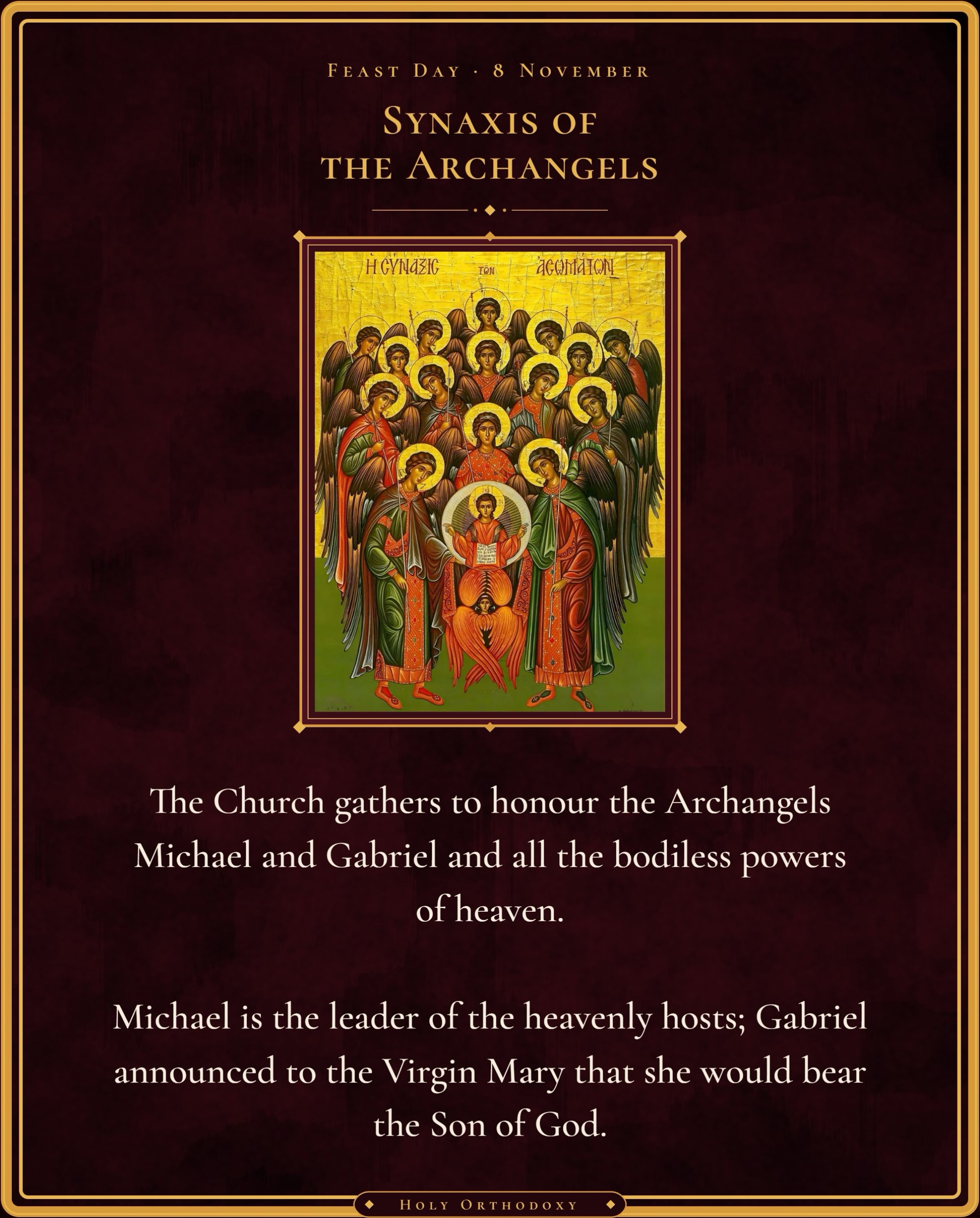
Synaxis of the Archangels Michael and Gabriel, 8 November

The post marks the feast of the Synaxis of the Archangels Michael and Gabriel and all the bodiless powers on 8 November. It explains that the Church gathers to honour the holy angels who stand before God's throne, guard the faithful, and carry His messages. Michael, whose name means "Who is like God?", is identified as the leader of the heavenly hosts. Gabriel is noted as the messenger who announced to the Virgin Mary that she would bear the Son…

The post marks the feast of the Synaxis of the Archangels Michael and Gabriel and all the bodiless powers on 8 November. It explains that the Church gathers to honour the holy angels who stand before God's throne, guard the faithful, and carry His messages. Michael, whose name means "Who is like God?", is identified as the leader of the heavenly hosts.

Gabriel is noted as the messenger who announced to the Virgin Mary that she would bear the Son of God. The post gives the reason for the date: November is the ninth month counting from March, the month of creation, recalling the nine ranks of angels. The Fathers call the Last Judgement "the eighth day", when the angels will come with Christ in glory.

The post concludes with a prayer to the holy archangels and a greeting to those celebrating their name day: Michael, Gabriel, Angelos, Angeliki, and Taxiarchis.

  • The feast honours Archangels Michael and Gabriel and all bodiless powers.
  • Michael means "Who is like God?" and leads the heavenly hosts.
  • Gabriel announced the Incarnation to the Virgin Mary.
  • The date 8 November reflects the ninth month from March (creation) and the nine angelic ranks.
  • The Fathers call the Last Judgement the eighth day, when angels accompany Christ.
Read more