WeOrthodox
EN UA

Prayer Orthodoxy ®

Instagram ↗ 196 discussions

Prayer Orthodoxy® Orthodox Christianity Through Scripture, Tradition, and the Saints Deepen Your Understanding of the Faith

Prayer Orthodoxy ® with Holy Orthodoxy Instagram

The Prayer That Opens Orthodox Life: O Heavenly King
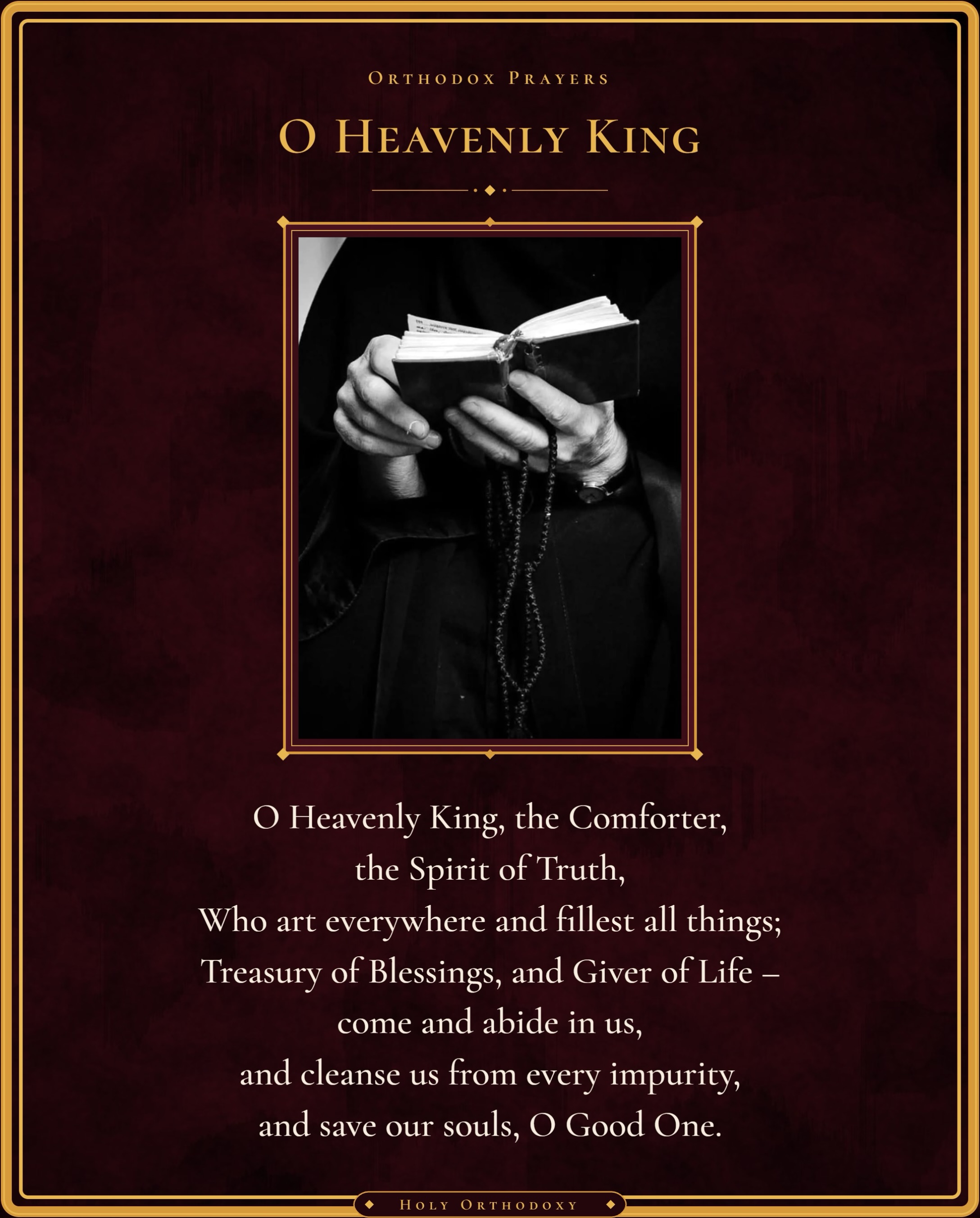
The post presents the prayer "O Heavenly King" as the foundational invocation that begins nearly every aspect of Orthodox Christian life, morning and evening prayers, the divine services, and the start of any task. Before petitioning God for specific needs, the faithful first call upon the Holy Spirit to come and dwell within them. The full text of the prayer is provided, addressing the Spirit as the Comforter, the Spirit of Truth, who is…

The post presents the prayer "O Heavenly King" as the foundational invocation that begins nearly every aspect of Orthodox Christian life, morning and evening prayers, the divine services, and the start of any task. Before petitioning God for specific needs, the faithful first call upon the Holy Spirit to come and dwell within them.

The full text of the prayer is provided, addressing the Spirit as the Comforter, the Spirit of Truth, who is everywhere present and fills all things, the Treasury of Blessings and Giver of Life. The petition asks the Spirit to come and abide in us, cleanse us from every impurity, and save our souls. The author encourages readers to memorize the prayer within a week and to recite it slowly before beginning the day or reading Scripture.

The practice is to be undertaken in accordance with the guidance of one's spiritual father.

  • "O Heavenly King" is the standard opening prayer for Orthodox services, daily rule, and undertakings
  • The prayer invokes the Holy Spirit as Comforter, Spirit of Truth, everywhere present, Treasury of Blessings, Giver of Life
  • It asks the Spirit to come, abide, cleanse from impurity, and save the soul
  • The author recommends memorizing it and saying it slowly before the day or Scripture reading
  • The practice should follow the advice of one's spiritual father
Read more
Prayer Orthodoxy ® Instagram

The Communion Spoon as Tongs: Isaiah's Coal and the Eucharist

The post explains the meaning behind the Greek name for the Communion spoon, lavida (λαβίδα), which translates as "tongs." This term connects the liturgical implement to the vision of the prophet Isaiah in the sixth chapter of his book. In that vision, Isaiah sees the Lord seated on a high throne, surrounded by seraphim. Aware of his own uncleanness, Isaiah cries out that he is a man of unclean lips. One of the seraphim then flies to him with a…

The post explains the meaning behind the Greek name for the Communion spoon, lavida (λαβίδα), which translates as "tongs." This term connects the liturgical implement to the vision of the prophet Isaiah in the sixth chapter of his book. In that vision, Isaiah sees the Lord seated on a high throne, surrounded by seraphim.

Aware of his own uncleanness, Isaiah cries out that he is a man of unclean lips. One of the seraphim then flies to him with a burning coal taken from the altar with tongs, touches his mouth, and declares that his guilt is taken away and his sin purged. Orthodox tradition reads this burning coal as a type or foreshadowing of Christ himself, who is received in the Holy Eucharist.

The Communion spoon, called lavida because it functions like the tongs in the vision, carries the Body and Blood of Christ to the lips of the faithful. The post presents this connection in both English and Greek, and the accompanying image breaks the explanation into three parts: the name lavida and its link to the Old Testament, the details of Isaiah's vision and the seraph's action, and the Eucharistic fulfillment in which the faithful approach the chalice with repentance, faith, and love to receive Christ's true Body and Blood for the forgiveness of sins and life everlasting.

The discussion centers on this typological interpretation, showing how a moment in the Divine Liturgy recalls and participates in a prophetic revelation of purification and communion with God.

  • The Greek term lavida (λαβίδα) means "tongs" and names the Communion spoon.
  • The name recalls the seraph who used tongs to touch Isaiah's lips with a burning coal (Isaiah 6).
  • Orthodox tradition sees the burning coal as a type of Christ received in the Eucharist.
  • The spoon functions as the tongs that bring the holy gift to the communicant's lips.
  • The faithful receive Christ's true Body and Blood for forgiveness of sins and eternal life.
Read more

Orthodox Atonement: Christ Heals Human Nature, Not Penal Substitution

The speaker begins by advising against conversion to Eastern Orthodoxy. He explains that Eastern Orthodox Christians reject penal substitution, the doctrine that Jesus bore the Father's punishment for human sins on the cross. The speaker clarifies that Orthodox theology does not deny the crucifixion but interprets it differently: human nature was corrupted by sin, and Christ assumed that corrupted nature to heal it through his death and…

The speaker begins by advising against conversion to Eastern Orthodoxy. He explains that Eastern Orthodox Christians reject penal substitution, the doctrine that Jesus bore the Father's punishment for human sins on the cross. The speaker clarifies that Orthodox theology does not deny the crucifixion but interprets it differently: human nature was corrupted by sin, and Christ assumed that corrupted nature to heal it through his death and resurrection.

He cites St. Gregory the Theologian's maxim: "What is not assumed is not healed." According to this view, Christ suffered willingly out of love to save humanity from sin and death, not because the Father required punishment. The speaker argues that penal substitution misunderstands the entire purpose of Christ's sacrifice.

He states that Orthodox Christians believe Jesus died on the cross, but not as a penal substitute; rather, Christ's assumption of fallen humanity enables its restoration. The purpose of the incarnation and crucifixion is to heal human nature from within, saving people from sin and death by divine love, not by satisfying divine wrath.

Key moments

  1. The speaker says people should not convert to Orthodoxy.
  2. Eastern Orthodox reject penal substitution, Jesus did not take punishment from the Father for our sins.
  3. Orthodox believe Jesus died on the cross but not as penal substitution.
  4. Penal substitution misunderstands the entire purpose of Christ's sacrifice.
  5. Human nature was corrupted by sin and Christ assumed it to heal it through his death and resurrection.
  6. St. Gregory the Theologian said: what is not assumed is not healed.
  7. Christ willingly suffered out of love, not because the Father needed to punish him.
  8. The purpose was to save us from sin and death.
Prayer Orthodoxy ® Instagram

Nativity Fast Begins November 15: Fasting as Preparation for Christ's Birth

The post announces the beginning of the Nativity Fast on November 15, a forty-day period of preparation for the feast of Christ's Nativity. It explains that fasting expresses the faithful's longing for Christ and readies the heart to receive His grace through prayer, repentance, and almsgiving. The text cites Luke 5:33-39, where the Pharisees and disciples of John question Jesus about why His disciples eat and drink while they fast often and…

The post announces the beginning of the Nativity Fast on November 15, a forty-day period of preparation for the feast of Christ's Nativity. It explains that fasting expresses the faithful's longing for Christ and readies the heart to receive His grace through prayer, repentance, and almsgiving. The text cites Luke 5:33-39, where the Pharisees and disciples of John question Jesus about why His disciples eat and drink while they fast often and make prayers.

Jesus responds that the friends of the bridegroom cannot fast while the bridegroom is with them, but they will fast when He is taken away. He then gives two parables. First, no one sews a piece from a new garment onto an old one, because the new tears the old and the patch does not match. Second, no one puts new wine into old wineskins, or the wine bursts the skins and is spilled; new wine must go into new wineskins so both are preserved.

Jesus adds that no one who has drunk old wine immediately desires new, for he says the old is better. The post applies these images to the Nativity Fast, suggesting the season renews the heart like new wineskins to receive the Savior. The message appears in both English and Greek, and is attributed to Prayer Orthodoxy.

Key moments

  1. 0:00 The Pharisees and disciples of John ask Jesus why his disciples eat and drink while they fast often and make prayers.
  2. 0:00 Jesus replies that the friends of the bridegroom cannot fast while the bridegroom is with them, but they will fast when the bridegroom is taken away.
  3. 0:30 Jesus gives the parable of the new garment: a piece from a new garment tears the old and does not match it.
  4. 0:30 Jesus gives the parable of the wineskins: new wine bursts old wineskins, spilling the wine and ruining the skins; new wine must go into new wineskins so both are preserved.
  5. 0:30 Jesus says no one who has drunk old wine immediately desires new, for he says the old is better.
Read more
Prayer Orthodoxy ® with thegreekguy Instagram

Greek Orthodox visitor describes Divine Liturgy at Saint Sava Cathedral in Belgrade

The author, a Greek Orthodox Christian, recounts attending Sunday Divine Liturgy at Saint Sava Cathedral in Belgrade. He notes the worship resembles Greek practice but with distinct differences: the nave has no chairs or pews, so the congregation stands throughout the service. The chanting combines a solo psaltis with a large choir and uses no organ accompaniment, which he considers among the best he has heard. The interior iconography inspires…

The author, a Greek Orthodox Christian, recounts attending Sunday Divine Liturgy at Saint Sava Cathedral in Belgrade. He notes the worship resembles Greek practice but with distinct differences: the nave has no chairs or pews, so the congregation stands throughout the service. The chanting combines a solo psaltis with a large choir and uses no organ accompaniment, which he considers among the best he has heard.

The interior iconography inspires humility and awe. A striking detail is that the icon of Christ beneath the central dome bears its inscription in Greek rather than Serbian. The author recommends that any Orthodox Christian visiting Belgrade attend the Sunday Liturgy at Saint Sava. The post was filmed by Chris Benis, identified as a TNH/EK journalist.

  • No seating; congregation stands for the entire Liturgy
  • Chanting blends a psaltis with a large choir, no organ
  • Iconography described as stunning, evoking humility and awe
  • Christ Pantocrator icon under the dome inscribed in Greek
  • Author recommends the Sunday Liturgy to visiting Orthodox Christians
Read more

Saint John Chrysostom on the Christian as athlete, soldier, and farmer

Saint John Chrysostom in Homily 3, To the People of Antioch, compares the faithful man to a farmer, a pilot, a soldier, an athlete, and a traveler. The homily teaches that to become an athlete one must strip off worldly affairs and enter the contest; to become a soldier one must put on spiritual weapons and stand in battle against demons. The soul must be cultivated like a field, the body disciplined, and desires subdued so that the vessel is…

Saint John Chrysostom in Homily 3, To the People of Antioch, compares the faithful man to a farmer, a pilot, a soldier, an athlete, and a traveler. The homily teaches that to become an athlete one must strip off worldly affairs and enter the contest; to become a soldier one must put on spiritual weapons and stand in battle against demons.

The soul must be cultivated like a field, the body disciplined, and desires subdued so that the vessel is saved, for an athlete is not crowned unless he competes according to the rules. The faithful must cultivate the soul and cut out the thorns, sow the word of piety and tend it with much care. They must discipline the body and bring it into subjection, subdue the waves of unseemly desires, beat back the storm of wicked thoughts, and save the vessel.

The homily presents spiritual life as active engagement: stripping off worldly cares because it is time for wrestling, putting on spiritual weapons because a difficult war has been arrayed against demons. Each metaphor illustrates a different aspect of the Christian struggle, cultivation, navigation, warfare, athletic contest, and pilgrimage, all requiring deliberate effort and adherence to divine rules.

Key moments

  1. The faithful man is both a farmer and a pilot and a soldier and an athlete and a traveler.
  2. If you are an athlete, you must enter the contest; if you are a soldier, you must stand in the line of battle fully armed.
  3. Strip off the affairs of this life and you have become an athlete; put on the spiritual weapons and you have become a soldier.
  4. Strip yourself of worldly cares for it is the time for wrestling; put on the spiritual weapons for a difficult war has been arrayed for us against demons.
  5. Cultivate your soul and cut out the thorns; sow the world of piety and tend it with much care.
  6. Discipline your body and bring it into subjection; subdue the waves of unseemly desires, beat back the storm of wicked thoughts and save the vessel.
  7. For an athlete is not crowned unless he competes according to the rules.
Read more

Three Lessons on Carrying the Cross from Luke 9:18-26

The speaker reads Luke 9:18-26, where Jesus asks the disciples who the crowds say he is, they answer John the Baptist, Elijah, or an old prophet, then Jesus asks who they say he is, and Peter confesses him as the Christ of God. Jesus warns them to tell no one, saying the Son of Man must suffer, be rejected by the elders, chief priests, and scribes, be killed, and be raised the third day. Jesus then says that anyone who desires to follow him must…

The speaker reads Luke 9:18-26, where Jesus asks the disciples who the crowds say he is, they answer John the Baptist, Elijah, or an old prophet, then Jesus asks who they say he is, and Peter confesses him as the Christ of God. Jesus warns them to tell no one, saying the Son of Man must suffer, be rejected by the elders, chief priests, and scribes, be killed, and be raised the third day.

Jesus then says that anyone who desires to follow him must deny himself, take up his cross daily, and follow him, for whoever desires to save his life will lose it, but whoever loses his life for Christ's sake will save it, and what profit is it to gain the whole world and be destroyed or lost. The speaker states that everyone wants the blessings of following Jesus but few are prepared to carry their cross, because Christ never promised an easy life and his teaching goes against modern ideas of happiness and self-fulfillment.

This teaching confronts the way most people live, because the world tells us to follow our passions and prioritize comfort, but Christ calls us to deny ourselves, take up our cross, and follow him. The speaker explains three lessons from this passage. First, denying yourself means fighting against sinful passions such as lust, pride, greed, and selfishness through practices like fasting, confession, repentance, and communion.

Second, taking up your cross is a daily commitment; Christ says daily, not weekly or monthly, and the cross can be suffering, illness, rejection, hardships, forgiving someone who hurt you, resisting temptation, or staying faithful when times get tough. Third, gaining the whole world means nothing if you lose your soul; you can build a successful business, accumulate wealth, develop an impressive physique, gain recognition, and achieve everything society considers successful, but if you neglect your relationship with God, you have gained nothing because everything in this world is temporary and the soul is eternal.

The speaker ends by asking whether we are following Christ or expecting Christ to follow the life we have chosen, and cites Matthew 6:33 to seek first the Kingdom of God.

Key moments

  1. 0:00 The speaker states that everyone wants the blessings of following Jesus but few are prepared to carry their cross, because Christ never promised an easy life and his teaching goes against modern ideas of happiness and self-fulfillment.
  2. 0:31 The speaker reads Luke 9:18-26, where Jesus asks the disciples who the crowds say he is, they answer John the Baptist, Elijah, or an old prophet, then Jesus asks who they say he is, and Peter confesses him as the Christ of God.
  3. 1:02 Jesus strictly warns them to tell no one, saying the Son of Man must suffer many things, be rejected by the elders, chief priests, and scribes, be killed, and be raised the third day.
  4. 1:02 Jesus then says to all that if anyone desires to come after him, let him deny himself, take up his cross daily, and follow him, for whoever desires to save his life will lose it, but whoever loses his life for Christ's sake will save it, and what profit is it to gain the whole world and be destroyed or lost.
  5. 1:34 The speaker says this teaching confronts the way most people live, because the world tells us to follow our passions and prioritize comfort, but Christ calls us to deny ourselves, take up our cross, and follow him.
  6. 2:06 The first lesson: denying yourself means fighting against sinful passions, selfish desires, lust, pride, greed, and habits that separate us from God, not hating yourself or neglecting responsibilities, and the Orthodox Church emphasizes fasting, confession, repentance, and communion for this.
  7. 2:06 The second lesson: taking up your cross is a daily commitment; Christ says "daily," not weekly or monthly, and the cross can be suffering, illness, rejection, hardships, forgiving someone who hurt you, resisting temptation, or staying faithful when times get tough.
  8. 2:40 The third lesson: gaining the whole world means nothing if you lose your soul; you can build a successful business, accumulate wealth, develop an impressive physique, gain recognition, and achieve everything society considers successful, but if you neglect your relationship with God, you have gained nothing because everything in this world is temporary and the soul is eternal.
Read more

Sexual Intimacy and Spiritual Danger: An Orthodox Perspective

The speaker addresses claims found in some occult traditions that sexual intimacy can establish spiritual bonds, transfer power, or drain another person's blessings. He distinguishes these claims from Christian teaching: the real danger, from an Orthodox Christian perspective, lies in sexual immorality, spiritual attachment, and lust pulling a person away from God. He turns to Genesis 39, where Joseph resisted Potiphar's wife and fled, leaving…

The speaker addresses claims found in some occult traditions that sexual intimacy can establish spiritual bonds, transfer power, or drain another person's blessings. He distinguishes these claims from Christian teaching: the real danger, from an Orthodox Christian perspective, lies in sexual immorality, spiritual attachment, and lust pulling a person away from God.

He turns to Genesis 39, where Joseph resisted Potiphar's wife and fled, leaving his garment behind, which some interpret as a symbol of his spiritual authority and divine favor. He cites 1 Corinthians 6:18, where Saint Paul says 'Flee sexual immorality,' and 1 Corinthians 6:16, which teaches that sexual union makes two people one flesh.

Sex, he argues, was never intended as a casual exchange of pleasure but is a sacred gift intended for marriage. He cautions against attributing every financial downfall or personal struggle to a sexual relationship or spiritual attack, while noting that the people we become intimate with can influence our peace, judgment, relationships, and spiritual direction.

Repeated surrender to lust, he says, leads to loss of spiritual vigilance, inner peace, and discernment, not because someone magically stole a person's destiny, but because sin has consequences. He concludes that believers should guard their bodies and souls and be careful about whom they allow into their lives, not out of fear of witches or warlocks, but because the body is sacred and the soul is precious.

Key moments

  1. 0:00 Some occult teachings claim that through sexual encounters a person can access another's spiritual inheritance, drain their energy, and establish spiritual covenants.
  2. 0:39 Joseph refused Potiphar's wife's seduction and fled, leaving his garment behind, which some interpret as a symbol of his spiritual authority, calling, or divine favor.
  3. 1:11 Saint Paul warns in 1 Corinthians 6:16 that sexual immorality is spiritually serious because it can enslave us to our passions, distort our relationships, and distance us from communion with God.
  4. 1:42 Repeatedly surrendering to lust causes loss of spiritual vigilance, inner peace, and discernment not because someone magically stole our destiny, but because sin has consequences.
  5. 1:42 Be careful who you allow into your life, not out of fear of witches or warlocks, but because your body is sacred and your soul is precious.
Read more
Prayer Orthodoxy ® with ☦︎ICXC•NIKA☦︎ Instagram

Icon of St Ephraim Weeps and Streams Myrrh at the Hospital of Kalymnos

A report from the Greek island of Kalymnos tells of a miraculous sign at the General Hospital there: the icon of Saint Ephraim the Great Martyr and Wonderworker has begun to weep and to stream myrrh. The speaker who announces this calls it a significant matter and says that everyone can come and see the phenomenon for themselves, describing it as incredible. He urges the faithful to pray to Saint Ephraim and asks the saint's intercession before…

A report from the Greek island of Kalymnos tells of a miraculous sign at the General Hospital there: the icon of Saint Ephraim the Great Martyr and Wonderworker has begun to weep and to stream myrrh. The speaker who announces this calls it a significant matter and says that everyone can come and see the phenomenon for themselves, describing it as incredible.

He urges the faithful to pray to Saint Ephraim and asks the saint's intercession before the throne of the Lord. The report treats the weeping icon as a call to repentance: the speaker says people should turn away from the world, repent of their sins, and draw closer to Christ. He also calls for a return to sacrifice and to the faith, saying that people should begin to believe more.

The post closes with the traditional invocation, Holy Great Martyr Ephraim, pray to God for us, and with the Greek words meaning through the prayers of Saint Ephraim. Saint Ephraim is honoured as a Great Martyr and Wonderworker, and his icon stands in the General Hospital of Kalymnos, where the myrrh-streaming was reported. The post presents the event as news for the whole Church rather than a local matter, pairing the report of the sign with an exhortation to prayer, repentance and a stronger life of faith.

It ends where it begins, with prayer to the saint: may Saint Ephraim intercede for us before the throne of our Lord.

Key moments

  1. 0:00 The icon of Saint Ephraim at the General Hospital in Kalymnos has wept and is streaming myrrh.
  2. 0:00 The speaker urges people to pray to Saint Ephraim, saying everyone sees the phenomenon and that it is incredible, and that the world should begin to believe more.
  3. 0:00 He says we must return to sacrifice and to our faith.
Read more

The Hardened Heart: How the Word of God Wears Away Stone

A narrated reflection on how the heart becomes hardened and how it is softened again. The heart is presented as the organ that shapes our decisions, and Orthodox Christians are called to understand how it grows hard. St. Isaac the Syrian teaches that a soft, charitable heart burns with love for all of God's creation and cannot bear witness to any suffering. Abba Pomen compares the hard heart to stone that is gradually worn down by the soft,…

A narrated reflection on how the heart becomes hardened and how it is softened again. The heart is presented as the organ that shapes our decisions, and Orthodox Christians are called to understand how it grows hard. St. Isaac the Syrian teaches that a soft, charitable heart burns with love for all of God's creation and cannot bear witness to any suffering.

Abba Pomen compares the hard heart to stone that is gradually worn down by the soft, frequently heard word of God, as water wears away stone. The narration turns to modern life: society is full of noise and spiritual traps, and work and responsibilities crowd out the time to slow down and decide rationally. Many put career or image before Christ, and without time for Christ and His example a person becomes arrogant.

Orthodox Christianity, the video says, is not just the wearing of the cross but the carrying of it. The remedy is to slow down, find inner peace, and create a space for prayer and spiritual mourning, asking Christ's grace and spirit to burn the thorns around the heart caused by years of sin, so that a blackened heart beats for Christ and reflects His image.

For those who doubt prayer or claim they have no time, the advice is to start small: a morning Jesus Prayer or Our Father and the veneration of an icon take only a few minutes, yet they remind the heart of the Alpha and Omega, through whom we are softened and restored by His tender love and mercy.

Key moments

  1. St. Isaac the Syrian says a soft charitable heart burns with love for all of God's creation and cannot bear witness to any suffering.
  2. Abba Pomen teaches that a hard heart is gradually worn down by the soft, frequently heard word of God, like water wearing away stone.
  3. Modern society is full of noise and spiritual traps, and work and responsibilities often keep us from slowing down and making decisions rationally.
  4. Many people put their career or image before Christ, and without time for Christ and His example we become arrogant.
  5. Orthodox Christianity is not just the wearing of the cross but the carrying of it.
  6. By slowing down, finding inner peace, and creating a space for prayer and spiritual mourning, we ask Christ's grace and spirit to burn the thorns around our heart caused by years of sin and wrongdoings.
  7. Our blackened hearts are brought to life again, beating for Christ and conditioning our being to think, act and reflect His image.
  8. For those who say they lack time or doubt the life-giving words of prayer, the advice is to start small: a morning Jesus prayer or Our Father and veneration of an icon take only a few minutes yet remind our hearts of the Alpha and Omega.
Read more

Stepping into God's Eternity on Mount Athos

The author reflects on entering the silence of Mount Athos, describing it as stepping into God's eternity away from worldly noise and false lights. In the shadow of the Garden of the Theotokos, every stone path and prayer whispers truth about fragile human nature and God's boundless mercy. True peace is defined not as the absence of storms but as deep, unshakable faith that God remains present even when waves rage. In this holy garden, prayer…

The author reflects on entering the silence of Mount Athos, describing it as stepping into God's eternity away from worldly noise and false lights. In the shadow of the Garden of the Theotokos, every stone path and prayer whispers truth about fragile human nature and God's boundless mercy. True peace is defined not as the absence of storms but as deep, unshakable faith that God remains present even when waves rage.

In this holy garden, prayer becomes the soul's quiet breathing and faith an anchor that keeps one upright. The author writes that whoever carries Christ's peace in their heart sees every temptation only as a gate through which one enters imperishable joy, knowing the human soul is created for heaven, not for the transience of earthly dust.

  • Mount Athos experienced as entry into God's eternity
  • The Garden of the Theotokos as setting for spiritual truth
  • Peace defined as unshakable faith amid storms, not absence of trouble
  • Prayer as quiet breathing of the soul, faith as anchor
  • Temptations seen as gates to imperishable joy for those carrying Christ's peace
Read more

The universe as temple in Orthodox vision

The post presents a single theological statement: in Orthodoxy the entire universe becomes a temple where every ray of light, every stone, and every moment of life breathes with the presence of the Creator. The statement is accompanied by nine photographs. The images show a church entrance with a mosaic above the doorway; icons and architectural details inside a church; an interior with an iconostasis and pulpit; a crucifix and frescoes on…

The post presents a single theological statement: in Orthodoxy the entire universe becomes a temple where every ray of light, every stone, and every moment of life breathes with the presence of the Creator. The statement is accompanied by nine photographs. The images show a church entrance with a mosaic above the doorway; icons and architectural details inside a church; an interior with an iconostasis and pulpit; a crucifix and frescoes on ceiling and walls; a close-up of a crucifix and icons; extensive frescoes on a vaulted ceiling; carved stone architectural details; an iconostasis with icons and frescoes; and a large ancient olive tree in a courtyard.

The photographs move from built sacred space to a living tree, illustrating the claim that the created world itself participates in the divine presence. No further commentary or discussion is included in the source.

  • The author states that in Orthodoxy the universe becomes a temple permeated by the Creator's presence.
  • Nine photographs accompany the statement.
  • Images depict church architecture, icons, frescoes, and an ancient olive tree.
  • The visual sequence moves from constructed sacred space to a natural element.
  • No additional explanation or discussion is provided.
Read more

Orthodox critique of Catholic confession approach to homosexuality

The speaker recounts confessing to a Catholic priest that he was gay. The priest took him out of the confessional and said he could not confess something he cannot change. The speaker identifies this response as humanism infiltrating the church.

He cites Saint Paul's clarity on sexual immorality and accuses Catholic priests of compromising Christ's teachings to grow their church. He asserts that an apostolic tradition of faith unchanged for 2000 years exists, but states it is not Catholicism.

Key moments

  1. 0:00 The speaker confessed to a priest that he was gay, and the priest took him out of the confessional and said he cannot confess to something he cannot change.
  2. 0:00 The speaker says this is exactly what happens when a church falls into humanism.
  3. 0:00 Saint Paul was clear about sexual immorality, yet Catholic priests are compromising these teachings.
  4. 0:00 In the name of growing their church, Catholic priests are willing to sacrifice the very teachings of Christ.
  5. 0:00 There is an apostolic tradition of faith that has remained unchanged for 2000 years, but it is not Catholicism.
22 opinions in the discussion Elpidophoros baptized the children, not the gay couple, and the Holy Synod of Greece unanimously protested what he did. Meanwhile Pope Francis approved Fiducia Supplicans, which officially… Read the discussion
Prayer Orthodoxy ® with Hannah Porter Instagram

Why I Stayed Orthodox: Spiritual Warfare and Historical Continuity

The author shares personal reasons for remaining in the Orthodox Church, framed around spiritual warfare during vulnerable life transitions. They argue that no one can judge another's convictions when God is leading them. They question whether God would abandon faithful believers who suffered persecution for 1,500 years before the Reformation. They contrast modern Protestant commentators, John MacArthur, John Piper, Mike Winger, Gavin Ortlund,…

The author shares personal reasons for remaining in the Orthodox Church, framed around spiritual warfare during vulnerable life transitions. They argue that no one can judge another's convictions when God is leading them. They question whether God would abandon faithful believers who suffered persecution for 1,500 years before the Reformation.

They contrast modern Protestant commentators, John MacArthur, John Piper, Mike Winger, Gavin Ortlund, Anthony Philip Mitchell, with the apostles and early Church Fathers who established the Church. They emphasize that Orthodoxy has remained unchanged throughout history, describing it as consistent rather than progressive.

  • Spiritual warfare intensifies during life transitions and deconstruction
  • Personal convictions guided by God cannot be judged by others
  • God would not abandon 1,500 years of faithful believers and martyrs
  • Early Church Fathers and apostles carry more authority than modern commentators
  • Orthodoxy remains historically consistent, not progressive
Read more
Prayer Orthodoxy ® with Prayer Orthodoxy® Instagram

St. Gregory Palamas commemorated November 14, tomb in Thessaloniki cathedral

The post commemorates St. Gregory Palamas on November 14, identifying him as Archbishop of Thessaloniki and a great teacher of prayer. It notes that his tomb rests in the cathedral bearing his name in Thessaloniki. The same information appears in Greek. The post includes images of the Cathedral of St. Gregory Palamas, a Greek inscription painted on an arch above a fresco of the saint, the holy relics, and fresco inscriptions reading "Synaxis of Saints Triada Family of Gregory Palamas."

  • St. Gregory Palamas commemorated November 14 as Archbishop of Thessaloniki and teacher of prayer
  • His tomb located in the Cathedral of St. Gregory Palamas in Thessaloniki
  • Post includes images of the cathedral, relics, and fresco inscriptions
  • Greek text parallels the English commemoration
  • Fresco inscriptions reference "Synaxis of Saints Triada Family of Gregory Palamas"
Read more
Prayer Orthodoxy ® Instagram

St. Gregory Palamas honored on November 14

The post marks the feast day of St. Gregory Palamas on November 14. It identifies him as Archbishop of Thessaloniki and a great teacher of prayer. It notes that his tomb rests in the cathedral that bears his name in Thessaloniki.

  • Feast day of St. Gregory Palamas observed on November 14
  • He served as Archbishop of Thessaloniki
  • Recognized as a great teacher of prayer
  • His tomb is located in the cathedral named for him in Thessaloniki
  • Post includes English and Greek texts with a prayer for intercession
Read more
Prayer Orthodoxy ® Instagram

Saint Paisios's Grave at Souroti Monastery Draws Pilgrims to Prayer

The post presents the Holy Monastery of Saint John the Theologian in Souroti, near Thessaloniki, Greece. Photographs show the monastery church and the grave of Saint Paisios the Athonite located outside beneath a simple wooden cross. The author writes that inside the church, holy icons draw hearts toward Christ, while the saint's words continue to guide many toward repentance, prayer, and trust in God. The site is described as a place to pause,…

The post presents the Holy Monastery of Saint John the Theologian in Souroti, near Thessaloniki, Greece. Photographs show the monastery church and the grave of Saint Paisios the Athonite located outside beneath a simple wooden cross. The author writes that inside the church, holy icons draw hearts toward Christ, while the saint's words continue to guide many toward repentance, prayer, and trust in God.

The site is described as a place to pause, pray, and remember that holiness grows through humility and love. The Greek portion includes an epitaph inscription stating that Saint Paisios fell asleep in the Lord on July 12, 1994, at age 70, identifying him as the holy and venerable father, Venerable Paisios of the Holy Mountain, and as Monk Paisios the Athonite.

The post concludes with the invocation "Saint Paisios, intercede for us" in both languages.

  • The monastery's icons direct worshippers toward Christ
  • Saint Paisios's grave lies outside under a simple wooden cross
  • His teachings continue guiding people to repentance, prayer, and trust in God
  • The site invites prayer and reflection on humility and love as paths to holiness
  • Epitaph records his repose on July 12, 1994, at age 70
Read more
Prayer Orthodoxy ® Instagram

Prayer at St. Paisios' Grave: A Testimony of the Theotokos' Providence

The video shows a quiet moment of prayer at the grave of St. Paisios the Athonite, located at the Holy Monastery of St. John the Theologian in Souroti near Thessaloniki. In the recording, a speaker addresses the Theotokos directly, stating they have come as she instructed. The speaker recounts that through her maternal providence the monastery has been reborn, those who had left the faith have returned, and no one was lost. The speaker declares…

The video shows a quiet moment of prayer at the grave of St. Paisios the Athonite, located at the Holy Monastery of St. John the Theologian in Souroti near Thessaloniki. In the recording, a speaker addresses the Theotokos directly, stating they have come as she instructed. The speaker recounts that through her maternal providence the monastery has been reborn, those who had left the faith have returned, and no one was lost.

The speaker declares readiness to remain in her will and adds that if it is her will to go to the Sinai desert, the answer is "Here I am." The caption accompanying the video repeats the location and offers the invocation "Saint Paisios, intercede for us" in both English and Greek. The content presents a personal spiritual testimony centered on obedience to the Theotokos, the renewal of a monastic community, the return of lapsed believers, and a radical willingness to follow a perceived divine call to the desert.

The discussion that follows such a testimony typically touches on the role of the Theotokos in guiding monastic life, the power of saintly intercession, the nature of vocational discernment, and the example of St. Paisios as a contemporary spiritual father.

Key moments

  1. 0:00 The speaker tells the Theotokos they have come as she told them to, and that through her maternal providence the monastery has been reborn, those who left the faith have returned, and no one was lost.
  2. 0:00 The speaker declares they are here in her will, and if it is her will that they go to the desert of Sinai, they answer "Here I am."
Read more

The icon of the Mother of God 'Koukouzelissa' at the Great Lavra

The post presents the icon of the Mother of God known as 'Koukouzelissa' (Cucuzelița), kept at the Great Lavra monastery on Mount Athos. The accompanying images show the icon in detail, including its inscriptions. Around the figures the Greek text reads 'MP ΘY' (Meter Theou, Mother of God) and 'NI', while below appears the prayer 'Θεοτόκε βοήθει τω δούλω σου Ιωάννη τω Παπαδόπουλω', 'Mother of God, help your servant John the Papadopoulos'. The…

The post presents the icon of the Mother of God known as 'Koukouzelissa' (Cucuzelița), kept at the Great Lavra monastery on Mount Athos. The accompanying images show the icon in detail, including its inscriptions. Around the figures the Greek text reads 'MP ΘY' (Meter Theou, Mother of God) and 'NI', while below appears the prayer 'Θεοτόκε βοήθει τω δούλω σου Ιωάννη τω Παπαδόπουλω', 'Mother of God, help your servant John the Papadopoulos'.

The name Koukouzelissa connects the icon with the tradition of St. John Koukouzelis, the famous Athonite cantor, to whom the icon is associated in Athonite memory. The post offers the icon itself for veneration and viewing, with no further discussion in the thread.

  • The icon of the Mother of God 'Koukouzelissa' is kept at the Great Lavra on Mount Athos.
  • The images show the icon in close detail.
  • The inscription includes the prayer 'Mother of God, help your servant John the Papadopoulos'.
  • The icon's name is linked to St. John Koukouzelis, the Athonite cantor.
Prayer Orthodoxy ® with Thekla Instagram

Friendship is a sacred vocation that leads to salvation

The post quotes St. John Chrysostom on love between friends. He teaches that one who loves should be ready to give even his soul if asked, and should rather run to offer the gift than wait to be asked. Nothing, he says, is sweeter than such love, and nothing grievous comes from it. He cites Scripture twice: a faithful friend is the medicine of life (Sirach 6:16) and a faithful friend is a strong defense (Sirach 6:14). Chrysostom asks what a…

The post quotes St. John Chrysostom on love between friends. He teaches that one who loves should be ready to give even his soul if asked, and should rather run to offer the gift than wait to be asked. Nothing, he says, is sweeter than such love, and nothing grievous comes from it.

He cites Scripture twice: a faithful friend is the medicine of life (Sirach 6:16) and a faithful friend is a strong defense (Sirach 6:14). Chrysostom asks what a genuine friend will not do, what pleasure, benefit and security he gives, and says that infinite treasures cannot compare with a genuine friend. He then describes the delight of friendship itself: a friend rejoices at seeing his friend and expands with joy, is knit to him with a union of soul that affords unspeakable pleasure, and is roused in mind and transported by the mere remembrance of him.

The author connects this to Christ's command in John's Gospel, where He told the disciples not only to love one another but commanded them to lay down their lives for their friends. From this the author concludes that friendship is not something external but a sacred vocation that leads to salvation.

Key moments

  1. The hymn asks the Lord Jesus to grant the departed rest.
  2. It repeats the plea that they are like the flowers of the field and have fallen, O Lord.
  3. The departed left all their possessions, their families and their friends, and went to the Lord the Most High, to the angels and to their relatives.
Read more