WeOrthodox
EN UA

Појединац, Породица и Друштво

Instagram ↗ 209 discussions

Ова страница је посвећена ПРАВОСЛАВЉУ и ДОБРОТОЉУБЉУ🫒

Metropolitan Fotije Announces Repose of Archbishop Irinej of Novi Sad

Metropolitan Fotije of Montenegro announced the repose of Archbishop Irinej of Novi Sad and Metropolitan of Bačka with the words "Earth mourns, and heavens rejoice." In a video message, Metropolitan Fotije described Archbishop Irinej as a great theologian and teacher of Serbian Orthodoxy, a father and teacher to many. He stated that the only appropriate response for the faithful is to weep and prayerfully accompany his soul to the heavenly…

Metropolitan Fotije of Montenegro announced the repose of Archbishop Irinej of Novi Sad and Metropolitan of Bačka with the words "Earth mourns, and heavens rejoice." In a video message, Metropolitan Fotije described Archbishop Irinej as a great theologian and teacher of Serbian Orthodoxy, a father and teacher to many. He stated that the only appropriate response for the faithful is to weep and prayerfully accompany his soul to the heavenly kingdom.

Metropolitan Fotije expressed his conviction that heaven now rejoices at the archbishop's arrival. He specifically named Saint Porphyrios the Kausokalyvite, who was Archbishop Irinej's spiritual father during his postgraduate studies in Greece. He also mentioned Saint Justin Popović and Saint Nikolaj Velimirović, saying they have received Archbishop Irinej as a father of fathers.

The announcement reflects the Orthodox understanding of death as a passage where the Church on earth mourns while the Church in heaven celebrates the entry of a faithful hierarch into eternal rest.

Key moments

  1. The speaker announces the day when Archbishop Irinej of Novi Sad and Metropolitan of Bačka was taken from them, calling him a great teacher, father, theologian, and teacher of Serbian Orthodoxy.
  2. The only response in this moment is to weep and prayerfully accompany his soul to the heavenly kingdom.
  3. The speaker believes heaven now rejoices, especially Saint Porphyrios the Kausokalyvite, who was Irinej's spiritual father during his postgraduate studies in Greece.
  4. The speaker also believes Saint Justin Popović and Saint Nikolaj Velimirović rejoice, having received Irinej as a father of fathers.
Read more

Elder Paisios: preparation for Communion matters more than frequency

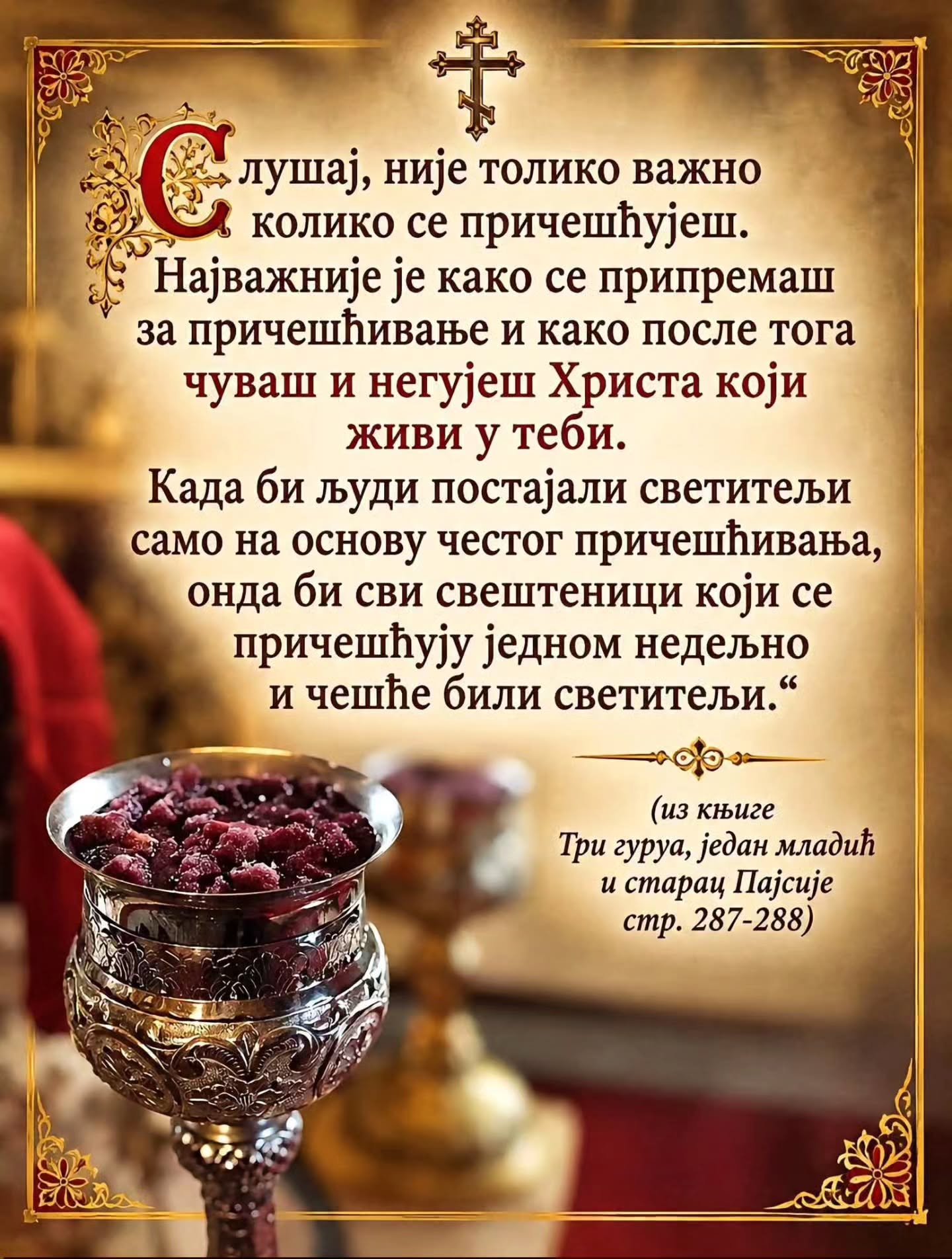
The quote from the book "Three Gurus, One Youth and Elder Paisios" (pages 287-288) conveys Elder Paisios's teaching that the frequency of receiving Holy Communion is not the most important factor. He emphasizes that proper preparation before Communion and preserving Christ within oneself afterward are what truly matter. The elder notes that if frequent Communion alone made people saints, then all priests who commune weekly or more often would…

The quote from the book "Three Gurus, One Youth and Elder Paisios" (pages 287-288) conveys Elder Paisios's teaching that the frequency of receiving Holy Communion is not the most important factor. He emphasizes that proper preparation before Communion and preserving Christ within oneself afterward are what truly matter. The elder notes that if frequent Communion alone made people saints, then all priests who commune weekly or more often would already be saints.

The passage highlights the spiritual discipline required around the sacrament rather than mere regularity.

  • Elder Paisios teaches that preparation for Communion and preserving grace afterward are more important than frequency.
  • He states that if frequent Communion alone conferred sainthood, all priests who commune weekly would be saints.
  • The quote comes from the book "Three Gurus, One Youth and Elder Paisios," pages 287-288.
  • The teaching focuses on spiritual disposition rather than ritual regularity.
  • The passage underscores the need for conscious cooperation with grace after receiving the sacrament.
Read more

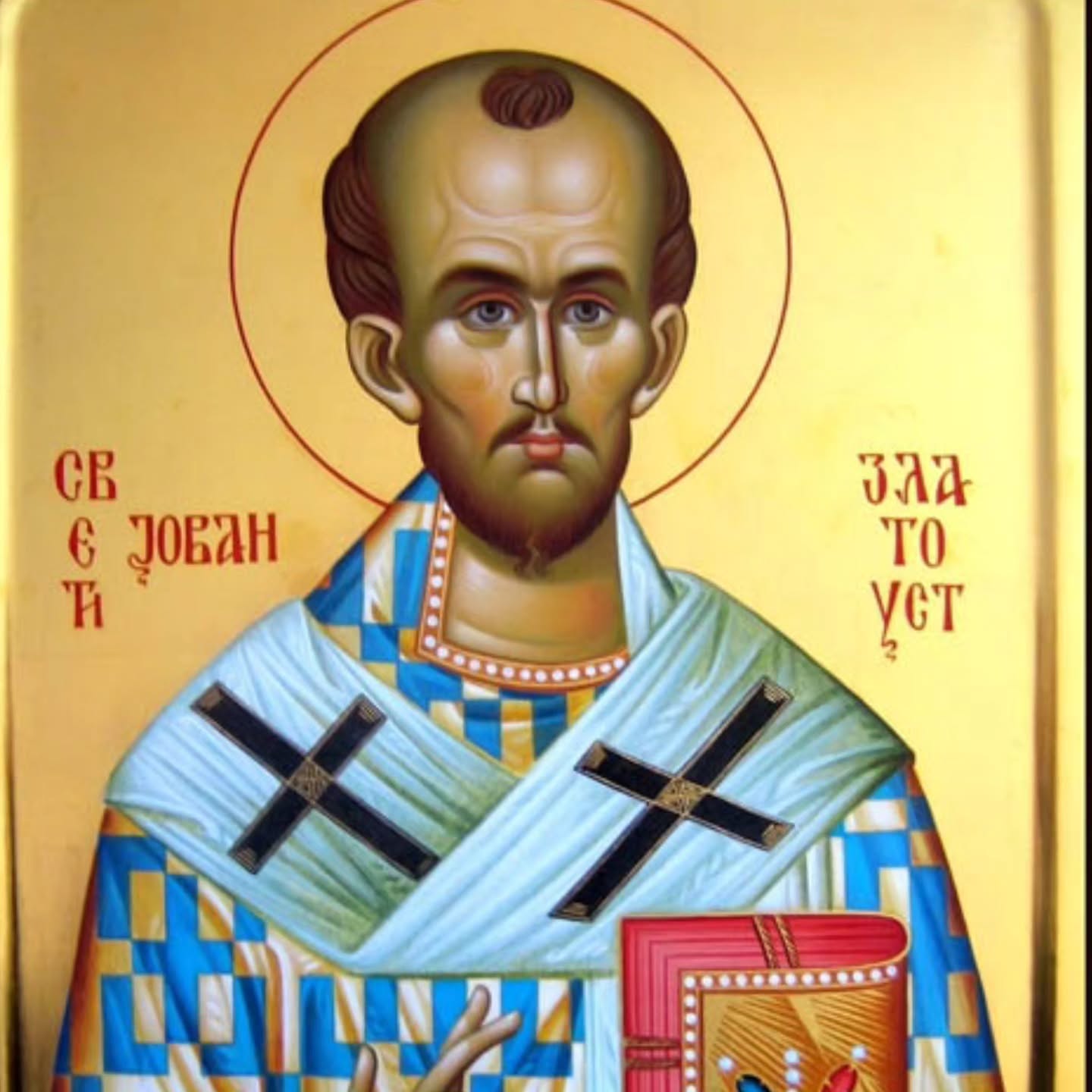
St. John Chrysostom: From Antioch to Exile and Enduring Legacy

The text presents a biographical account of St. John Chrysostom, Archbishop of Constantinople, likely composed for his feast day. It begins with his birth around 347 in Antioch to Secundus and Anthusa, noting his early education in philosophy and rhetoric under the pagan teacher Libanius, who reportedly said on his deathbed that John would have been his successor had the Christians not taken him. After his mother's death, John distributed his…

The text presents a biographical account of St. John Chrysostom, Archbishop of Constantinople, likely composed for his feast day. It begins with his birth around 347 in Antioch to Secundus and Anthusa, noting his early education in philosophy and rhetoric under the pagan teacher Libanius, who reportedly said on his deathbed that John would have been his successor had the Christians not taken him.

After his mother's death, John distributed his possessions to the poor and entered monastic life, devoting himself to prayer, fasting, and study of Scripture, especially the Pauline epistles. He returned to Antioch, was ordained deacon and then priest, and gained renown for sermons on repentance, mercy, justice, and love for neighbor, while denouncing injustice, greed, and hypocrisy.

His eloquence earned him the epithet Chrysostom (Golden-mouthed). In 397 or 398 he was elected Patriarch of Constantinople. As archpastor he cared for the poor, regulated church life, and demanded worthy conduct from clergy and laity alike, rebuking even the highest officials for injustice. His uncompromising stance led to persecution, deposition, and exile.

He died in 407 in Comana, exhausted by travel and suffering. The text notes his vast theological legacy: scriptural commentaries, homilies, treatises on the priesthood, and instructions on Christian living. His name is attached to the Divine Liturgy most frequently celebrated in the Orthodox Church.

The account emphasizes his formation in both classical rhetoric and ascetic discipline, the directness of his pastoral preaching, and the cost of his prophetic witness against corruption. It also highlights the enduring liturgical tradition that bears his name, marking his lasting influence on Orthodox worship.

  • Born c. 347 in Antioch to Secundus and Anthusa; educated by Libanius.
  • Entered monastic life after mother's death; studied Pauline epistles extensively.
  • Ordained deacon and priest in Antioch; renowned for sermons on repentance, justice, and mercy.
  • Elected Patriarch of Constantinople in 397/398; cared for poor, reformed clergy, confronted power.
  • Exiled and died in 407 at Comana; left commentaries, homilies, and the Divine Liturgy bearing his name.
Read more

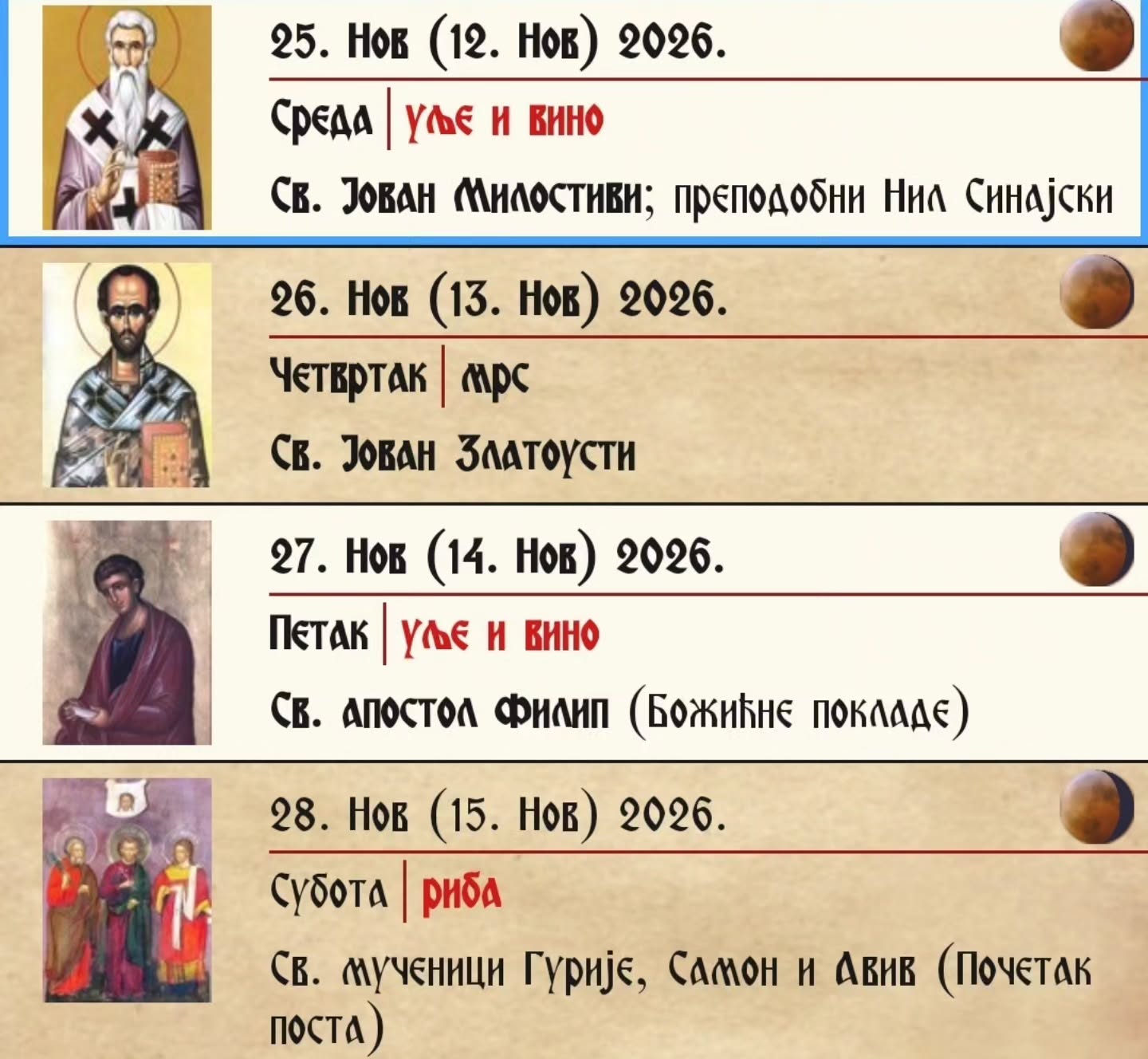
St. Nikolai Velimirovich on saints' foreknowledge of death and almsgiving

St. Nikolai Velimirovich writes in the Ohrid Prologue for November 25 that many holy men and women are revealed beforehand when they will die and change their life. This is a great gift from heaven. However, not waiting for this gift, we unworthy ones must prepare every day through repentance for our departure. From people one can flee, but from God never. He gives two examples. St. John the Merciful was fleeing the Persians from Egypt. On the…

St. Nikolai Velimirovich writes in the Ohrid Prologue for November 25 that many holy men and women are revealed beforehand when they will die and change their life. This is a great gift from heaven. However, not waiting for this gift, we unworthy ones must prepare every day through repentance for our departure. From people one can flee, but from God never. He gives two examples.

St. John the Merciful was fleeing the Persians from Egypt. On the ship a radiant man with a golden scepter appeared to him and said, 'The King of Kings calls you to Himself.' John understood these words and began to prepare for death, which soon followed. From the immeasurable wealth he possessed as patriarch of the Church of Alexandria, at his death he had only a third of one dinar, and he ordered that it be given to the poor.

St. King Stefan Dečanski was often visited by his beloved St. Nicholas, who also appeared to him before death and said, 'Stefan, prepare for your departure, soon you will stand before the Lord.' While Stefan was in the Pantokrator Monastery in Constantinople, a Serbian noble secretly sent him a considerable sum of money. Stefan told the messenger, 'I thank the good lord for his love, but he would give me greater joy if the money intended for me were distributed to the poor.' By their mercy these two saints were very similar.

  • Many saints receive foreknowledge of their death as a heavenly gift.
  • The faithful should prepare daily for death through repentance, since one cannot flee from God.
  • St. John the Merciful was warned by a radiant figure on a ship and prepared for his imminent death.
  • St. John died possessing only a third of a dinar, which he gave to the poor.
  • St. Stefan Dečanski was visited by St. Nicholas before death and also gave away money sent to him to the poor.
Read more