WeOrthodox
EN UA

Orthodox Life

Instagram ↗ 67 discussions

•ᴅᴀɪʟʏ ᴏʀᴛʜᴏᴅᴏx ɪᴄᴏɴᴏɢʀᴀᴘʜʏ, ᴘʀᴀʏᴇʀꜱ, ᴀɴᴅ ꜱᴘɪʀɪᴛᴜᴀʟ ʀᴇꜰʟᴇᴄᴛɪᴏɴꜱ ☦️ •ᴛʜᴇᴏʟᴏɢʏ ɪɴ ᴄᴏʟᴏʀꜱ 🎨 | ᴡɪɴᴅᴏᴡꜱ ᴛᴏ ʜᴇᴀᴠᴇɴ 🪟 •“ᴛʜᴇ ʙᴇᴀᴜᴛʏ ᴏꜰ ᴏʀᴛʜᴏᴅᴏxʏ”🕊️

Orthodox Life Instagram

Saint Gabriel of Georgia: Death Is Transfiguration, Fear the Judgment

The post shares a quotation attributed to Saint Gabriel of Georgia. He says death is transfiguration and tells listeners not to fear death but to fear the Judgment Day. He compares the anxiety of facing a professor during examinations to the far greater awe of standing before the Creator, emphasizing the incomparable greatness of God.

  • Saint Gabriel of Georgia calls death a transfiguration.
  • He urges believers not to fear death but to fear the Judgment Day.
  • He likens the fear of an exam before a professor to the fear before God.
  • He stresses the incomparable greatness of God.
Read more
Orthodox Life Instagram

Saint Gabriel of Georgia: Fool for Christ and Confessor of the Faith

On November 2 the Church commemorates Saint Gabriel the Fool for Christ, New Confessor of Georgia. Born Goderdzi Urgebadze in Tbilisi in 1929, he grew up during intense Soviet crackdowns on religion. From youth he felt a calling to spiritual life, building a small church in his family's yard and reading the Gospels with devotion. In May 1965 he made a public stand against the regime by setting fire to a massive portrait of Vladimir Lenin during…

On November 2 the Church commemorates Saint Gabriel the Fool for Christ, New Confessor of Georgia. Born Goderdzi Urgebadze in Tbilisi in 1929, he grew up during intense Soviet crackdowns on religion. From youth he felt a calling to spiritual life, building a small church in his family's yard and reading the Gospels with devotion.

In May 1965 he made a public stand against the regime by setting fire to a massive portrait of Vladimir Lenin during a May Day parade. Arrested, beaten, and interrogated by the KGB, he was officially declared mentally unstable to discredit his actions. Afterward he embraced the ancient path of the fool for Christ, hiding his deep wisdom, prayer life, and clairvoyant gifts behind eccentric behavior.

He lived in poverty, often sleeping in a makeshift wooden coop or ruins near Samtavro Monastery in Mtskheta. Through his feigned madness he shocked people out of complacency and drew them toward genuine repentance. In his final years he became a beloved spiritual elder. He reposed on November 2, 1995, and was buried at Samtavro Monastery.

Innumerable pilgrims flocked to his grave to pray and seek healing. On December 20, 2012, the Holy Synod of the Georgian Orthodox Church officially canonized him as Holy Father Saint Gabriel, Confessor and Fool for Christ. His relics were uncovered in February 2014 and placed in the Transfiguration Cathedral at Samtavro Monastery, where they continue to draw the faithful.

The post includes historical photographs of his act of defiance, his later life as an elder, and fresco and tomb details from his shrine. His central teaching remains: "In the end days a man will be saved by love, humbleness, and kindness."

  • Born Goderdzi Urgebadze in Tbilisi, 1929; built a church in his yard as a youth.
  • Burned a Lenin portrait during a 1965 May Day parade; arrested, beaten, declared mentally unstable by KGB.
  • Embraced fool-for-Christ path, lived in poverty near Samtavro Monastery, feigned madness to awaken repentance.
  • Reposed 1995, buried at Samtavro; pilgrims sought healing at his grave.
  • Canonized by Georgian Orthodox Holy Synod in 2012; relics uncovered 2014, placed in Transfiguration Cathedral; teaching: salvation through love, humility, kindness.
Read more
Orthodox Life Instagram

Saint David of Evia: From Hermit to Wonderworker Under Ottoman Rule

On November 1 the Church commemorates Saint David the Righteous of Evia, a 16th-century monk, priest and wonderworker. The post recounts his life from the village of Gardinitsa, where he was born to a devout priestly family. Tradition holds that at the age of three Saint John the Baptist appeared to him and led him to a nearby church, where he stood barefoot in prayer for six days before an icon. At fifteen he left home to seek spiritual…

On November 1 the Church commemorates Saint David the Righteous of Evia, a 16th-century monk, priest and wonderworker. The post recounts his life from the village of Gardinitsa, where he was born to a devout priestly family. Tradition holds that at the age of three Saint John the Baptist appeared to him and led him to a nearby church, where he stood barefoot in prayer for six days before an icon.

At fifteen he left home to seek spiritual guidance and became a disciple of the Elder Akakios, embracing rigorous asceticism, perfect obedience and unceasing prayer. He accompanied his mentor on pilgrimages, was ordained a priest and was appointed Abbot of the Panagia Varnakova Monastery near Nafpaktos. Seeking a quieter place for his spiritual struggles, he left Varnakova and settled as a hermit in a barren mountainous region.

Under Ottoman rule he endured hardship: he was wrongfully accused of harboring runaway slaves, arrested, imprisoned and tortured by local Ottoman authorities until pious Christians raised ransom money for his release. After his release he crossed to the island of Evia, a journey marked by the reported miracle of sailing across the sea on his monastic cloak as a raft.

On the island he founded the Monastery of Saint David, dedicated to the Transfiguration of the Savior. He became known for charity that crossed religious boundaries, offering food, shelter and comfort to Christians and Muslims alike, with particular care for the poor. He gathered his spiritual children, gave his final blessings and fatherly counsel, and reposed in peace three days later. The accompanying images show icons and frescoes of the saint and his cave hermitage.

  • Commemorated November 1: Saint David the Righteous of Evia, a 16th-century monk, priest and wonderworker born in Gardinitsa.
  • At age three, tradition says, Saint John the Baptist led him to a church where he prayed barefoot for six days before an icon.
  • He left home at fifteen, became a disciple of Elder Akakios, and later served as Abbot of the Panagia Varnakova Monastery near Nafpaktos.
  • Under Ottoman rule he was wrongly accused of harboring runaway slaves, imprisoned and tortured until local Christians ransomed him.
  • He crossed to Evia, reportedly sailing on his cloak, founded the Monastery of the Transfiguration, and cared for Christians and Muslims alike before his repose.
Read more
Orthodox Life Instagram

Saints Cosmas and Damian: Unmercenary Physicians and Martyrs

Saint Cosmas and Saint Damian were twin brothers born in third-century Asia Minor who became renowned physicians. They are universally celebrated as Holy Unmercenaries because they practiced medicine entirely free of charge. Driven by Christian faith, they treated the sick, the poor, and the forgotten, refusing any payment and attributing every recovery to the healing power of Jesus Christ. Their blend of medical skill and prayer converted…

Saint Cosmas and Saint Damian were twin brothers born in third-century Asia Minor who became renowned physicians. They are universally celebrated as Holy Unmercenaries because they practiced medicine entirely free of charge. Driven by Christian faith, they treated the sick, the poor, and the forgotten, refusing any payment and attributing every recovery to the healing power of Jesus Christ.

Their blend of medical skill and prayer converted countless pagans who witnessed both physical healing and unconditional love. Tradition records their most famous miracle: they amputated the gangrenous leg of a sleeping patient and replaced it with the healthy leg of a recently deceased man, an event cited as the first successful surgery of its kind and making them patrons of surgeons and physicians.

During the persecution under Emperor Diocletian they were arrested for their faith, refused to renounce Christ or sacrifice to idols, and endured brutal torture. They were thrown into the sea and cast into fires yet survived unharmed until finally beheaded around 303 AD. Their mother Theodota is also commemorated. The post includes multiple icons of the saints, several from Mount Athos and other locations, with Greek inscriptions identifying them as the Holy Unmercenaries.

Their legacy continues to inspire medical professionals to approach healthcare with compassion and a commitment to serving those in need.

  • Twin brothers, third-century Asia Minor, physicians who treated patients without payment
  • Known as Holy Unmercenaries (Anargyroi); combined medical practice with prayer
  • Famous miracle: leg transplantation from a deceased donor to a living patient
  • Martyred under Diocletian around 303 AD after surviving torture, sea, and fire
  • Commemorated with their mother Theodota; patrons of surgeons and physicians
Read more
Orthodox Life Instagram

Saint John Kochurov: From American Missionary to Protomartyr of Russia

The post recounts the life of Saint John Kochurov, born July 13, 1871, in the Ryazan region of Russia into a pious priestly family. After graduating from the St. Petersburg Theological Academy in 1895, he was ordained into the priesthood and immediately sent to serve as a missionary in the United States. This assignment launched a dedicated period of early ministry focused on nurturing and establishing the growing Orthodox Christian community in…

The post recounts the life of Saint John Kochurov, born July 13, 1871, in the Ryazan region of Russia into a pious priestly family. After graduating from the St. Petersburg Theological Academy in 1895, he was ordained into the priesthood and immediately sent to serve as a missionary in the United States. This assignment launched a dedicated period of early ministry focused on nurturing and establishing the growing Orthodox Christian community in North America.

During his twelve years in America, Father John became a foundational figure for Orthodoxy across the Midwest. He served as the first permanent priest of St. Vladimir's parish in Chicago, where he oversaw the construction of the landmark Holy Trinity Orthodox Cathedral designed by renowned architect Louis Sullivan. He also organized the first All-American Church Council in 1907 and helped establish several new parishes across Illinois, New York, and Oklahoma.

In the summer of 1907, Father John returned to Russia, where he spent nearly a decade teaching catechism and religious law in Narva, Estonia. In November 1916, he was transferred to Saint Catherine's Cathedral in Tsarskoye Selo, a prominent suburb near St. Petersburg. There, his eloquent, heartfelt sermons and spiritual guidance earned him deep respect and a dedicated following during a period of intense political and social upheaval.

On October 30, 1917, as the Bolshevik Revolution spilled into the suburbs, Bolshevik forces began shelling Tsarskoye Selo. Seeking to calm the terrified population, Father John led the townspeople in a prayer procession for peace. Bolshevik soldiers falsely accused him of praying for an opposing Cossack victory, and on October 31, 1917, they arrested him, dragged him to the outskirts of town, and shot him, making him the first clergy martyr of the Russian Revolution.

In December 1994, the Council of Bishops of the Russian Orthodox Church officially glorified him as Saint John Kochurov, the Protomartyr of the New Martyrs and Confessors of Russia.

  • Born 1871 in Ryazan, ordained 1895, sent as missionary to United States
  • Served 12 years in Midwest, built Holy Trinity Cathedral in Chicago, organized first All-American Church Council 1907
  • Returned to Russia 1907, taught in Narva, then served at Tsarskoye Selo
  • Led prayer procession for peace during Bolshevik shelling Oct 30 1917, arrested and shot Oct 31 1917
  • Glorified as saint and protomartyr by Russian Orthodox Church in 1994
Read more
Orthodox Life Instagram

100,000 Martyrs of Tbilisi: Choosing Death Over Apostasy in 1226

The post commemorates the 100,000 Holy Martyrs of Tbilisi, who are among the most revered saints in the Georgian Orthodox Church. In 1226, the Khwarazmian Sultan Jalal al-Din captured Tbilisi, the capital of Georgia. The city was plundered, and its Christian population faced a brutal ultimatum: abandon their Orthodox faith or face execution. To test their loyalty, the Sultan ordered the icons of the Theotokos and Jesus Christ to be taken from…

The post commemorates the 100,000 Holy Martyrs of Tbilisi, who are among the most revered saints in the Georgian Orthodox Church. In 1226, the Khwarazmian Sultan Jalal al-Din captured Tbilisi, the capital of Georgia. The city was plundered, and its Christian population faced a brutal ultimatum: abandon their Orthodox faith or face execution.

To test their loyalty, the Sultan ordered the icons of the Theotokos and Jesus Christ to be taken from the Sioni Cathedral and placed on the bridge spanning the Mtkvari River. The captured citizens were lined up and commanded to walk across the bridge, defiling and trampling the holy icons as a public sign of apostasy. Instead of compliance, the event became a profound demonstration of collective faith.

Men, women, children, and the elderly chose death over desecration. They walked onto the bridge not to trample the icons, but to venerate them, openly confessing Jesus Christ as their Lord and Savior. Enraged by their defiance, the Sultan's executioners beheaded the faithful one by one, throwing their bodies into the Mtkvari River.

Historical accounts describe the river turning red with the blood of the thousands who willingly laid down their lives. Today, the Georgian Orthodox Church commemorates these 100,000 martyrs annually on November 13 (October 31 according to the Old Calendar). They stand as a powerful symbol of spiritual endurance, and the Metekhi Bridge in Tbilisi remains a sacred site of pilgrimage where Orthodox Christians honor their memory.

  • The 100,000 Holy Martyrs of Tbilisi are commemorated on November 13 (October 31 Old Calendar).
  • In 1226, Sultan Jalal al-Din captured Tbilisi and ordered icons placed on the Mtkvari bridge.
  • Citizens were forced to trample the icons but chose to venerate them instead.
  • The faithful were beheaded and thrown into the river, which turned red with blood.
  • The Metekhi Bridge remains a pilgrimage site honoring their memory.
Read more
Orthodox Life Instagram

Saint Anastasia of Rome: Martyr under Decius

The post recounts the life and martyrdom of Saint Anastasia of Rome, a third-century nun commemorated on October 29. Orphaned at three, she was raised by Abbess Sophia in a women's monastery near Rome and spent seventeen years in ascetic prayer, becoming known for her holiness and physical beauty. During the persecution under Emperor Decius (249-251 AD), the city administrator Probus ordered her arrest. She received a blessing from Abbess Sophia…

The post recounts the life and martyrdom of Saint Anastasia of Rome, a third-century nun commemorated on October 29. Orphaned at three, she was raised by Abbess Sophia in a women's monastery near Rome and spent seventeen years in ascetic prayer, becoming known for her holiness and physical beauty. During the persecution under Emperor Decius (249-251 AD), the city administrator Probus ordered her arrest.

She received a blessing from Abbess Sophia and went willingly before the tribunal. Probus tried to persuade her to renounce Christ with flattery and promises of luxury, but Anastasia declared Christ her life, wealth, and only spouse. Enraged, Probus ordered severe tortures: whippings and mutilation.

According to tradition, her endurance and the cruelty of the punishments stirred outrage among pagan onlookers. To prevent a riot, Probus halted the torture and ordered her beheading outside Rome around 250 AD. The post also includes Greek inscriptions from an icon depicting scenes of her martyrdom, identifying her as "Anastasia the Roman" and "Anastasia the Pharmakolytria" (deliverer from poisons).

  • Orphaned at three, raised by Abbess Sophia in a monastery near Rome
  • Lived seventeen years in ascetic discipline, noted for holiness and beauty
  • Arrested during Decius' persecution by administrator Probus
  • Refused to renounce Christ despite flattery and promises of luxury
  • Tortured severely; public outrage led to beheading around 250 AD
Read more
Orthodox Life Instagram

Saint Nestor of Thessaloniki: Martyr who defeated gladiator Lyaeus

Saint Nestor of Thessaloniki is commemorated on October 27. He lived in the early fourth century under the Roman Emperor Maximian. Nestor was a young, courageous Christian known for his deep faith and physical agility. He was a dedicated disciple and companion of Saint Demetrius, the great patron saint of Thessaloniki, from whom he learned the teachings of Christianity. During a visit by the Emperor to Thessaloniki, a massive barbarian gladiator…

Saint Nestor of Thessaloniki is commemorated on October 27. He lived in the early fourth century under the Roman Emperor Maximian. Nestor was a young, courageous Christian known for his deep faith and physical agility. He was a dedicated disciple and companion of Saint Demetrius, the great patron saint of Thessaloniki, from whom he learned the teachings of Christianity.

During a visit by the Emperor to Thessaloniki, a massive barbarian gladiator named Lyaeus tormented the local population by challenging people to combat in the public arena. Lyaeus was notoriously ruthless, mocking Christians and throwing his defeated opponents onto a floor covered in upward-pointing spears. Moved by the suffering of his fellow believers, Nestor felt a divine calling to confront the giant gladiator and end his reign of terror.

Before entering the arena, Nestor visited the imprisoned Saint Demetrius to ask for his prayers and blessing to fight Lyaeus. Demetrius blessed the young man, made the sign of the cross over him, and prophesied that Nestor would not only defeat the giant but would also suffer martyrdom for Christ. Armed with nothing but his faith and the blessing of his mentor, Nestor confidently stepped into the stadium.

Standing before the gladiator, Nestor boldly proclaimed, "Help me, O God of Demetrius," and engaged the giant in single combat. In a stunning display of divine intervention over brute force, the agile youth overpowered Lyaeus and hurled him down onto the very spears he used to murder others. The unexpected defeat of his favorite champion completely humiliated and enraged Emperor Maximian.

In a fit of fury, the Emperor immediately ordered the executions of both young men without trial. Saint Nestor was dragged outside the city gates and beheaded with a sword around 306 AD, while Saint Demetrius was pierced with spears in his prison cell.

  • Commemoration of Saint Nestor of Thessaloniki on October 27
  • Nestor was a disciple of Saint Demetrius and confronted the gladiator Lyaeus
  • He received a blessing and prophecy of martyrdom from Demetrius
  • Nestor defeated Lyaeus in the arena, throwing him onto spears
  • Both Nestor and Demetrius were executed by Emperor Maximian around 306 AD
Read more
Orthodox Life Instagram

Saint Demetrios the Myrrh-streamer: Great Martyr of Thessaloniki

Saint Demetrios of Thessaloniki was a Roman noble, military commander, and proconsul in the third century. Born into a prominent Macedonian family, he secretly practiced Christianity while openly teaching the faith during his service in the Roman administration, using his position to convert many pagans. When Emperor Galerius Maximian began a severe persecution of Christians, Demetrios was arrested and thrown into a cold underground prison cell.…

Saint Demetrios of Thessaloniki was a Roman noble, military commander, and proconsul in the third century. Born into a prominent Macedonian family, he secretly practiced Christianity while openly teaching the faith during his service in the Roman administration, using his position to convert many pagans. When Emperor Galerius Maximian began a severe persecution of Christians, Demetrios was arrested and thrown into a cold underground prison cell.

There he spent his time in continuous prayer and offered spiritual guidance to fellow believers who faced trial. During imperial games held in the city, a young Christian named Nestor sought Demetrios's blessing to confront the emperor's champion, a giant named Lyaios. With the saint's prayers, Nestor defeated Lyaios, an outcome that enraged Galerius and led to the execution of both men.

On October 26, 306 AD, soldiers entered Demetrios's cell and killed him with lances, making him a Great Martyr. His servant Lupus collected the saint's blood-stained tunic and ring, which later became instruments of miraculous healings. After his death, a fragrant oil known as myrrh began to flow from his tomb in the Church of Saint Demetrios in Thessaloniki, giving him the title Myrrh-streamer.

The saint is venerated as the eternal protector and patron of Thessaloniki. The accompanying images display icons inscribed in Greek and Church Slavonic, depictions of the saint's martyrdom and repose, and the silver reliquary in the Thessaloniki church where his relics rest, surrounded by flowers and written prayer requests.

  • Saint Demetrios was a Roman noble, military commander, and proconsul who secretly lived as a Christian in the third century.
  • He was imprisoned during the persecution under Emperor Galerius Maximian and continued to pray and guide fellow prisoners.
  • A young Christian named Nestor, with Demetrios's blessing, defeated the emperor's champion Lyaios in the arena.
  • Demetrios was martyred by lances on October 26, 306 AD, and his servant Lupus preserved his tunic and ring as sources of healing.
  • Myrrh flowed from his tomb in the Thessaloniki church, giving him the title Myrrh-streamer, and he is honored as the city's patron saint.
Read more
Orthodox Life Instagram

Saint Tabitha, Raised by Peter, Model of Quiet Charity

The post commemorates Saint Tabitha, also called Dorcas, on October 25. She lived in Joppa and is mentioned in Acts 9:36-42. Luke calls her a disciple, a title rarely given to women in the New Testament. Her Aramaic and Greek names both mean gazelle. She served the early Church through practical charity: as a skilled seamstress she made tunics and coats for widows and orphans in her community. When she fell ill and died, the believers sent for…

The post commemorates Saint Tabitha, also called Dorcas, on October 25. She lived in Joppa and is mentioned in Acts 9:36-42. Luke calls her a disciple, a title rarely given to women in the New Testament. Her Aramaic and Greek names both mean gazelle. She served the early Church through practical charity: as a skilled seamstress she made tunics and coats for widows and orphans in her community.

When she fell ill and died, the believers sent for Peter, who was preaching in nearby Lydda. Widows met him weeping and showed him the garments Tabitha had sewn. Peter knelt, prayed, and said, "Tabitha, arise." She opened her eyes, sat up, and was restored to life.

The miracle spread through Palestine, leading many Jews and pagans to believe in Christ. Tabitha continued her charitable work for many more years and reposed at a very old age. The accompanying images include an icon of the raising and a Greek inscription praising almsgiving: "The merciful saint, brothers: he who loves and shows mercy to the poor shall receive mercy from God unto the light."

  • Commemorated October 25; named Tabitha (Aramaic) and Dorcas (Greek), both meaning gazelle
  • Explicitly called a disciple by Luke in Acts 9:36-42
  • Expressed faith through sewing garments for widows and orphans in Joppa
  • Raised from the dead by Peter after widows showed him her handiwork
  • Miracle led many to belief; she lived on serving quietly until old age
Read more
Orthodox Life Instagram

Saint James the Brother of the Lord: First Bishop of Jerusalem

The post commemorates Saint James the Apostle, called the Brother of God (Adelphotheos) and James the Just, on October 23. In Orthodox tradition he is the son of Joseph the Betrothed from a previous marriage, making him the step-brother of Jesus Christ, and the Church carefully distinguishes him from the other apostles named James, specifically James the son of Zebedee and James the son of Alphaeus. From youth he lived a strict ascetic life,…

The post commemorates Saint James the Apostle, called the Brother of God (Adelphotheos) and James the Just, on October 23. In Orthodox tradition he is the son of Joseph the Betrothed from a previous marriage, making him the step-brother of Jesus Christ, and the Church carefully distinguishes him from the other apostles named James, specifically James the son of Zebedee and James the son of Alphaeus.

From youth he lived a strict ascetic life, abstaining from oil and animal fats, subsisting on bread and water, and praying so much on his knees that his skin hardened like a camel's. After the Ascension he became the first Bishop of Jerusalem, serving for thirty years. He presided at the Council of Jerusalem recorded in Acts 15, where his judgment guided the early Church on Gentile believers.

Even Jewish elders respected his integrity, calling him James the Just. The Apostle Paul notes a personal appearance of the risen Christ to James in 1 Corinthians 15:7. Around 63 A.D. Jewish authorities, angered by his preaching of the resurrection, pushed him from the pinnacle of the Temple. He survived the fall, knelt and prayed for his persecutors, and was stoned; a fuller struck the final blow with a club.

The accompanying images show Greek inscriptions identifying him as the holy Adelphotheos, including a Gospel manuscript fragment and a liturgical text that reads: "Holy Apostle & James Brother of the Lord and remember your death, and we confess your resurrection. Do this so that you do not forget me. For as often as you eat this bread and drink this cup, you will proclaim the death of the Son of Man, and confess his resurrection until he comes."

A fresco depicts a saint being struck down, and another inscription names the holy church of Father Paul in Jerusalem and Saint Luke.

  • Commemorated October 23 as the Brother of God and first Bishop of Jerusalem
  • Identified as son of Joseph from a prior marriage, step-brother of Christ
  • Presided at the Council of Jerusalem (Acts 15) and served thirty years
  • Known for extreme asceticism and constant prayer; knees hardened like a camel's
  • Martyred c. 63 A.D. by being thrown from the Temple, stoned, and clubbed
Read more
Orthodox Life Instagram

Saint Averkios, Equal-to-the-Apostles: Bishop, Wonderworker, Missionary

The post commemorates Saint Averkios, Equal-to-the-Apostles and Wonderworker, Bishop of Hierapolis in Phrygia Salutaris during the reign of Emperor Marcus Aurelius in the second century. It recounts that he grieved for the idol-worshippers and prayed for their conversion. During a festival for Apollo, prompted by a divine vision, he entered the pagan temple by night and overthrew the statues with his staff. When townspeople sought to kill him,…

The post commemorates Saint Averkios, Equal-to-the-Apostles and Wonderworker, Bishop of Hierapolis in Phrygia Salutaris during the reign of Emperor Marcus Aurelius in the second century. It recounts that he grieved for the idol-worshippers and prayed for their conversion. During a festival for Apollo, prompted by a divine vision, he entered the pagan temple by night and overthrew the statues with his staff.

When townspeople sought to kill him, he walked into the marketplace and cast demons out of three afflicted youths before the crowd. The miracle led the people of Hierapolis to ask for teaching, and he baptized hundreds. He also healed the blind mother of the provincial proconsul Publius.

His reputation reached Rome, where he traveled and cured the emperor's daughter of a severe affliction. Beyond Hierapolis, he made missionary journeys across Syria, Cilicia, and Mesopotamia, converting multitudes, defending the Church against false teachers, and strengthening believers. For his apostolic zeal, widespread travels, and numerous miracles, tradition honors him with the title Equal-to-the-Apostles.

Before his peaceful repose around 167 or 186 AD, he composed his own Christian epitaph, which was carved onto his tombstone. The post includes image descriptions showing a fresco detail of a praying bishop and Greek and Church Slavonic inscriptions naming the saint.

  • Bishop of Hierapolis in second century under Marcus Aurelius
  • Destroyed idols in Apollo's temple after a divine vision
  • Cast out demons publicly, leading to mass baptism in Hierapolis
  • Healed proconsul's mother and emperor's daughter in Rome
  • Missionary journeys in Syria, Cilicia, Mesopotamia; composed epitaph
Read more
Orthodox Life Instagram

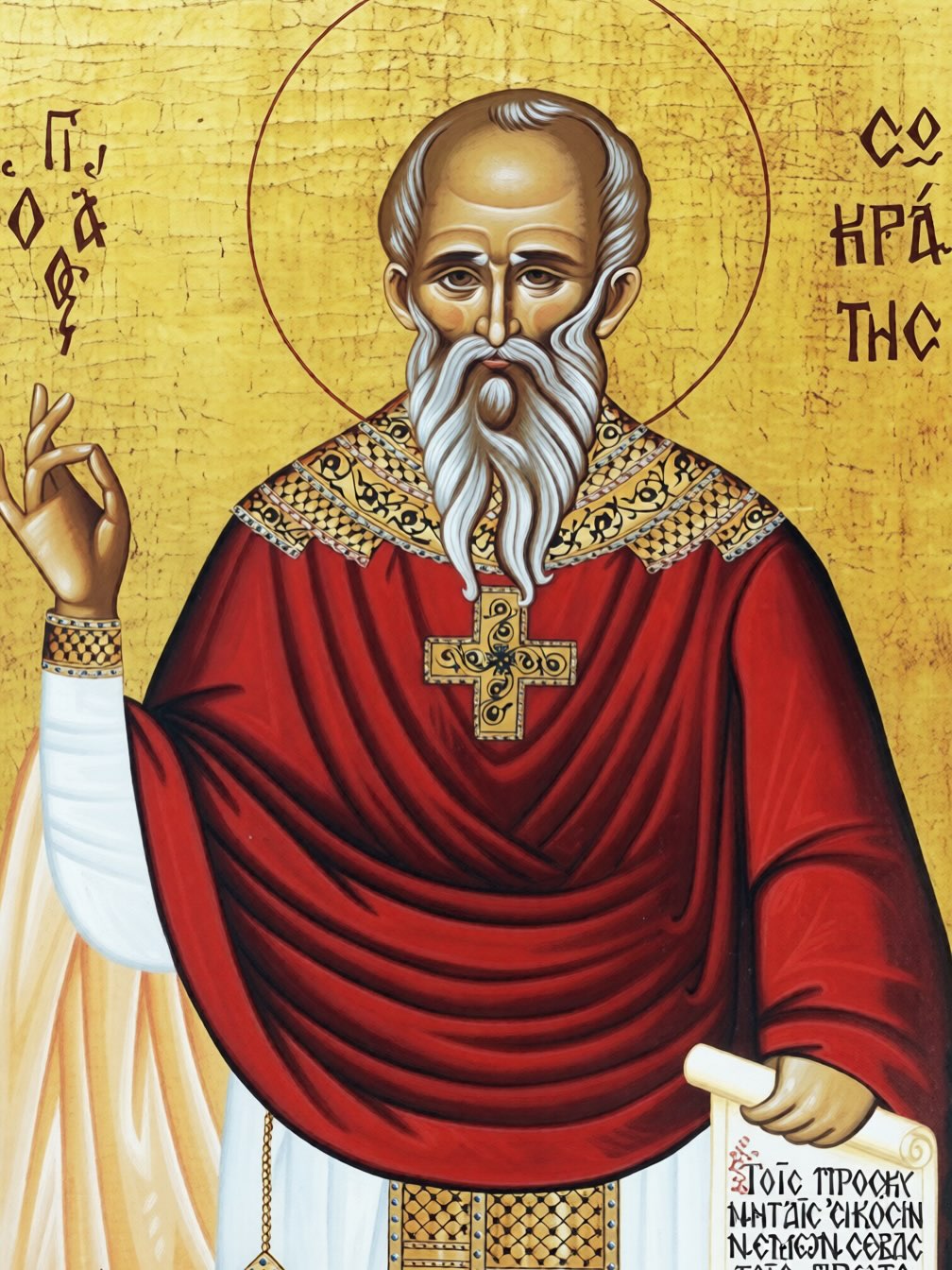
Saint Socrates of Ancyra: Priest and Martyr Who Defied Pagan Worship

The post commemorates Saint Socrates, a priest and martyr from the ancient city of Ancyra, modern Ankara, Turkey, who lived in the 3rd century AD. It describes his ministry alongside Saint Theodote, a pious woman, during a period of severe persecution under Roman regional authorities. During a prominent pagan festival, Socrates publicly intervened and toppled the sacrificial altar, an act of defiance that led to his immediate arrest. He and…

The post commemorates Saint Socrates, a priest and martyr from the ancient city of Ancyra, modern Ankara, Turkey, who lived in the 3rd century AD. It describes his ministry alongside Saint Theodote, a pious woman, during a period of severe persecution under Roman regional authorities. During a prominent pagan festival, Socrates publicly intervened and toppled the sacrificial altar, an act of defiance that led to his immediate arrest.

He and Saint Theodote were subjected to horrific tortures but refused to renounce Christ or sacrifice to idols. Socrates was sentenced to death and martyred by beheading. The post presents his life as an example of steadfast faith and sacrifice by early Christian clergy. The accompanying image contains Greek text that appears fragmented.

  • Saint Socrates served as a priest in Ancyra during the 3rd century.
  • He ministered with Saint Theodote amid systemic persecution.
  • He toppled a pagan altar during a public festival.
  • Authorities arrested and tortured him and Saint Theodote.
  • He was beheaded after refusing to renounce Christ.
Read more
Orthodox Life Instagram

Saint Hilarion the Great, Founder of Palestinian Monasticism

The post commemorates Saint Hilarion the Great on October 21. Born in 291 AD to pagan parents in Thabatha near Gaza, he traveled to Alexandria for education, converted to Christianity, was baptized, and learned of Saint Anthony the Great. Inspired, he sought Anthony in the Egyptian desert and became his disciple. Because massive crowds visited Anthony for healings and blessings, Hilarion returned to his homeland to find quiet solitude. Finding…

The post commemorates Saint Hilarion the Great on October 21. Born in 291 AD to pagan parents in Thabatha near Gaza, he traveled to Alexandria for education, converted to Christianity, was baptized, and learned of Saint Anthony the Great. Inspired, he sought Anthony in the Egyptian desert and became his disciple. Because massive crowds visited Anthony for healings and blessings, Hilarion returned to his homeland to find quiet solitude.

Finding his parents dead, he distributed his inheritance to the poor and withdrew into the desert near Maiuma at age fifteen. He wore sackcloth and a leather coat, ate figs, lentils, and dry bread, and fought intense temptations, physical passions, and demonic phantoms through continuous labor, fasting, and fervent prayer. God granted him spiritual discernment and the power to cast out unclean spirits and heal the sick free of charge.

As thousands of pilgrims flocked to his cell, shattering his solitude, numerous monasteries sprang up across Palestine under his guidance, establishing a structured, strict ascetic life. As Anthony was to Egypt, Hilarion became to Palestine. To escape fame, he spent his later years fleeing to Egypt, Sicily, and Dalmatia, where he reposed around 371 AD at age eighty.

The post also includes descriptions of frescoes and icons depicting Hilarion, a gathering of bishops in a cave, Saints Theopatores, Andrew, Anna, the Theotokos, Christ, Constantine, and Saint Stephen.

  • Born 291 AD in Thabatha, converted in Alexandria, disciple of Saint Anthony.
  • Lived as anchorite near Maiuma from age fifteen, extreme asceticism.
  • Granted gifts of discernment, exorcism, and healing without charge.
  • Founded monasteries across Palestine, establishing monasticism there.
  • Fled fame to Egypt, Sicily, Dalmatia; reposed c. 371 AD at age eighty.
Read more