WeOrthodox
EN UA

Timothy

Instagram ↗ 5 discussions

IC XC ☦︎ NI KA Husband, Father, Firefighter, Layman Talk to your priest.

Timothy with Prayer Orthodoxy® Instagram

St. John Climacus's Ladder of Divine Ascent: 30 steps toward God
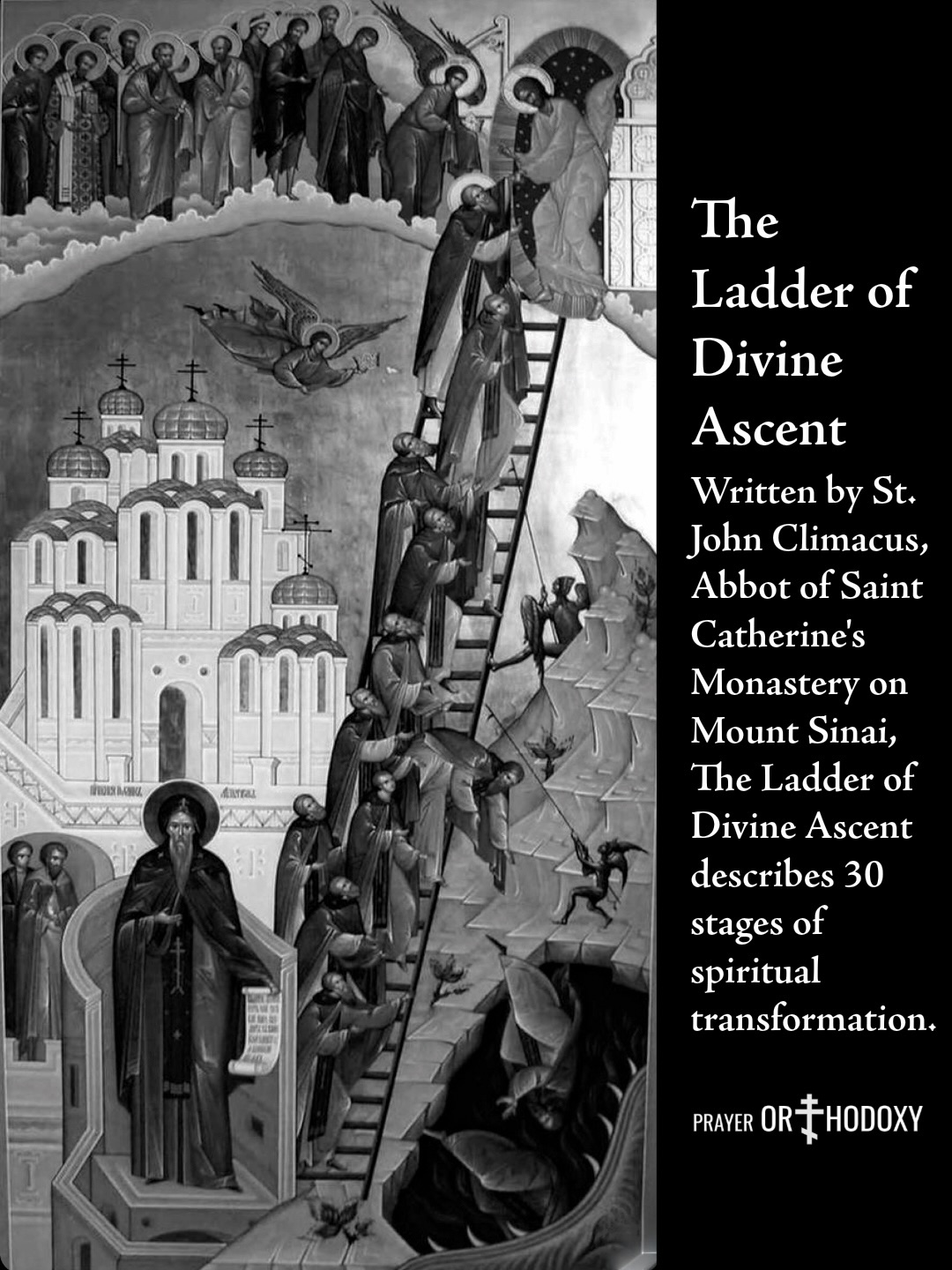
The post presents St. John Climacus's teaching from The Ladder of Divine Ascent. The saint outlines a spiritual journey of 30 steps that leads toward Christ. Each step represents progress in virtues including repentance, humility, prayer, and perseverance. The text identifies love as the highest virtue at the summit of the ladder. The post appears in both English and Greek, with the Greek text naming the work as Η Κλίμακα της Θείας Ανόδου and…

The post presents St. John Climacus's teaching from The Ladder of Divine Ascent. The saint outlines a spiritual journey of 30 steps that leads toward Christ. Each step represents progress in virtues including repentance, humility, prayer, and perseverance.

The text identifies love as the highest virtue at the summit of the ladder. The post appears in both English and Greek, with the Greek text naming the work as Η Κλίμακα της Θείας Ανόδου and the author as Ο Άγιος Ιωάννης της Κλίμακος. The content is marked as an original production of Prayer Orthodoxy.

  • St. John Climacus teaches a 30-step spiritual ascent toward Christ
  • The steps require repentance, humility, prayer, and perseverance
  • Love is identified as the highest virtue
  • The teaching appears in both English and Greek
  • The post is an original production of Prayer Orthodoxy
Read more

Making PSA compatible with Orthodoxy requires redefining its foundations

Attempting to reconcile penal substitutionary atonement with Orthodoxy forces a fundamental redefinition of its philosophical basis and theological structure. At that point you are no longer defending PSA; you are rebuilding it into Orthodox atonement theology.

5 opinions in the discussion Think about it: PSA goes against the very nature of God, because why would God "need" a legal payment for sin? God needs nothing, he's perfect and depends on nothing. The incarnation… Read the discussion

St. Isaac the Syrian on mercy, humility, and boundless love

The post presents St. Isaac the Syrian's teaching that God's love and mercy exceed human understanding. It outlines his view that true spiritual wisdom begins with humility, that repentance opens the door to transformation, and that prayer purifies the heart to perceive God's presence. The text describes his celebrated teaching on the merciful heart, a soul so filled with compassion that it burns with love for all creation, for humanity, for…

The post presents St. Isaac the Syrian's teaching that God's love and mercy exceed human understanding. It outlines his view that true spiritual wisdom begins with humility, that repentance opens the door to transformation, and that prayer purifies the heart to perceive God's presence. The text describes his celebrated teaching on the merciful heart, a soul so filled with compassion that it burns with love for all creation, for humanity, for animals, for enemies, and even for those who cause suffering.

For St. Isaac, holiness is not merely the avoidance of sin but the transformation of the entire human person through the grace of God. He calls believers beyond superficial religion into the hidden depths of the heart, where silence becomes prayer, repentance becomes healing, and compassion becomes the reflection of Christ Himself.

He urges Christians not to judge their neighbour but to recognise their own need for God's mercy. The post concludes that the true measure of closeness to God is not how much one speaks about Him but how deeply one loves His creation, and that to know God is to be transformed by His love; and to be transformed by His love is to learn to love without boundaries.

  • God's love and mercy surpass human understanding
  • Spiritual wisdom begins with humility; repentance and prayer lead to transformation
  • The merciful heart burns with compassion for all creation, including enemies
  • Holiness is transformation of the whole person through grace, not just sin avoidance
  • Closeness to God is measured by depth of love for creation, not words about Him
Read more
Eastern Orthodoxy Daily He/Who/Is with Timothy Instagram

Orthodox response: justification requires church, not Christ alone

The speaker responds to a claim that Jesus and the cross alone place someone in right standing, apart from tradition or theology. He argues that Orthodoxy holds a both/and position rather than either/or, and that the word Catholic is misunderstood in the West because of what he calls papal Protestantism. From the Orthodox perspective, the first Protestant was the Pope, who protested and walked away from the church saying "I know better." The…

The speaker responds to a claim that Jesus and the cross alone place someone in right standing, apart from tradition or theology. He argues that Orthodoxy holds a both/and position rather than either/or, and that the word Catholic is misunderstood in the West because of what he calls papal Protestantism. From the Orthodox perspective, the first Protestant was the Pope, who protested and walked away from the church saying "I know better."

The speaker grants that tradition and the fathers do not replace Christ's work on the cross. He points out that saying Christ justifies us is itself a theological claim, and that faith alone is an even more specific theological claim. He asks what epistemic criteria show that one's understanding of justification is apostolic.

The speaker notes an inconsistency in dismissing theology while insisting that one's own theology of justification is correct. Father Peter's remark about the Pope targets the principle of separating from the church while claiming doctrinal correctness. Orthodoxy holds that the Christ who saved us established a church, and that the head cannot be separated from the body.

The discussion turns on whether justification can be known apart from the church that Christ established, and whether an individual's interpretation of Scripture can serve as its own epistemic foundation.

  • The speaker addresses a claim that Jesus and the cross alone justify, not tradition or theology.
  • Orthodoxy holds a both/and position; the term Catholic is misunderstood due to papal Protestantism.
  • From the Orthodox view, the first Protestant was the Pope, who protested and walked away saying "I know better."
  • Saying Christ justifies is a theological claim; faith alone is a more specific one, requiring an epistemic criterion to verify it is apostolic.
  • Father Peter's remark targets separating from the church while claiming doctrinal correctness; Orthodoxy holds the head cannot be separated from the body.

Key moments

  1. The speaker addresses a claim that Jesus and the cross alone justify, not tradition or theology.
  2. In Orthodoxy it is both/and; nothing is left out because Catholic is misunderstood due to papal Protestantism.
  3. From the Orthodox perspective, the first Protestant was the Pope, who protested and walked away saying "I know better."
  4. Tradition and the fathers do not replace Christ's work on the cross.
  5. Saying Christ justifies us is a theological claim; faith alone is an even more specific one.
  6. It is inconsistent to dismiss theology while insisting your theology of justification is correct.
  7. The speaker asks what epistemic criteria show one's understanding of justification is apostolic.
  8. Father Peter's remark about the Pope targets separating from the church while claiming doctrinal correctness.
Read more
Timothy Instagram discussion

Post contains only Orthodox and Catholic hashtags

The post consists of an Orthodox cross emoji and six hashtags: #orthodoxchristian, #christian, #orthodoxy, #catholic, #church. There is no accompanying text, thread, or discussion. The hashtags indicate topics related to Orthodox Christianity and Catholicism.

  • Orthodox cross emoji
  • Hashtag: #orthodoxchristian
  • Hashtag: #christian
  • Hashtag: #orthodoxy
  • Hashtag: #catholic
24 opinions in the discussion I used to like Phil right up until he started going after apostolic churches. Read the discussion

How Three Can Be One: The Trinity Without Contradiction

A questioner asks how the Trinity, three co-equal and co-eternal persons, can really be one God. The answer states that the Trinity only sounds contradictory when it is defined badly. The Church does not say God is one person and three persons, or one God and three Gods. It affirms one divine essence existing in three hypostases. The persons are distinguished by their relations of origin. The Father is the one Arche, the source and cause within…

A questioner asks how the Trinity, three co-equal and co-eternal persons, can really be one God. The answer states that the Trinity only sounds contradictory when it is defined badly. The Church does not say God is one person and three persons, or one God and three Gods.

It affirms one divine essence existing in three hypostases. The persons are distinguished by their relations of origin. The Father is the one Arche, the source and cause within the Godhead. The Son is eternally begotten of the Father, and the Holy Spirit eternally proceeds from the Father.

The three are not divided in will, essence, power, or energy, so the distinction between them is hypostatic, not essential. St. Gregory the Theologian is quoted: the three have one nature, God, and the union is the Father, from whom and to whom the order of the persons runs its course. The discussion turns on how unity and distinction are held together.

Monarchy gives the unity, and relation gives the distinction. This holds without collapsing the three into one person or splitting God into three separate beings. The reply stays within classical trinitarian terminology: essence, hypostasis, begetting, procession, and monarchy of the Father.

The questioner's puzzle dissolves once the terms are used precisely, since the alleged contradiction comes from mixing categories of person and essence. The answer closes on the same point it opened with: the Church's formulation avoids both errors, the one that merges the persons and the one that divides the Godhead.

  • The Trinity sounds contradictory only when defined badly: the Church affirms one divine essence in three hypostases, not one person and three persons.
  • The Father is the one Arche, the source and cause; the Son is eternally begotten of him and the Holy Spirit eternally proceeds from him.
  • The persons are distinguished by relations of origin, not divided in will, essence, power, or energy.
  • St. Gregory the Theologian: the three have one nature, God, and the union is the Father, from whom and to whom the order of the persons runs its course.
  • Monarchy gives the unity and relation gives the distinction, without collapsing the three into one person or splitting God into three.

Key moments

  1. A questioner asks how three co-equal, co-eternal persons, Father, Son, and Holy Spirit, can be one God.
  2. The Trinity only sounds contradictory if defined badly; the Church affirms one divine essence in three hypostases, not one person and three persons or one God and three Gods.
  3. The Father is the one Arche, the source and cause within the Godhead.
  4. The Son is eternally begotten of the Father, and the Holy Spirit eternally proceeds from the Father; the persons are distinguished by relations of origin.
  5. The persons are not divided in will, essence, power, or energy; the distinction is hypostatic, not essential.
  6. St. Gregory the Theologian says the three have one nature, God, and the union is the Father, from whom and to whom the order of the persons runs its course.
  7. Monarchy gives the unity and relation gives the distinction, without collapsing the three into one person or splitting God into three.
10 opinions in the discussion The Nicene Creed lays it out too. I believe in ONE God the Father Almighty. The son is begotten and the spirit proceeds. So the son and the spirit share the same divine characteristics.… Read the discussion

Orthodoxy as fullness of Christian faith, not added structure

Bryce recounts that many Orthodox people tell him he needs Orthodoxy. He notes that before a suicidal crisis he was advised that religious structure would bring safety, yet such structure outside Christianity does not satisfy. He says he loves tradition, sacraments, and similar things. He explains that Orthodoxy is not about adding rules or religious structure but about receiving the whole Christian faith: doctrine, worship, sacraments,…

Bryce recounts that many Orthodox people tell him he needs Orthodoxy. He notes that before a suicidal crisis he was advised that religious structure would bring safety, yet such structure outside Christianity does not satisfy. He says he loves tradition, sacraments, and similar things. He explains that Orthodoxy is not about adding rules or religious structure but about receiving the whole Christian faith: doctrine, worship, sacraments, spiritual life, and tradition.

He argues that loving tradition and sacraments but not belonging to the church that preserves them falls apart. He says the Eucharist, baptism, and apostolic succession belong to a certain understanding of the church and require existing within the life of that church. He concludes that people urge him toward holy Orthodoxy not for more religion but because without it he lacks the fullness of the Christian faith.

  • Orthodox Christians tell Bryce he needs Orthodoxy
  • Religious structure outside Christianity did not satisfy him during a suicidal crisis
  • Orthodoxy is receiving the whole Christian faith, not adding rules
  • The Eucharist, baptism, and apostolic succession belong to the church's life
  • People urge him toward Orthodoxy for the fullness of the Christian faith

Key moments

  1. Bryce recounts that many Orthodox people tell him he needs Orthodoxy.
  2. He says that before a suicidal period people told him religious structure would make him safe.
  3. He observes that religious structure outside Christianity does not give satisfaction, significance, or security.
  4. He states that he loves tradition, sacraments, and similar things.
  5. He explains that Orthodoxy is not about adding rules or religious structure but about receiving the Christian faith as a whole, including doctrine, worship, sacraments, spiritual life, and tradition.
  6. He argues that loving tradition and sacraments but not belonging to the church that preserves them falls apart.
  7. He says the Eucharist, baptism, and apostolic succession belong to a certain understanding of the church and require existing within the life of that church.
  8. He concludes that people urge him toward holy Orthodoxy not for more religion but because without it he lacks the fullness of the Christian faith.
26 opinions in the discussion When will the Orthodox community online realize that if you keep harassing someone to join the Orthodox Church and if you keep calling them a heretic your pushing them away from the Church… Read the discussion