WeOrthodox
EN UA

Prayer Orthodoxy ®

Instagram ↗ 196 discussions

Prayer Orthodoxy® Orthodox Christianity Through Scripture, Tradition, and the Saints Deepen Your Understanding of the Faith

Prayer Orthodoxy ® Instagram

Entrance of the Theotokos into the Temple Celebrated November 21

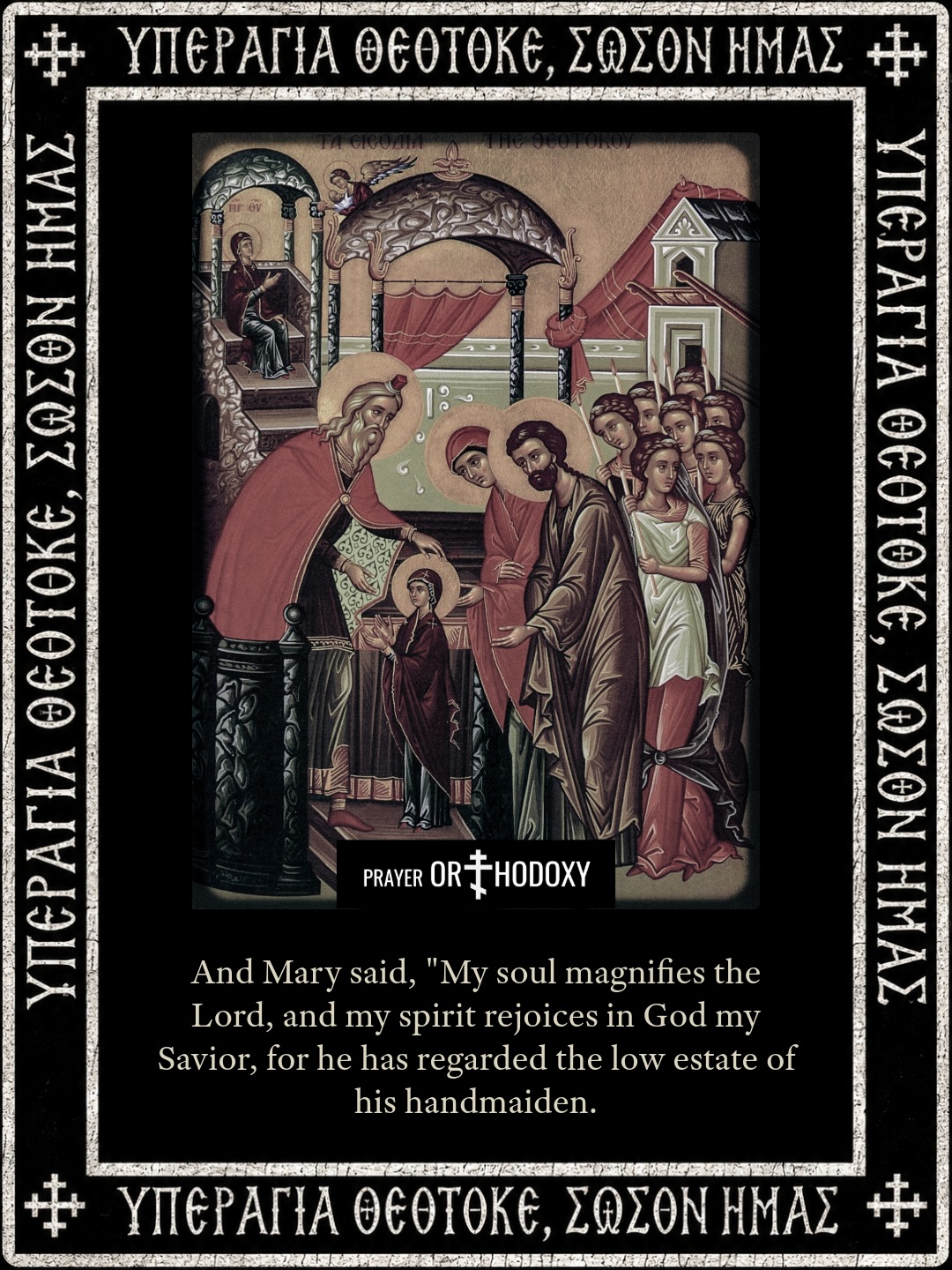
The post announces the feast of the Entrance of the Most Holy Theotokos into the Temple, celebrated on November 21. It explains that according to Holy Tradition, the Virgin Mary at the age of three was brought to the Temple in Jerusalem by her parents, Saints Joachim and Anna, fulfilling their promise to dedicate her to God. The High Priest Zacharias received her, and she entered the Holy of Holies, an event understood as preparing her for her…

The post announces the feast of the Entrance of the Most Holy Theotokos into the Temple, celebrated on November 21. It explains that according to Holy Tradition, the Virgin Mary at the age of three was brought to the Temple in Jerusalem by her parents, Saints Joachim and Anna, fulfilling their promise to dedicate her to God. The High Priest Zacharias received her, and she entered the Holy of Holies, an event understood as preparing her for her calling as the Mother of the Lord and Savior Jesus Christ.

The post provides this account in English followed by a Greek translation. An accompanying image displays the invocation "ΥΠΕΡΑΓΙΑ ΘΕΟΤΟΚΕ, ΣΩΣΟΝ ΗΜΑΣ" (Most Holy Theotokos, save us) repeated multiple times, interspersed with verses from Luke 1:39-55. Those verses recount Mary's journey to the hill country of Judah, her greeting of Elizabeth, the leaping of John the Baptist in Elizabeth's womb, Elizabeth's Spirit-filled proclamation of blessing, and Mary's response in the Magnificat, which begins "My soul magnifies the Lord."

The image text includes a minor variation in the seventh section where "ΣΩΣΟΝ" appears as "ΣΩΖΩΝ." The post ends with the invocation in both languages.

  • Feast of the Entrance of the Theotokos into the Temple on November 21
  • Virgin Mary presented at the Temple at age three by Saints Joachim and Anna
  • High Priest Zacharias receives her; she enters the Holy of Holies
  • Event understood as preparation for her becoming the Mother of Christ
  • Image pairs the Theotokos invocation with the Visitation and Magnificat (Luke 1:39-55)
Read more

The Entry of the Theotokos: Christmas begins in the Temple

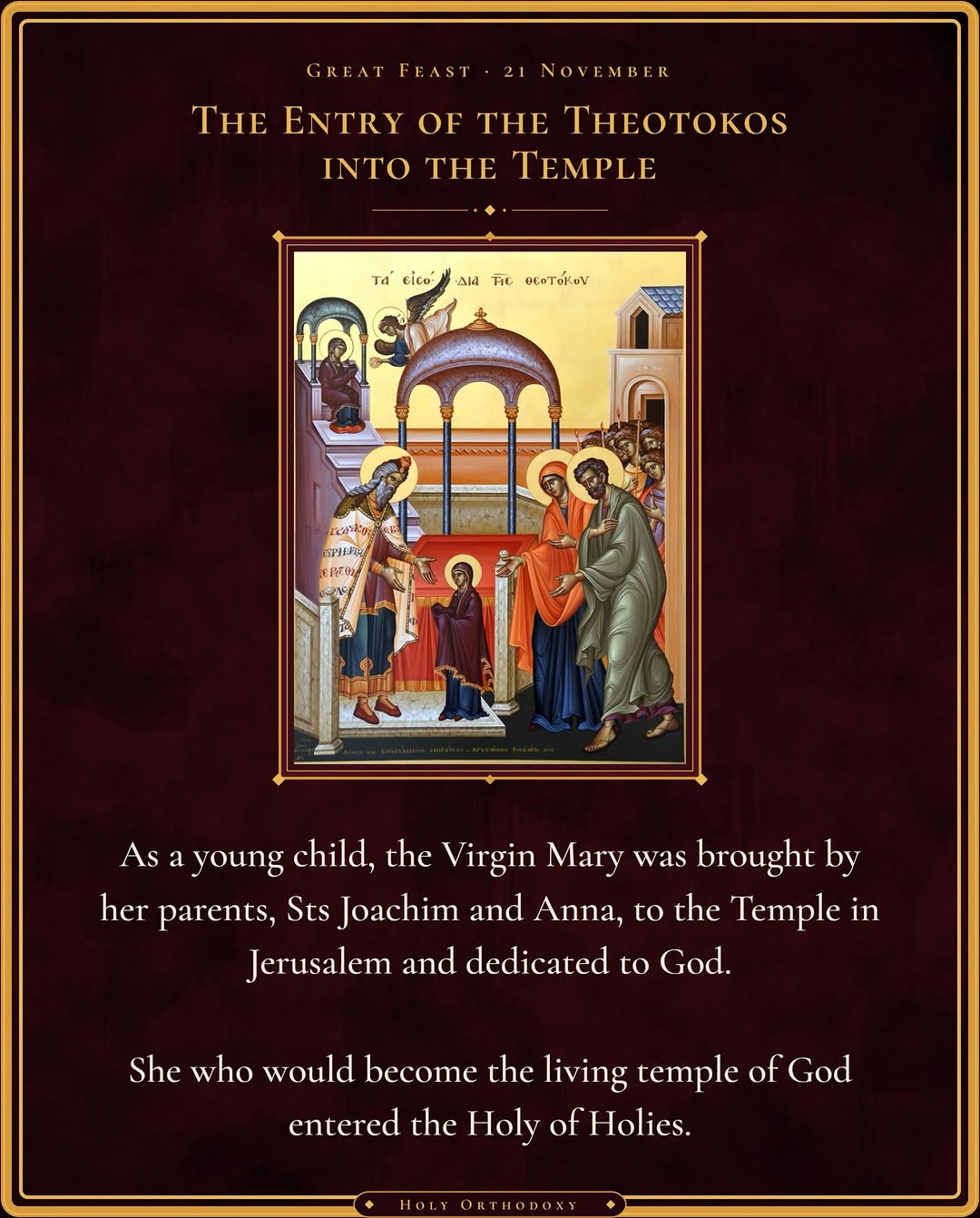
The post reflects on the Great Feast of the Entry of the Theotokos into the Temple, celebrated on 21 November. It describes how the Virgin Mary, as a young child, was brought by her parents, Sts Joachim and Anna, to the Temple in Jerusalem and dedicated to God. She entered the Holy of Holies, prefiguring her role as the living temple of God who would dwell in the flesh. The feast marks the first time in the liturgical year that the Church sings…

The post reflects on the Great Feast of the Entry of the Theotokos into the Temple, celebrated on 21 November. It describes how the Virgin Mary, as a young child, was brought by her parents, Sts Joachim and Anna, to the Temple in Jerusalem and dedicated to God. She entered the Holy of Holies, prefiguring her role as the living temple of God who would dwell in the flesh.

The feast marks the first time in the liturgical year that the Church sings the Nativity katavasia, "Christ is born, glorify Him!", signalling that the Nativity is already in sight. The author draws a parallel for the faithful: like Joachim and Anna, we are invited to offer what is most precious to us to God; like the Theotokos, we are called to make our hearts a place where He can live.

The post ends with the invocation, "Most Holy Theotokos, save us." The accompanying image text summarises the feast, noting that the Virgin Mary entered the Holy of Holies as a child and became the living temple of God.

  • Feast of the Entry of the Theotokos into the Temple on 21 November
  • Mary brought by Sts Joachim and Anna, entered the Holy of Holies
  • Prefigures her as the living temple of the Incarnation
  • Church begins singing "Christ is born, glorify Him!" for the first time
  • Invitation to offer our hearts to God as Joachim, Anna, and the Theotokos did
Read more
Prayer Orthodoxy ® with TimothyNegrete Instagram

Miracles Don't Prove a Church Is True: An Orthodox Perspective

0:32

The speaker presents an Orthodox dilemma regarding miraculous signs. Scripture lists signs that accompany believers, yet these signs appear in Protestant churches, Mormonism, Islam, and contradictory Protestant denominations. The presence of miracles does not prove a church is the one true church. Christ warns that some who cast out demons in His name will hear "I never knew you." God can perform miracles outside the Orthodox Church without…

The speaker presents an Orthodox dilemma regarding miraculous signs. Scripture lists signs that accompany believers, yet these signs appear in Protestant churches, Mormonism, Islam, and contradictory Protestant denominations. The presence of miracles does not prove a church is the one true church.

Christ warns that some who cast out demons in His name will hear "I never knew you." God can perform miracles outside the Orthodox Church without approving false teachings. The discussion centers on how Orthodoxy understands the relationship between spiritual phenomena and ecclesial truth, emphasizing that miraculous activity alone cannot validate doctrinal claims when contradictory groups all report similar experiences.

Key moments

  1. The Orthodox affirm Scripture including the signs that accompany believers.
  2. These signs, visions, dreams, healings, appear in Protestant churches, among Mormons, Muslims, and contradictory Protestant denominations.
  3. If every group claiming miracles belonged to the one true church, contradictory churches would all be true.
  4. Christ says some who cast out demons in His name will be told "I never knew you."
  5. God can perform miracles outside the Orthodox Church, but that does not mean He approves of false teachings.
Read more

St. Moses the Black on humility as the weapon against Satan

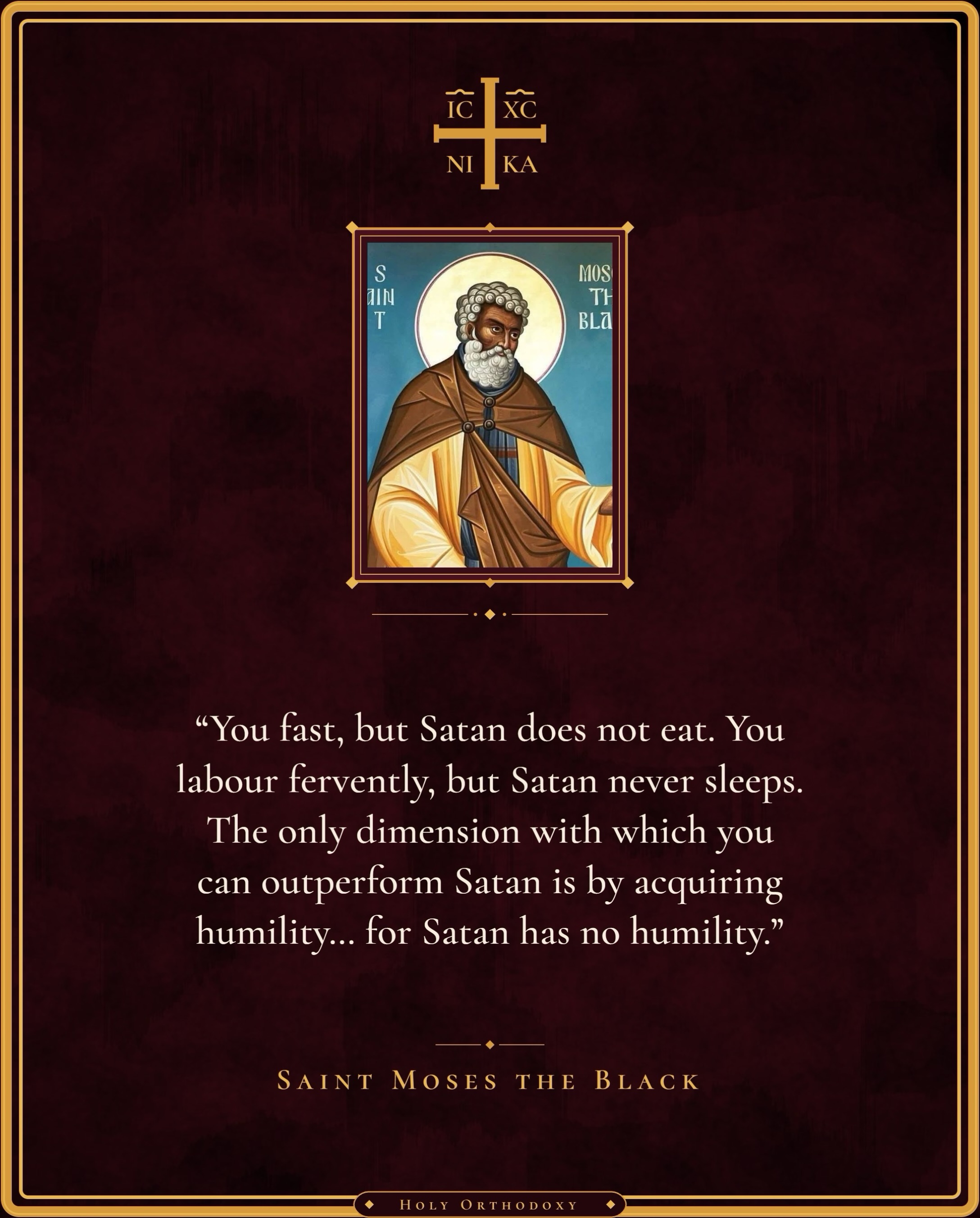
The post shares a saying attributed to St. Moses the Black, a fourth-century Egyptian robber who became a monk in Scetis and one of the great Desert Fathers. The saying contrasts human ascetic effort with Satan's nature: fasting does not affect Satan because he does not eat, and labor does not weary him because he never sleeps. The only dimension in which a person can surpass Satan is humility, since Satan has none. The post notes that Moses'…

The post shares a saying attributed to St. Moses the Black, a fourth-century Egyptian robber who became a monk in Scetis and one of the great Desert Fathers. The saying contrasts human ascetic effort with Satan's nature: fasting does not affect Satan because he does not eat, and labor does not weary him because he never sleeps. The only dimension in which a person can surpass Satan is humility, since Satan has none.

The post notes that Moses' own life illustrates this: his repentance, not his own strength, turned him from a feared gang leader into a saint. He was martyred by raiders in the early fifth century. The text concludes with a request for his prayers.

  • St. Moses the Black was a robber and gang leader in Egypt before converting and becoming a monk in Scetis
  • He is counted among the great Desert Fathers and was martyred in the early 5th century
  • The attributed saying states that fasting and labor cannot outdo Satan because Satan does not eat or sleep
  • Humility is the only virtue Satan lacks and the only way to surpass him
  • Moses' own repentance, not personal effort, transformed him from robber to saint
Read more