WeOrthodox
EN UA
P paulkingsnorth.substack.com Substack

AI and the Imago Dei: A Christian Argument Against Outsourcing the Mind
AI and the Imago Dei: A Christian Argument Against Outsourcing the Mind

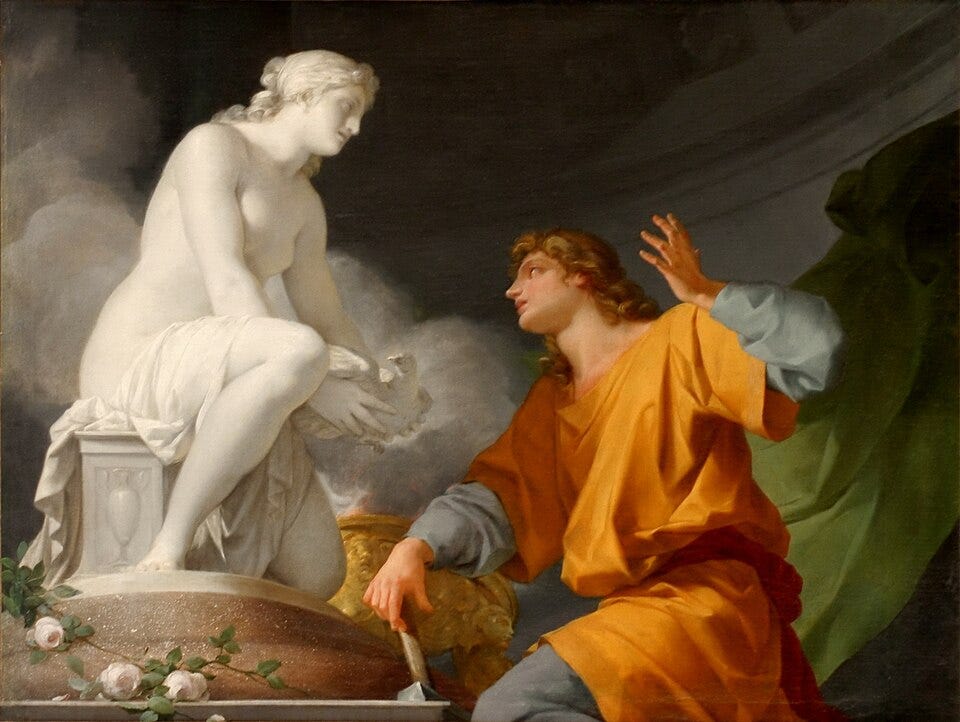
The post shares an article by Andrew Caspersen that reframes the Christian debate on artificial intelligence. Rather than weighing AI’s potential benefits against its risks — the "fruits" of the technology — Caspersen examines the "tree" itself: what AI is by nature. Drawing on the Pygmalion myth and the doctrine of the imago Dei, he argues that the human intellect is a finite image of the infinite Word, given so that we may know and love God.

AI, by simulating ideation, composition, analysis, and conversation, offers an "enhanced mind" that tempts us to outsource our God-given cognitive faculties. Accepting this man-made substitute treats the divine gift as inadequate and, by extension, treats the Giver as inadequate. The article addresses counter-arguments, such as the claim that AI is merely artificial and cannot truly replace human intelligence, contending that even a functional replacement constitutes a practical rejection of our created nature.

The discussion in the comments reflects both appreciation for the ontological approach and concern about equating the imago Dei with cognitive function, which could inadvertently devalue persons with impaired reasoning. Other contributors distinguish between tools that enhance human ability and devices that replace it, reference Orthodox and Catholic theological nuances, and share personal experiences of AI’s encroachment on thought and work.

Main points

  • AI should be evaluated by its nature, not only by its outcomes or utility.
  • The human intellect bears the imago Dei; outsourcing it to AI rejects that divine image.
  • Using AI as a substitute for thinking treats God’s gift as insufficient.
  • The "tool vs. device" distinction highlights AI’s replacement of human agency.
  • Commenters debate whether the argument risks a functionalist view of the imago Dei.
127 comments at the source Original on Substack

Discussion · 22

Opinions are anonymous retellings of real comments from the original discussion. The same colour marks the same participant.

Log in Log in or sign up to join the discussion.

  • opinion#276

    There's much to appreciate here, and the tree-and-branches framing rather than just the fruit is genuinely useful. My slight worry is that the piece drifts toward treating the imago dei as a matter of function (what we can do, like reason) instead of ontology (who we are). That's a slippery slope, because it risks implicitly diminishing people who can't perform that function well. A minor-ish quibble in an otherwise excellent piece.

    • opinion#288

      Well said and worth remembering... what defines us and gives us worth doesn't rest on our capabilities, but on the One who made us.

    • opinion#289

      Yes, my chief objection was equating the Image of God with the rational intellect. I don't believe that's right at all. Beyond that, I don't think we actually know what LLMs are — even their creators don't, as someone else here pointed out.

  • opinion#277

    Kieślowski's 1989 Dekalog 1 makes a powerful Christian case against AI. But for every Berdyaev or Bernanos there's a de Chardin or Nikolai Fedorov claiming technology is God's route to resurrection. Recently I unintentionally endured an hour-long lecture from a Jesuit priest praising AI's virtues and insisting the Church must adopt it. AI is a diabolical technology, yet ontologically not evil. It's the people who build it, promote it, and knowingly use it who commit evil. But can Christians still be persuaded to oppose AI? Could this be the modern Church's Amish moment? Sadly, I doubt it. The churches have grown too decrepit, becoming anti-Christian institutions, so the only path now is small groups forming genuinely Christian communities like the early Apostles.

    • opinion#290

      As far as I know, the Orthodox Church has never opposed technology itself; its concern is always how it's used. Many early saints were well versed in the science of their day. Still, worldly progress isn't the Christian's main concern — our true goal is loving union with God. The challenges technology brings can become occasions for spiritual growth as we learn to choose in cooperation with God's will. God lets us stumble and face temptation so that, by His grace, we learn to overcome our fallen tendencies. The Christian aim isn't a perfect earthly world but entrance into the Kingdom of Heaven and eternal life. A Greek Church-sponsored website now lets people submit questions and get answers drawn from trusted Church documents — not a general chatbot, but AI confined to a library of Orthodox sources, offering no personal counseling. Such a resource could prove valuable. We'll see whether the ancient Church, through her living Tradition, keeps supporting such applications to help people grasp ancient truths. Perhaps they may even expose the serious theological errors of many modern churches born of the Reformation. Today's Orthodox parishes already resemble the small communities you describe. We must trust the Lord and strive to follow His teaching, especially the Sermon on the Mount (Matthew 5–7). I don't believe AI can control our souls unless we willingly hand over that…

    • opinion#291

      Farasha is right. The Amish have managed to live alongside wider society while keeping their beliefs and way of life. Yet the temptations outside — wealth, dress, music, celebrity — were always a threat to the community's survival. An Amish-style approach to AI would be equally hard for young people in an AI-free community, whose employment prospects could be badly damaged. Historically, it would be like trying to engage with the world unable to read or write. At 71, I'm confident I can live happily without most of what technology offers, social media included. I'm fairly sure our young people won't have that luxury.

  • opinion#279

    I really like this argument. It gives sophisticated form to the nagging feeling I've had in the back of my mind. We keep hearing "AI is just a tool." But as Andrew so thoughtfully shows, it isn't. Other tools existed to enhance our work — physical machines like levers and pulleys, mental machines like word processors and spreadsheets. AI is designed to replace our work. To replace us. So it isn't a tool. It's a usurper. It is antihuman, and therefore antichrist, since we bear His image.

    • opinion#293

      "Therefore it is not a tool. It is a usurper. It is antihuman, therefore it is antichrist, since we bear His image." Exactly — that's it precisely.

    • opinion#294

      Yes! Enhancement versus replacement. That distinction seems crucial.

  • opinion#278

    This essay was a soothing balm. Thank you. I don't believe AI is a "tool" — it's a device. A tool enhances human ability; a device replaces it entirely. I can peel an apple with my fingernails, or use a tool to do it. A device removes the need for a human to peel it at all. Etymologically, "device" traces back to division/divide/separate. Many of my Christian and Catholic friends enthusiastically embrace AI, and some have sadly devoted their careers to building it. In one conversation, a Catholic friend mentioned her chats with Gemini four times. She talks to it because she wants to know something. She could sit and ponder, or ask a person — her questions are well within human thought. But with her device she didn't enhance human thought; she replaced it with machine "thought."

    • opinion#292

      I use AI to learn Spanish so I can communicate better with my in-laws and my wife's friends when we visit her hometown. Five new words or constructions a day, daily quizzes, sentences composed at its prompting when I have time to review. I could hire a tutor — but who could I pay to be available whenever I have five spare minutes, from after the kids are in school until bedtime? A book can't judge whether my sentences make sense or whether I'm even intelligible. A machine won't get frustrated while you hunt for a word. It's not a job anyone could volunteer for — not even my wife, who's busier than I am. So it's a machine or pretty much nothing. My point about devices is that sometimes you're not actually replacing a person, even if a person could theoretically do the job.

  • opinion#281

    I'm grateful to have read this; it deepens my grasp of the issue's details. But honestly, Paul, I think you already addressed this as deeply and fully as it can be in your earlier essays. Yours is the answer and approach that will never gain traction in secular contexts — it will only draw scoffing and demands for a more coherent, 'intelligent' response (perhaps what Andrew's essay aimed at, in a positive sense). But that only shows how far 'the world' is from the truth, which is this: this is demonic. Ephesians 6:12. Beginning of story, end of story. Engaging with AI is engaging with the demonic. The fruit is demonic, and the tree is demonic. Saying this among intellectuals wins no friends; in secular circles, none either; and in my experience, even in the Orthodox Church it often wins few. Everyone keeps hunting for nuance and shunning the binary nature of this — and of most things, frankly. But as the Apostles wrote in the Didache's very first line: "There are two ways, one of life and one of death, and there is a great difference between the two ways." I know which way AI is. There is zero nuance. Again, Paul, you've expressed this well before, and I'm grateful — for that and for this. Glory to God for all things!

    • opinion#295

      Thank you for your sober, straight words, James — I share your thoughts and feelings. A visceral rejection, however, doesn't appeal to intellectuals and appeasers (negotiators). Still, I'm glad we're struggling to dig deeper into this challenge and our reactions. In the end, I know no reasoning will satisfy someone who loves debate and the neatness of their own arguments. I remain a simple-minded sheep listening for my shepherd's voice. He says — No.

  • opinion#280

    Andrew's essay is rich and brilliant. I've been waiting for my fellow Catholics to catch up and take AI's deeper problems seriously instead of blindly leaping onto every bandwagon the way we did with social media and smartphones.

  • opinion#284

    I'll start by admitting I'm no AI fan, but a few thoughts came to mind — just thinking out loud, not a passionate argument. First, I value the approach of examining the tree itself rather than only its fruits. Second, I'm not convinced the Roman Catholic understanding of the human person matches the Orthodox one (I know little of RC teaching). What I was taught about the Orthodox view is that the person has multiple levels in a hierarchy: the physical level — matter shared with rocks, water, all creation; the vegetative soul — growth and stasis, shared with plants; the animal soul — movement, appetite, thoughts, emotions, shared with animals; the rational mind — what we moderns call "the brain": logic, discursive reasoning; and the nous / heart — the center of our being, where Christ lives, the spiritual organ by which we see God, our true self. In the spiritual person (especially a saint), the nous / heart is at the top and each lower level is subject to it. In the fleshly person, the physical rules, each level serves the one beneath, and (as often today) we don't even recognize the nous / heart exists — we don't know what part of us it is or how to find it. My main problem with the argument is equating the rational mind one-to-one with the divine image. I simply don't believe that. I'm still a neophyte, no expert in Orthodox theology, so I can't confidently answer "where is…

  • opinion#285

    Profound, thoughtful, and — like all truth — hard to contradict. I wonder whether Substack is using AI to curate the prompts we all get, steering us toward new authors on this platform? I agree with this writer's arguments one hundred percent, but it's also worth asking today: is the question not so much where AI is, but where AI is not? 🤔

    • opinion#296

      I'd bet Substack is doing exactly that. And it's a very good question. Give it a few more years and it's hard to imagine any online space that won't have been colonised.

  • opinion#286

    I spent a 46-year career in computers. When I began, I was told computers are very stupid but darn loyal — they'll do exactly what you tell them, right or wrong. AI computers are just as stupid. A recent example: the robots running in a track meet. Very fast, but whoever "trained" them forgot to train them to stop running. It took a wall to show them how. As I said — very stupid. AI can do many wonderful things. What it can't do is replace our God-given humanness.

  • opinion#287

    First, I think the original argument is seriously flawed, but I'll jump to the concluding argument, which deserves separate consideration. It starts from the observation that artificial intelligence doesn't possess human intelligence in the full personal sense. It generates language resembling the speech of an intelligent human even though no conscious human speaker stands "behind" the words. From this it's argued that AI is intrinsically deceptive or duplicitous. There's an important truth here that shouldn't be dismissed: we shouldn't anthropomorphize AI. A language model is not a human person, has no human soul or nous, and shouldn't be treated as a spiritual or moral subject. Its ability to produce persuasive language doesn't show that it understands, loves, wills, believes, repents, or communes with God as a person does. But that doesn't establish that AI is inherently deceptive. The key difficulty is the claim that words are "exclusively a manifestation of intelligence." Words can certainly manifest personal intelligence, but the physical or symbolic production of words doesn't require a conscious speaker at the moment they appear. A printed book puts words before our eyes without the book being intelligent. Take your book Against the Machine as an example: it presents thoughtful ideas one can agree or disagree with, accept or reject. Likewise a recording reproduces…

    • opinion#297

      I ran this comment through an AI detector. It tested positive for AI.

  • opinion#282

    Very interesting! I have huge reservations about AI. I see it used daily at work to replace 'work' (and thought) because it makes life easier. Eventually, I can imagine us making life so easy that we forget how to think, how to read — maybe even how to breathe! There'll be an app for that! My office-mate uses ChatGPT, calls it 'Alan', and it made its own avatar. She asks it for life advice. That alone is enough for me to avoid it like the plague! I don't believe AI will ever be conscious, because only God creates true, living consciousness. But I do believe it can (already does?) ape consciousness, and it's a perfect instrument for a dark, malicious consciousness that has existed for millennia to draw people away from God. Yes, 'it could be used for good', we tell ourselves. Unfortunately, we are fallen, and trying to do good without God never ends well.

  • opinion#283

    For what it's worth, I handle AI (LLMs) the way I'd handle a "criminal informant" — with me playing the "interrogator." Since my work forces me to use it (it's now baked into every Google search), I keep an attitude of aggressive distrust toward it.