WeOrthodox
EN UA
F

Fr. Barnabas Powell

Substack 8 discussions · Open the original

Curated discussions from Fr. Barnabas Powell (Substack) with summaries and the most thoughtful opinions.

F Fr. Barnabas Powell Substack

"I Am Sure": St. Paul's Well-Placed Confidence in Philippians

This reflection opens with a personal anecdote: the author was once criticized for being 'sure of himself,' and a wiser man explained that confident people often make those without confidence nervous—sometimes revealing a life driven by fear rather than faith. From there, the post turns to St. Paul's Epistle to the Philippians (Philippians 1:1-7), focusing on three small words: 'I am sure.' Writing from prison about ten years after planting the church in Philippi—a strategic, cosmopolitan trade city in northern Greece—Paul expresses confidence not in himself or his circumstances, but in God: 'he who began a good work in you will bring it to completion at the day of Jesus Christ.' The author distinguishes this from arrogance: arrogance trusts itself, while faith trusts the One who began the work.

The 'day of Jesus Christ' connects to the Liturgy's prayer for 'a Christian end to our life... and a good defense before the awesome judgment seat of Christ.' Paul's confidence was also grounded in what he witnessed in the Philippians—their 'partnership in the gospel from the first day until now,' including St. Epaphroditus, remembered by tradition as their faithful bishop who personally served Paul in hardship.

Well-placed confidence grows from watching God's faithfulness in real people and real circumstances. Finally, the author draws a practical lesson: a life centered on Christ brings clarity of purpose that may discomfort others. Be kind, humble, and patient with the 'Eeyores' in your life, but don't let their discomfort steer your choices.

The post closes with the commemoration of St. Charitina, a young orphaned martyr under Diocletian who boldly confessed Christ and died in prayer—embodying the same confidence that the One who began a good work would complete it. Readers are invited to ask what they are truly sure of, and to remember God's past faithfulness.

  • St. Paul's 'I am sure' (Philippians 1:1-7) expresses confidence in God, not in himself or his circumstances—he wrote it from prison.
  • The difference between arrogance and faith: arrogance trusts itself; faith trusts the One who began the work and promised to finish it.
  • Paul's confidence was confirmed by the Philippians' lived 'partnership in the gospel,' including St. Epaphroditus's faithful service.
  • Confidence rooted in Christ brings clarity of purpose; be kind and patient with those it makes uncomfortable, but don't let their discomfort steer your life.

F Fr. Barnabas Powell Substack

What God Calls Blessed: The Beatitudes as a Reboot for the Human Heart

This reflection contrasts the modern, social-media use of the word 'blessed'—comfort, success, abundance, things going our way—with what Jesus actually calls blessed in Luke 6:17-23: the poor, the hungry, those who weep, and those who are hated and excluded for His sake. The author is careful to note that gratitude for good gifts is right, but that our culture has quietly redefined blessing as comfort and popularity—measurements that can all be lost in an afternoon.

The post walks through the Gospel passage read at the Liturgy and draws out three main lessons. First, Christ deliberately turns the world's definition of blessing upside down—not to romanticize suffering (He heals the sick and frees the possessed throughout the Gospels), but to expose how badly our priorities have been scrambled when we measure blessing only by what is temporary.

Second, our disordered desires enslave us: if being blessed depends on possessions, fullness, constant happiness, or others' approval, we are slaves to each of those things. The Beatitudes act as a diagnosis—what we call blessed reveals what we actually worship—and each 'blessed' condition strips away an illusion of self-sufficiency, which is where healing begins.

Third, the Church's spiritual disciplines let us practice the Beatitudes on purpose: fasting is chosen hunger, almsgiving is chosen poverty, Confession is chosen tears, and living the Faith in a mocking culture is chosen rejection for Christ's sake. The post closes with the life of Sts. Cyprian and Justina, martyred at Nicomedia under Diocletian: Cyprian, once a pagan sorcerer whose demons fled before Justina's sign of the Cross, burned his magic books, was baptized, became a bishop, and died for Christ—proof that everything once called power can turn out to be slavery, and everything once despised can prove blessed.

  • The world defines 'blessed' as comfort, success, and abundance; Jesus blesses the poor, hungry, weeping, and rejected (Luke 6:17-23).
  • Christ does not romanticize suffering—He heals and frees—but reorients our priorities away from temporary measures of blessing.
  • If our sense of blessing depends on possessions, pleasure, feelings, or approval, we are enslaved by them; what we call blessed reveals what we worship.
  • The Church's disciplines—fasting, almsgiving, Confession, enduring mockery—are the Beatitudes practiced on purpose.
F Fr. Barnabas Powell Substack

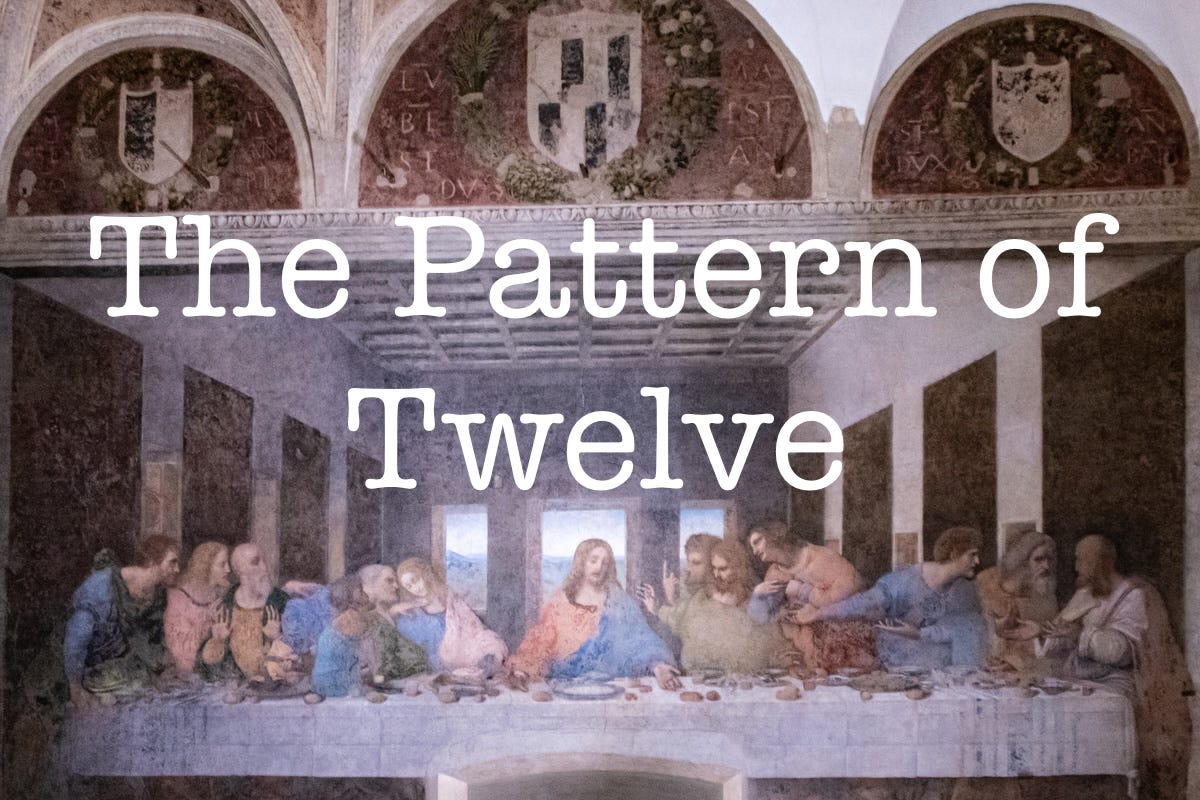
Twelve Again: How Christ Fulfills the Pattern of Israel

This reflection on Luke 6:12-19 argues that Jesus did not come to found a new religion but to fulfill the promises made to Abraham and to recreate the People of God as a new humanity. Drawing on Matthew 5:17 and Ephesians 2:15, the author presents the choice of the twelve Apostles as a deliberate repetition of the twelve tribes of Israel: the same God who formed one people from the sons of Jacob now forms the New Israel, the Church, through twelve 'sent ones.' The Fathers call this pattern recapitulation—God gathering up what He began, fulfilling it, and making it more beautiful and more inclusive.

The post walks through the Gospel passage in three movements. First, Christ prays all night before choosing Twelve, showing that the number is no accident but the foundation of a renewed people. Second, immediately after choosing them, He descends to a level place and teaches, heals, and frees the demonized—demonstrating what the new community is for.

That same power, given to the Apostles at Pentecost, continues in the Church and reaches each believer through Chrismation. Third, the list of names shows God choosing ordinary, unimpressive people—fishermen, a tax collector, a Zealot—and even one who would betray Him; Matthias later restored the number, showing that God's grace, not human credentials, is the point.

The post closes with St. Romanos the Melodist, a sixth-century deacon who, according to tradition, received a scroll from the Theotokos in a dream and composed the Nativity kontakion the Church still sings—an ordinary man made a gift to the whole Church. The discussion invitation asks readers whether they believe they fit into God's pattern, encouraging prayer before major decisions and trust that God's pattern of grace includes them.

  • Christ fulfills, not abolishes: the choice of Twelve recapitulates the twelve tribes, founding the New Israel.
  • Before choosing the Apostles, Jesus prays all night—the number twelve is deliberate, not accidental.
  • Right after choosing them, He teaches, heals, and delivers crowds, showing what the new community is meant to do.
  • God chooses ordinary people—fishermen, a tax collector, a Zealot; even Judas' betrayal did not break the pattern, as Matthias restored the Twelve.
F Fr. Barnabas Powell Substack

Ready, Not Surprised: Watchfulness Rooted in Love, Not Fear

This reflection on Matthew 24:42-47, the Lord's call to "Watch, for you do not know on what day your Lord is coming," explores how Christians should rightly order their expectations about Christ's return. Opening with Alexander Pope's cynical maxim about expecting nothing, the author argues that the problem is not having expectations but having the wrong ones—and that grounding expectation in the reality of Christ transforms one's priorities and choices.

The Gospel passage, drawn from the Olivet Discourse, deliberately withholds details about the timing of the Second Coming. The author presents this lack of specifics as intentional: it keeps our expectation rooted in love for Christ Himself rather than in fear or speculation. This stands in sharp contrast to sensationalistic "end times" systems—rapture theories, blood moons, supposed secret knowledge—whose very sensationalism reveals their incompatibility with the sober, peaceful message of the Faith.

People caught up in such speculation typically fix their attention on temporary things: politics, cultural turmoil, headlines. The healthier focus is anchoring anticipation entirely in love for Christ and living in preparation for being with Him forever. The reflection also distinguishes motivations: fear may initially wake us (as an alarm clock does), but the spiritually mature move from fear to the sustainable motivation of love, once they truly see how lovely Christ is.

The rhythm of worship, prayer, and practice turns faith from something we merely know into Someone we genuinely love—so that His return, or our own death, finds us simply awake. The post closes with the commemoration of St. Gregory the Illuminator, apostle to Armenia, who endured over a decade of imprisonment with his anticipation fixed on Christ alone, and whose witness led Armenia to become the first nation to officially embrace Christianity.

  • The Lord deliberately withholds details of His return so our expectation stays rooted in love, not fear or speculation
  • Sensational end-times theories reveal their falseness by their very sensationalism and fixation on temporary things like politics and headlines
  • Fear may initially prompt watchfulness, but love for Christ is the mature and sustainable motivation
  • The rhythm of worship, prayer, and practice transforms faith from something we know into Someone we love