

Pope Leo contradicts traditional Catholic teaching on the death penalty
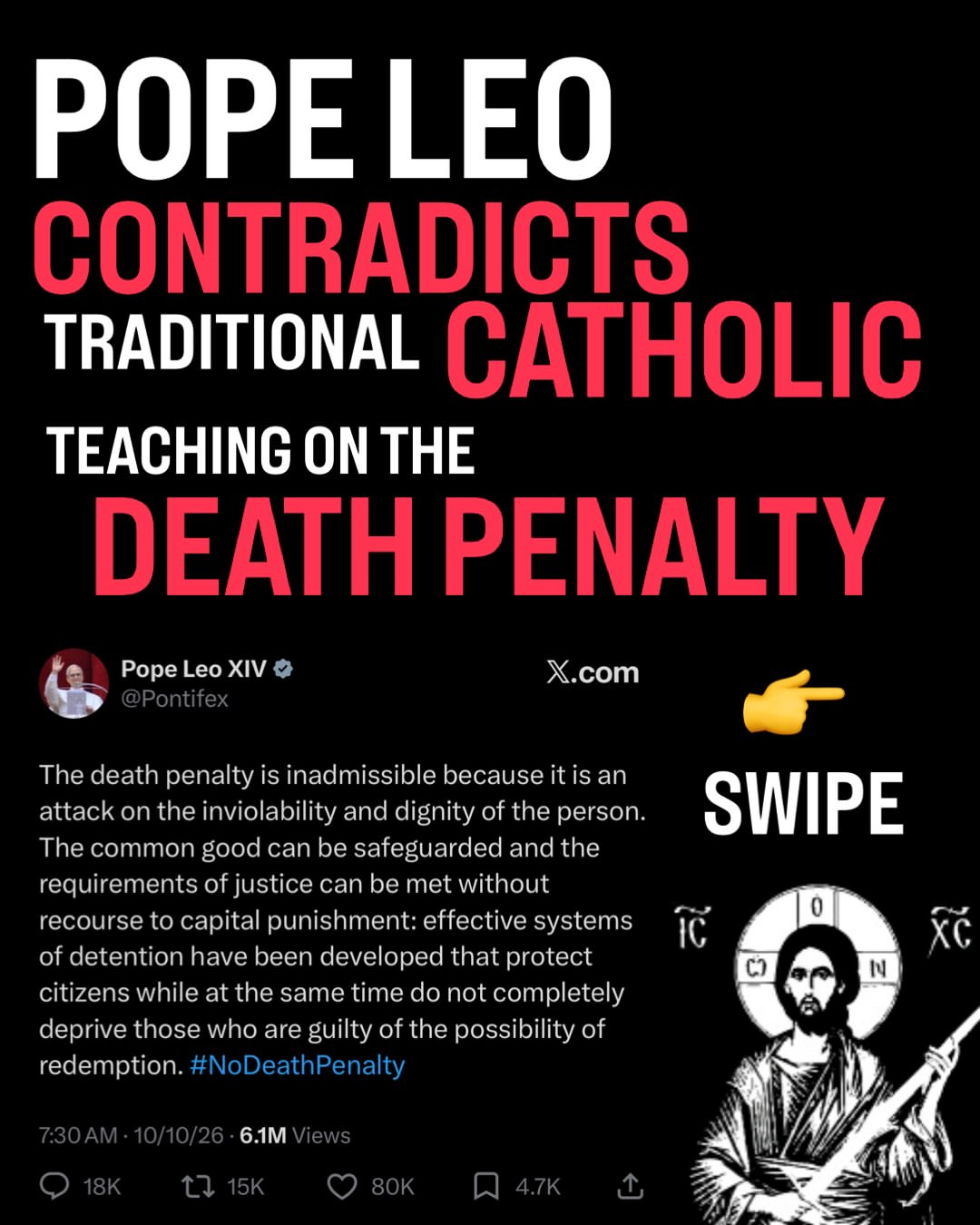
Pope Leo contradicts traditional Catholic teaching on the death penalty.
80 comments at the source
Original on Instagram
Pope Leo contradicts traditional Catholic teaching on the death penalty.
Opinions are anonymous retellings of real comments from the original discussion. The same colour marks the same participant.
Log in Log in or sign up to join the discussion.
I don't agree with live streaming an execution though
The Vatican kept its own executioner and carried out public executions of thousands for more than a thousand years
The pope is "infallible" but then keeps contradicting what earlier popes said. I'm confused. If person A says X is true and person B says Y is true, and X and Y are opposites, how can both be right?
The Pope isn't infallible all the time, the last infallible statement was more than 50 years ago
Then you clearly don't get how papal infallibility works. Not saying that to be rude, I genuinely suggest you look it up.
Look up what infallibility actually means, he's not infallible in that sense. It's only been used a handful of times, with the full assistance of the Holy Spirit and speaking ex cathedra
Some people will make up excuses to argue against your logical take on this
Catholics often dodge by claiming they don't really know what an infallible statement is, or even when something counts as infallible. This is a teaching on morals, which makes it infallible in the RCC system, since in their system the pope can't err when teaching on faith or morals. So yes, this would be infallible, and even if it weren't, they'd still be required to submit their will and intellect to the pope's decision. (Lumen Gentium 25 [165], 1983 code of canon law, c.752)
The question isn't whether it's licit in principle, it's whether it's needed today, which is a prudential call people can disagree on. The Pope isn't speaking ex cathedra here, and Ed Feser has explained that over and over.
I don't think anyone, at least nobody I've seen, is agreeing with the pope. I'm Orthodox, so the Pope doesn't concern me. What I can't get behind is live-streaming the execution. I honestly see that desire as demonic.
Wrong. Most people aren't against capital punishment, so most people don't side with the pope. Though I'd hope most are against public executions. We can WISH most people opposed capital punishment, but the statistics say otherwise.
I'm not saying he isn't contradicting himself, but he does have a point. And I'm not Roman Catholic.
The death penalty is a fully moral and objective punishment for heinous crimes. The Orthodox Church has always held that position.
So you hold an opinion that goes against the teachings of the church?
Patriarch Bartholomew has warned against it before and is opposed to capital punishment
I do, and I still submit to the church's authority. But I can still disagree on plenty of things.
It's strange how nobody seems to grasp the difference between disciplines that are cultural and evolve over time, and Sacred Tradition.
I agree there's a human dignity we're meant to uphold. But I don't agree with abolishing the death penalty. It's a serious punishment that demands the utmost reverence when carried out. It's not some halftime show or spectacle, it's the deliberate taking of a life as the final punishment for grave offenses. We shouldn't condemn someone's soul to hell; we should offer them repentance and grace before sending them to the Lord's judgement.
Being against the death penalty is just a moral cause. You oppose it because you're handing the government the power to kill anyone who doesn't fit their policies. So stop painting Catholics as the bad guys. We aren't.
"... If, however, non-lethal means are sufficient to defend and protect people's safety from the aggressor, authority will limit itself to such means, as these are more in keeping with the concrete conditions of the common good and more in conformity with the dignity of the human person." (CCC, para. 2267)
I'd also add that plenty of criminals never get any genuinely harsh sentence and just keep offending over and over... how many innocent people have to be put at risk before they finally change??? The judges share the blame here too.
Nothing Aquinas or even the church fathers taught goes against this. Back then we didn't have modern prisons where murderers and other lawbreakers could be locked away. They couldn't risk letting a rapist or killer back into society, so they executed them. Now that we have the means, taking away someone's chance to repent is unholy and cruel.
The problem is taking authority over someone's life. Sure, the criminal took an authority that wasn't theirs when they ended another person's life. That was wrong and sinful, and it deserves punishment, like all our sins. But two wrongs don't make a right. Who are we to decide this person can't be redeemed? Who are we to say they no longer have a right to live? God has redeemed plenty of people who didn't deserve to live in the eyes of others, and those same people became great Saints. It's the same question as "why does God let bad things happen?" Because if He stepped in to fix everything, nobody would still be alive. Just because something might be permissible sometimes doesn't make it good.
One of the most common attacks on the Catholic Church is: "If the Vatican executed thousands in the past and the Old Testament mentions the death penalty, why do they reject it now?" Here's how the Church answers that without denying its history: 1) The development of moral conscience: just as humanity took centuries to abolish slavery and judicial torture, our grasp of the inviolable dignity of every human life has matured under the Gospel's guidance. The Church isn't a static museum; it's a living tradition. 2) Spiritual Church vs. Temporal State: for over a thousand years the Papal States were a temporal power of the medieval world. They enforced the penal laws of their era to survive in a violent age without secure prisons. That was political reality, not a dogma of faith. 3) Jesus vs. Vengeance: Jesus never endorsed the death penalty; he was himself an innocent victim of it on the cross, and he saved the adulterous woman from stoning. Today Pope Francis updated the Catechism (no. 2267) declaring it inadmissible, because modern prisons let us protect society without shutting the door on a sinner's conversion.
Since you all brought up the Catholic Church: the death penalty is not a dogma. It falls under the discipline and government of the Church. The Pope isn't wrong. He's giving his thoughts on government and discipline, areas where he has supreme authority to change things, even to the point of contradiction, hence "loosening & binding". It's part of his office, and our salvation doesn't hinge on this. If you disagree, believe what you want. Just stop acting like you know the subject when you blur the line between faith and discipline, because you're ignorant.
If the people claiming "so-and-so contradicts such-and-such Catholic teaching" actually read what the person said, it would be a miracle. The Holy Father didn't contradict anything or condemn the death penalty. He simply affirmed what the CCC already teaches: we now have mechanisms that make it unnecessary and therefore inadmissible. Honestly, you people are worse than the SSPX and the Prots.