WeOrthodox
EN UA

☦️An Orthodox Blog☦️

Instagram ↗ 116 discussions

"La Ortodoxia es lo que Jesús enseñó, los Apóstoles predicaron y los Padres guardaron"

St. Nektarios on Repentance and Confession

St. Nektarios the Wonderworker describes repentance as a mystery in which the penitent confesses sins before a spiritual father appointed by the Church. The spiritual father has been given authority to forgive sins. Through this confession, the penitent receives absolution and is reconciled with God, against whom he has sinned.

The teaching emphasizes the sacramental character of repentance, the role of the spiritual father as the Church's appointed minister, and the restoration of communion with God through absolution.

  • Repentance is a mystery involving confession before a spiritual father.
  • The spiritual father is appointed by the Church and given authority to forgive sins.
  • The penitent receives absolution from sins through the spiritual father.
  • The penitent is reconciled with God, against whom he has sinned.
  • The teaching comes from St. Nektarios the Wonderworker.
Prayer for the Commemoration of Saint Amphilokios of Iconium

The post marks the commemoration of Saint Amphilokios, Bishop of Iconium, on 23 November and presents a prayer used for the occasion. The prayer opens with a petition that blesses the body and asks the Lord to save the faithful so they may glorify Him. It gives thanks for being deemed worthy to partake of the Holy Mysteries and asks to be established in sanctification throughout the day while meditating on God's righteousness. The prayer then…

The post marks the commemoration of Saint Amphilokios, Bishop of Iconium, on 23 November and presents a prayer used for the occasion. The prayer opens with a petition that blesses the body and asks the Lord to save the faithful so they may glorify Him. It gives thanks for being deemed worthy to partake of the Holy Mysteries and asks to be established in sanctification throughout the day while meditating on God's righteousness.

The prayer then chants Alleluia three times, each followed by a verse from Psalm 33. The first Alleluia introduces Psalm 33:1, which calls the faithful to bless the Lord at all times with His praise continually in the mouth. The second Alleluia accompanies Psalm 33:2, declaring that the soul shall be praised in the Lord and that the meek shall hear and rejoice.

The third Alleluia accompanies Psalm 33:3, inviting all to magnify the Lord together and exalt His name as one. The structure moves from personal petition and thanksgiving for communion to corporate praise rooted in the psalms.

Key moments

  1. The opening petition blesses the body and asks the Lord to save the faithful that they may glorify Him.
  2. The prayer thanks God for making the faithful worthy to partake of the Holy Mysteries and asks to be kept in sanctification all day to meditate on His righteousness.
  3. The first Alleluia leads into Psalm 33:1, calling to bless the Lord at all times with His praise continually in the mouth.
  4. The second Alleluia accompanies Psalm 33:2, declaring the soul shall be praised in the Lord and the meek shall hear and rejoice.
  5. The third Alleluia accompanies Psalm 33:3, inviting all to magnify the Lord together and exalt His name as one.
☦️An Orthodox Blog☦️ Instagram

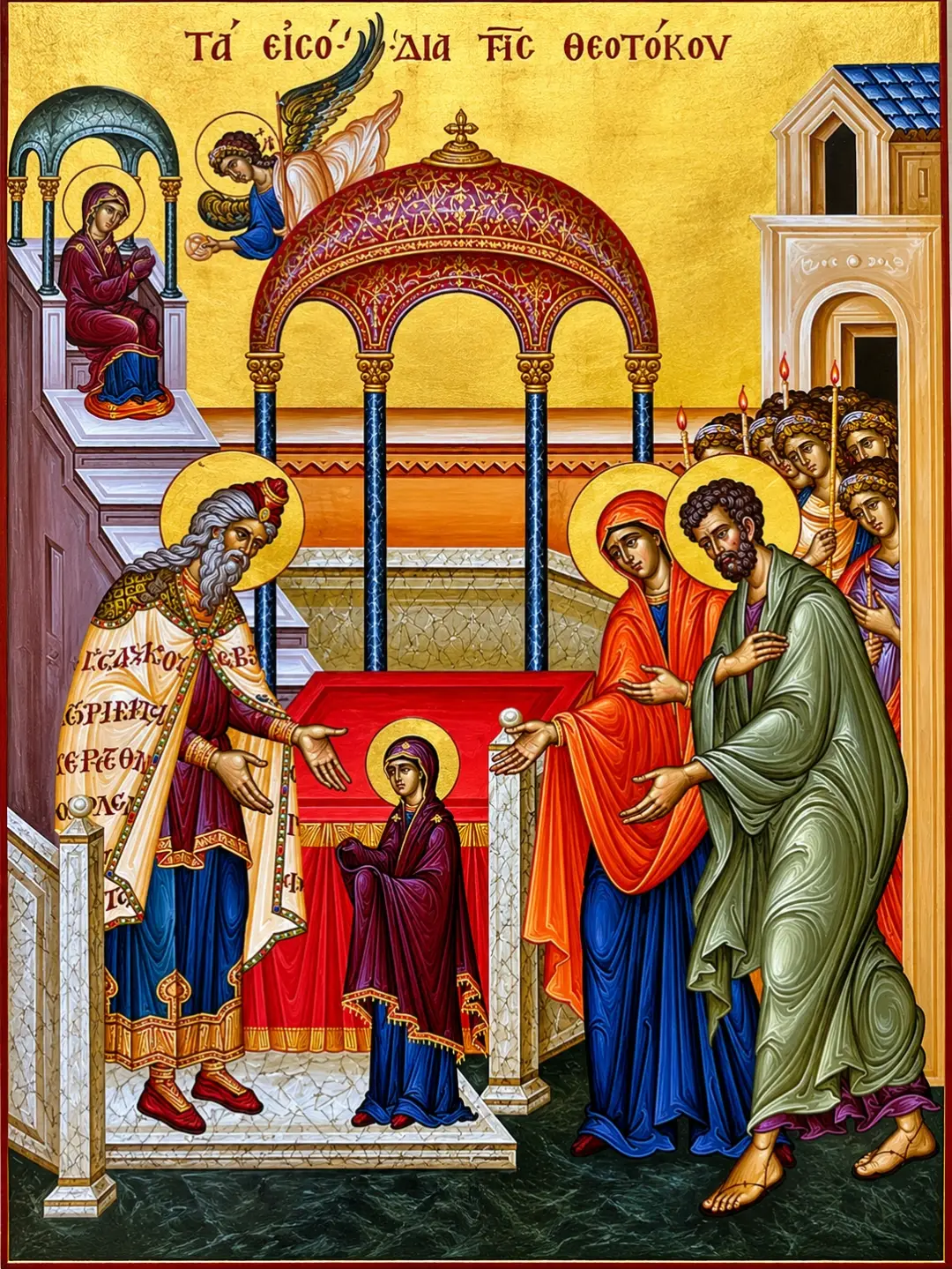
The Entry of the Most Holy Mother of God into the Temple

The post presents the traditional account of the Entry of the Most Holy Mother of God into the Temple, a major feast of the Orthodox Church. It begins with Saints Joachim and Anna, who prayed for an end to their childlessness and vowed to dedicate any child to God. When the Virgin Mary reached three years of age, they fulfilled the vow. They assembled relatives and acquaintances, dressed Mary in her finest garments, and maidens escorted her to…

The post presents the traditional account of the Entry of the Most Holy Mother of God into the Temple, a major feast of the Orthodox Church. It begins with Saints Joachim and Anna, who prayed for an end to their childlessness and vowed to dedicate any child to God. When the Virgin Mary reached three years of age, they fulfilled the vow.

They assembled relatives and acquaintances, dressed Mary in her finest garments, and maidens escorted her to the Temple while singing hymns and carrying lighted candles, a scene linked to Psalm 44/45:14-15. At the Temple, the High Priest and other priests met them. Fifteen steps led to the sanctuary, a space reserved for priests and the High Priest; these steps correspond to the Psalms of Ascents (Psalms 119/120-133/134), traditionally recited on each step.

Although Mary was young, when placed on the first step she was strengthened by God and quickly climbed the remaining steps. The High Priest, inspired from above, then led her into the Holy of Holies, where he entered only once a year to offer a blood sacrifice. The event astonished all present. Joachim and Anna returned home, while Mary stayed in the quarters for maidens adjacent to the Temple.

The post cites Scripture (Exodus 38; 1 Kings 1:28; Luke 2:37) and the historian Flavius Josephus as evidence for such dwellings. It notes that Mary's life from childhood to her assumption is shrouded in mystery, quoting Saint Jerome: "If anyone were to ask me, how the Most Holy Virgin spent the time of her youth, I would answer that God Himself and the Archangel Gabriel, her constant guardian, know." The author indicates that the discussion continues in the comments.

  • Saints Joachim and Anna vowed to dedicate their child to God and brought the three-year-old Virgin Mary to the Temple.
  • Maidens escorted Mary with hymns and candles; she ascended the fifteen Temple steps by God's power.
  • The High Priest, inspired from above, led her into the Holy of Holies, astonishing those present.
  • Mary remained in the Temple quarters for maidens, supported by scriptural and historical references (Exodus 38; 1 Kings 1:28; Luke 2:37; Flavius Josephus).
  • Saint Jerome stated that only God and the Archangel Gabriel know the details of Mary's life in the Temple; the post invites further discussion in the comments.

Father Mario Calderón refutes the claim that Orthodoxy opposes reason

Father Mario Calderón opens the program "Myths vs Realities" to address the common misconception that the Orthodox faith is frozen in the past and rejects reason. He states that the reality is completely different. Orthodoxy values mystical experience, contemplation, and liturgical tradition above the scholastic rationalism of the Middle Ages, but this prioritization does not entail a rejection of reason or anti-intellectualism. Rather,…

Father Mario Calderón opens the program "Myths vs Realities" to address the common misconception that the Orthodox faith is frozen in the past and rejects reason. He states that the reality is completely different. Orthodoxy values mystical experience, contemplation, and liturgical tradition above the scholastic rationalism of the Middle Ages, but this prioritization does not entail a rejection of reason or anti-intellectualism.

Rather, Orthodoxy holds that knowledge of God is attained through prayer, theosis, and divinization. He encourages viewers to continue following the series for further myths and realities about the Orthodox Church.

Key moments

  1. Father Mario Calderón introduces himself and the series "Myths vs Realities."
  2. He identifies the myth that the Orthodox faith is stagnant in the past and rejects reason.
  3. He states that the reality is totally different from that myth.
  4. He explains that Orthodoxy prioritizes mystical experience, contemplation, and liturgical tradition over medieval scholastic rationalist formulations.
  5. He clarifies that this prioritization does not mean Orthodoxy rejects reason or is anti-intellectual.
  6. He affirms that in Orthodoxy one comes to know God through prayer, theosis, and divinization.
  7. He invites the audience to keep following for more myths and realities about the Orthodox Church.

Elder Isaac Atallah on Worldly Schemes and a Prayer Confronting Death

The post presents a quotation from Elder Isaac Atallah the Athonite warning that worldly schemes aim to distance people from God by promoting unnecessary luxuries and ever-changing fashions. The elder explains that clothing has shifted from a covering to a means of display, exposing the body according to fashion, and that the Church does not approve because humans are created in God's image, not objects for fashion. Accompanying the text is a…

The post presents a quotation from Elder Isaac Atallah the Athonite warning that worldly schemes aim to distance people from God by promoting unnecessary luxuries and ever-changing fashions. The elder explains that clothing has shifted from a covering to a means of display, exposing the body according to fashion, and that the Church does not approve because humans are created in God's image, not objects for fashion.

Accompanying the text is a video of a liturgical prayer that addresses death as a foreign power holding sway over humanity, kings, and even the Lord, and that proclaims the kingdom of immortal life in Christ. The prayer concludes with the doxology "now and ever and unto ages of ages" and the Trisagion "Holy, Holy, Holy."

Key moments

  1. Death is addressed as a foreign, alien power.
  2. The doxology 'Now and ever and unto ages of ages. Amen.' is recited.
  3. The prayer mentions the power of death over man, kings, and the Lord.
  4. It speaks of the kingdom and immortal life in Christ.
  5. It concludes with the Trisagion: 'Holy, Holy, Holy.'

St. Nektarios: Holy Tradition Preceded Holy Scripture

St. Nektarios the Wonderworker teaches that the Holy Church of Christ was based on Holy Tradition before the writing of the Holy Scriptures, that is, the Gospels, the Acts, and the Epistles of the Holy Apostles, and before they were spread to all the churches of the world. He concludes that the Holy Scriptures are only a part of the whole.

The statement reflects the Orthodox view that Scripture exists within the broader life of Tradition, which preceded and encompasses the written New Testament.

  • Holy Tradition was the foundation of the Church before the New Testament was written.
  • The New Testament includes the Gospels, Acts, and Epistles.
  • These writings were spread to all churches over time.
  • Holy Scripture is only a part of the whole of Holy Tradition.
  • The quote is attributed to St. Nektarios the Wonderworker.

Forefeast of the Entry of the Theotokos into the Temple

1:48

The post notes the commemoration on 20 November of the Forefeast of the Entry into the Temple of the Most Holy Theotokos. It presents a hymn addressing the Virgin Mary as the Pure and Holy Theotokos, calling her to rejoice. The hymn names her the Bride Unwedded, Queen, and Virgin Mother who covers all.

It describes her as surpassing both heavenly and earthly beings, as the hypostasis of joy, and as exceeding the angels in holiness. The hymn concludes by naming her Heavenly and holier than all.

Key moments

  1. The hymn addresses Mary as the Pure and Holy Theotokos and calls her to rejoice.
  2. She is named the Bride Unwedded, Queen, and Virgin Mother who covers all.
  3. She is described as surpassing both heavenly and earthly beings.
  4. She is called the hypostasis of joy and said to exceed the angels.
  5. The hymn concludes by naming her Heavenly and holier than all.

St. John Chrysostom: Forgive to Become Like God

The post shares a passage from St. John Chrysostom on forgiveness and brotherly love. He argues that insulting a brother contradicts the prayer "Our Father," since the word "our" shows God is Father of all, making everyone brothers. One cannot call the all-good God Father while treating a brother as an enemy. Chrysostom uses vivid comparisons: charging like a bull, kicking like a donkey, howling like a wolf, stinging like a scorpion, such…

The post shares a passage from St. John Chrysostom on forgiveness and brotherly love. He argues that insulting a brother contradicts the prayer "Our Father," since the word "our" shows God is Father of all, making everyone brothers. One cannot call the all-good God Father while treating a brother as an enemy.

Chrysostom uses vivid comparisons: charging like a bull, kicking like a donkey, howling like a wolf, stinging like a scorpion, such behavior means a person is not truly human, for a true human bears the image of the Creator. He notes that predatory beasts can be tamed, but humans, who are naturally gentle, become beasts through anger.

To become true sons of God, one must become like Him, and nothing makes us more like God than forgiving those who wrong us, doing good to those who harm us, praising those who accuse us, and answering insults with gentleness.

  • Insulting a brother contradicts calling God "Our Father" because we share the same Father.
  • Aggressive, animal-like behavior shows a person is not truly human nor a son of God.
  • Humans are naturally gentle but become beasts through anger, unlike wild beasts that can be tamed.
  • Becoming like God requires forgiving those who have wronged us.
  • Doing good to enemies, praising accusers, and meeting insults with gentleness makes us like God.
Read more