WeOrthodox
EN UA

☦️An Orthodox Blog☦️

Instagram ↗ 4 discussions

"La Ortodoxia es lo que Jesús enseñó, los Apóstoles predicaron y los Padres guardaron"

Once a sheep of the world, now His: a short confession of faith

The author writes a short personal confession about leaving behind the desire to fit in with the crowd. They state that they no longer follow the crowd but follow Christ, and that they no longer seek acceptance from people but acceptance from Him. The author adds that they no longer live for this world but live for His Kingdom, and describes their former life as having been a sheep of the world, in contrast to belonging to Christ now. The post…

The author writes a short personal confession about leaving behind the desire to fit in with the crowd. They state that they no longer follow the crowd but follow Christ, and that they no longer seek acceptance from people but acceptance from Him. The author adds that they no longer live for this world but live for His Kingdom, and describes their former life as having been a sheep of the world, in contrast to belonging to Christ now.

The post closes with the word Amen and a set of symbols, including a cross. There is no discussion in the thread; the post is a single statement of personal commitment with no replies, questions, or further context given. The language is direct and declarative throughout, built on a series of contrasts: crowd versus Christ, acceptance by people versus acceptance by Him, this world versus His Kingdom, being the world's sheep versus being His.

  • The author no longer follows the crowd but follows Christ.
  • They seek acceptance from Christ rather than from people.
  • They say they no longer live for this world but for His Kingdom.
  • They describe their former self as a sheep of the world and now as belonging to Christ.
  • The post is a single statement of faith with no discussion or replies.
Read more
☦️An Orthodox Blog☦️ Instagram

Martyrs Eulampius and Eulampia of Nicomedia, with 200 Martyrs: October 10

The post marks October 10 on the calendar and names the saints commemorated that day: the Martyrs Eulampius and Eulampia at Nicomedia, together with 200 Martyrs who suffered with them. The accompanying video presents the opening verses of Psalm 17 (Psalm 18 in the Hebrew numbering) in Greek. The verse reads: 'I will love You, O Lord, my strength. The Lord is my firm foundation, my refuge and my deliverer, my God, my helper, my hope in Him.' The…

The post marks October 10 on the calendar and names the saints commemorated that day: the Martyrs Eulampius and Eulampia at Nicomedia, together with 200 Martyrs who suffered with them. The accompanying video presents the opening verses of Psalm 17 (Psalm 18 in the Hebrew numbering) in Greek. The verse reads: 'I will love You, O Lord, my strength. The Lord is my firm foundation, my refuge and my deliverer, my God, my helper, my hope in Him.' The verses are then repeated, with the second repetition shortened to the first part: 'I will love You, O Lord, my strength.

The Lord is my firm foundation and my refuge and my deliverer.' The post carries hashtags pointing to Christian and Orthodox themes, including faith, the Church Fathers, and Jesus. The combination of the commemoration notice and the psalm text gives the reader both the day's saints and a verse of Scripture to read or listen to.

  • October 10 commemorates the Martyrs Eulampius and Eulampia at Nicomedia.
  • 200 Martyrs who suffered with them are also commemorated the same day.
  • The video presents Psalm 17 (18 in the Hebrew numbering) in Greek.
  • The verse: 'I will love You, O Lord, my strength. The Lord is my firm foundation, my refuge and my deliverer, my God, my helper, my hope in Him.'
  • The verse is repeated, shortened to its first part on the second repetition.

Key moments

  1. 'I will love You, O Lord, my strength. The Lord is my firm foundation, my refuge and my deliverer, my God, my helper, my hope in Him.'
  2. The verse is repeated: 'I will love You, O Lord, my strength. The Lord is my firm foundation and my refuge and my deliverer.'
☦️An Orthodox Blog☦️ Instagram

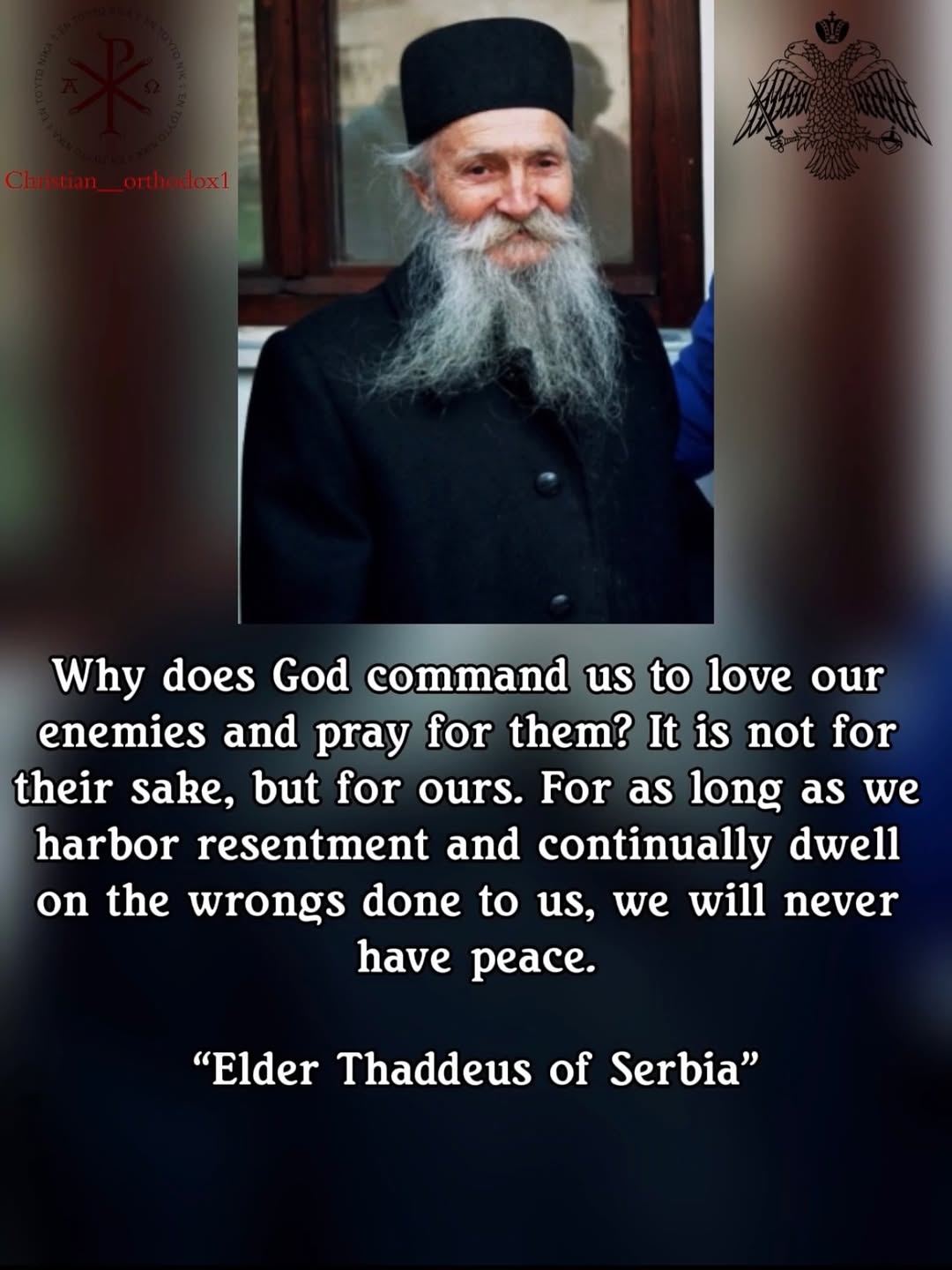
Elder Thaddeus of Serbia: We Love Our Enemies for Our Own Sake

The post quotes Elder Thaddeus of Serbia on why God commands us to love our enemies and pray for them. The elder says the command is not for their sake but for ours. As long as we harbor resentment and continually dwell on the wrongs done to us, we will never have peace.

The quote is presented with tags for Christian, Orthodox, church, faith, and church fathers content. The post consists of the quotation alone, with no further commentary or discussion in the source text.

  • Elder Thaddeus of Serbia is quoted on the command to love and pray for enemies.
  • He says the command is not for their sake, but for ours.
  • Harboring resentment and dwelling on wrongs done to us removes our peace.
  • The quote is shared with Orthodox and church fathers tags.
☦️An Orthodox Blog☦️ Instagram

Athan: an Orthodox app for daily prayer, Scripture and the saints

The speaker presents Athan, an app made for Orthodox Christians who want to carry their spiritual life with them everywhere. The app offers daily reading of the Bible, with the possibility to go deeper into each day's Gospel reading and into the teachings of the holy fathers of the Church. Beyond reading, Athan helps users organize their prayer life and learn to put into practice what they read, so that the texts become part of daily action…

The speaker presents Athan, an app made for Orthodox Christians who want to carry their spiritual life with them everywhere. The app offers daily reading of the Bible, with the possibility to go deeper into each day's Gospel reading and into the teachings of the holy fathers of the Church. Beyond reading, Athan helps users organize their prayer life and learn to put into practice what they read, so that the texts become part of daily action rather than remaining on the page.

A second area of the app concerns the saints: each day the app shows which saints the Church celebrates, users can read their lives, ask for their prayers, and also pray for other people. The speaker notes this as a way to connect with the communion of saints in a daily rhythm. For those looking for a local community, the app shows Orthodox parishes near the user's location, which can help people find a church to attend.

The speaker describes Athan overall as a simple tool with three purposes: to teach you, to remind you, and to help you live your faith every day. The presentation stays at the level of the app's features: Scripture reading, the daily Gospel and patristic teachings, prayer organization, the lives of the saints of the day, intercession for others, and the parish finder.

No technical details, pricing, platform availability or user reviews are mentioned in the source; the description is limited to what the app contains and the uses the speaker names for it.

  • Athan is an app for Orthodox Christians who want to carry a spiritual life everywhere.
  • It offers the Bible, each day's Gospel and the teachings of the holy fathers of the Church.
  • It helps organize your prayer life and put into practice what you read.
  • It shows the saints celebrated each day: you can read their lives, ask for their prayers and pray for others.
  • It displays Orthodox parishes near you.

Key moments

  1. Athan is an app for Orthodox Christians who want to carry a spiritual life everywhere.
  2. It lets you read the Bible, go deeper into each day's Gospel and the teachings of the holy fathers of the Church.
  3. You can organize your prayer life and learn to put into practice what you read.
  4. You can learn about the saints celebrated each day, read their lives, ask for their prayers and pray for others.
  5. The app helps you find Orthodox parishes near you.
  6. The speaker calls it a simple tool to teach you, remind you and live your faith every day.
☦️An Orthodox Blog☦️ Instagram

St. John Chrysostom: A Beautiful Woman Without Virtue Is Like a Painted Coffin

The post quotes St. John Chrysostom on beauty and virtue. The saint asks his listener not to speak to him of female beauty, but rather of the virtues of the soul. He states that a beautiful woman who has not decorated herself with virtue is like a painted coffin. The quotation is offered under Orthodox hashtags, including tags for Orthodox saints, female beauty, and virtue. The post is brief and consists of the quotation alone, with no further…

The post quotes St. John Chrysostom on beauty and virtue. The saint asks his listener not to speak to him of female beauty, but rather of the virtues of the soul. He states that a beautiful woman who has not decorated herself with virtue is like a painted coffin. The quotation is offered under Orthodox hashtags, including tags for Orthodox saints, female beauty, and virtue.

The post is brief and consists of the quotation alone, with no further commentary from the author. The contrast the saint draws is between outward appearance and inward adornment: the body may be beautiful, but without virtue it is like a coffin that has been painted on the outside while holding death within. The image places the value of a woman not in her physical appearance but in the state of her soul, and it names virtue as the true decoration a person should seek.

The hashtags suggest the author shares the quote for an Orthodox audience interested in the sayings of the saints and in the topic of female beauty as the Church Fathers treated it. No discussion, replies, or additional sources appear in the post itself; it stands as a single patristic quotation on the priority of the soul's virtues over bodily beauty.

  • St. John Chrysostom says: 'Don't talk to me of female beauty, rather virtues of the soul.'
  • He compares a beautiful woman without virtue to a painted coffin.
  • The quote contrasts outward beauty with the inward adornment of virtue.
  • The post is a single quotation shared with Orthodox hashtags on saints, female beauty, and virtue.
  • No commentary or discussion accompanies the quote in the post.

Key moments

  1. 0:00 The Kyrie eleison and Christe eleison open the Mass, asking the Lord and Christ for mercy.
Read more